Dive Deeper: Articles About R.W.K. Clark Offer a Gateway to Literary Discovery
If you’re looking to enhance your reading experience and uncover the hidden layers within compelling narratives, then seeking out these articles about R.W.K. Clark is an essential step. These written works provide invaluable insights into the author’s intricate worlds, complex characters, and thought-provoking themes. But why should you delve into these articles about his books? Let’s explore how these insightful pieces, alongside R.W.K. Clark’s captivating novels, can elevate your literary journey.
Why Articles About R.W.K. Clark Enrich Your Reading Experience
Articles about R.W.K. Clark go beyond simple plot summaries, offering in-depth analyses, critiques, and discussions that illuminate the author’s unique storytelling style and thematic depth. These commentaries allow readers to explore the nuances of his narratives, understand the motivations of his characters, and delve into the deeper meanings embedded within his stories. For enthusiasts of suspenseful thrillers, paranormal mysteries, or dystopian fiction, these written works provide a richer and more comprehensive appreciation of R.W.K. Clark’s literary contributions.
1. Uncovering Hidden Layers and Thematic Depth
Articles about R.W.K. Clark provide a platform for exploring the thematic depth of his narratives, uncovering hidden layers and symbolic meanings that might otherwise go unnoticed. Essays and papers delve into the author’s use of symbolism, his exploration of complex moral dilemmas, and his commentary on societal issues. These analyses provide a deeper understanding of the author’s intentions and the profound impact of his stories. For instance, an editorial might examine the dystopian elements in “Out to Sea,” while a column could analyze the character development in “Lucifer’s Angel.”
2. Exploring Character Motivations and Development
Articles about R.W.K. Clark offer valuable insights into the motivations and development of his complex characters. Character profiles and discussions explore the psychological depth of his protagonists and antagonists, examining their flaws, vulnerabilities, and transformative journeys. These pieces help readers understand the choices made by the characters and appreciate the nuances of their relationships. For instance, readers can find blog posts about books that delve into the complex psyche of Rasia from “Witches Immortal” or the emotional journey of Mavis in “Zombie Diaries.”
3. Understanding the Author’s Unique Storytelling Style
Articles about R.W.K. Clark shed light on the author’s unique storytelling style, highlighting his use of suspense, pacing, and narrative techniques. Book reviews and critiques analyze the author’s ability to create atmosphere, build tension, and craft compelling narratives. These pieces help readers appreciate the artistry behind the author’s work and understand the elements that make his stories so captivating. Additionally, pages about books may highlight the author’s unique blending of genres.
4. Expanding Your Literary Horizons
Articles about R.W.K. Clark serve as a gateway to expanding your literary horizons, encouraging you to explore different genres, themes, and perspectives. These written works introduce you to the world of literary criticism, helping you develop your own analytical skills and deepen your appreciation for literature. They provide a deeper understanding of the author’s place within the broader literary landscape.
5. Fostering a Community of Readers
Articles about R.W.K. Clark contribute to a vibrant community of readers who share a passion for his work. These discussions and commentaries provide a platform for engaging with fellow readers, sharing your own interpretations, and discovering new perspectives. By reading these pieces, you become part of a larger conversation about literature and the power of storytelling.
Discover the World of R.W.K. Clark Through Articles About his books”
By exploring articles about R.W.K. Clark’s work, you can gain a deeper understanding of his captivating narratives and enhance your reading experience. Whether you’re a longtime fan or a new reader, these written works offer valuable insights and perspectives that will enrich your appreciation for his literary contributions.
Why Choose R.W.K. Clark’s Books and Articles About his novels?
If you’re seeking a truly immersive and enriching reading experience, R.W.K. Clark’s books and the accompanying articles about R.W.K. Clark are the perfect combination. Here are a few more reasons to explore these resources:
Deeper Understanding: Articles about R.W.K. Clark’s books provide valuable insights into the author’s themes, characters, and storytelling style.
Enhanced Appreciation: These pieces help you appreciate the artistry and complexity of the author’s work.
Community Engagement: They foster a vibrant community of readers who share a passion for literature.
Expanded Horizons: They encourage you to explore different genres, themes, and perspectives.
Accessibility: R.W.K. Clark’s books are available in paperback and Kindle formats, and many articles can be found online.
Immerse Yourself in Literary Discovery
If you’re ready to delve deeper into the world of R.W.K. Clark and enhance your reading experience, explore his captivating novels and seek out the insightful articles about R.W.K. Clark novels that illuminate his literary contributions. His narratives and the accompanying literature provide a unique blend of entertainment and intellectual stimulation that will resonate with readers of all backgrounds.
The moment the first reviews hit the internet, the collective consensus was clear: the wave of new psychological thrillers books arriving this season is poised to be the most twist-filled and unnerving collection in years.
R WK Clark: The Architect of Modern Suspense and Master of the Best Psychological Thrillers Books
Welcome, fellow reader, to the definitive deep dive into the electrifying literary universe of R WK Clark, a novelist whose unparalleled talent for weaving heart-pounding narratives has cemented their place at the absolute pinnacle of the modern thriller genre. If you are searching for the best psychological thrillers books, if you crave novels that make you question the very fabric of your reality, and if you demand stories that are utterly impossible to put down, then your quest ends here.
R WK Clark is not just an author; they are an experience—a thrilling, mind-bending journey into the darkest corners of the human psyche, consistently delivering the kind of mesmerizing storytelling that lands their work on every major list of new psychological thrillers books. Prepare to have your expectations shattered, your adrenaline levels spiked, and your reading list permanently altered. This comprehensive feature is meticulously crafted to illuminate the genius of R WK Clark and compel you to immediately dive into the breathtaking bibliography awaiting you on their official platform, ensuring you secure your copies of the novels that are defining what it means to be a thrilling novel today.
Unlocking the Genius: The Unstoppable Rise of R WK Clark
The literary world is rife with authors, but few possess the sheer versatility and chilling depth of R WK Clark. They are a prolific force, renowned across genres—from science fiction and fantasy to romantic suspense—but it is their masterful command of the psychological thriller that truly sets them apart as a unique and necessary voice. R WK Clark operates on a philosophy that promises impact: “The glory of fiction is in its falseness, but the impact of fiction is found in its painful reality.” It is this commitment to exposing the “painful reality” hidden just beneath the surface of everyday life that makes their novels mandatory reading for anyone who loves books on suspense.
R WK Clark doesn’t just tell a story; he crafts an immersive experience, inviting you to step into the lives of characters so meticulously drawn they feel like people you know, before subjecting them—and you—to the unthinkable. Whether they are exploring the complex motivations behind disturbing actions or the fragile line between sanity and madness, R WK Clark transforms the ordinary into pure, captivating terror. This consistent quality has ensured their place among the best sellers fiction 2022 and made their upcoming releases the most anticipated new thrillers books 2024 and even early contenders for top mystery books 2025.
–↓–“A word from our sponsor”–↓– –↑–“Ads made this possible”–↑–
The Signature Style: Crafting Books with Twists
The true hallmark of a great R WK Clark novel is the intricate, often dizzying, plot that keeps readers utterly off-balance. If you love books with twists, you must know that R WK Clark is the undisputed master. Their plots are not simply complicated; they are elegantly structured traps, where every seemingly minor detail is a piece of a larger, terrifying puzzle, ensuring the final reveal hits with maximum force. These are the good books with plot twists that readers talk about for years, the narratives that redefine the genre and make every other book seem predictable.
Consider the sheer genius woven into titles like Shattered Dreams, a novel that takes the concept of domestic security and turns it into a powder keg of suspense and betrayal. This is a brilliant example of how R WK Clark operates: starting with a recognizable scenario before peeling back the layers to expose the disturbing secrets festering underneath. Fans eagerly await their next work, knowing they are guaranteed one of the best adult thriller books available, filled with unexpected turns and psychological depth that transcends simple entertainment.
This masterful ability to subvert expectations makes their books irresistible to groups looking for most popular book club books 2024 and sets a high bar for all new mysteries and thrillers. The thrill of the chase, the intellectual stimulation of trying to anticipate the next move, and the ultimate shock of the resolution—this is the R WK Clark guarantee.
A Definitive Guide to the Must-Read R WK Clark Bibliography
To fully appreciate the scope of R WK Clark’s brilliance, one must immerse themselves in the rich tapestry of his collected works. Each novel stands as a testament to his versatility, yet all share the core DNA of high-stakes tension and profound character exploration. For those seeking the ultimate suspense experience, start with titles frequently lauded as the best psychological fiction books. Take, for instance, Brother’s Keeper, a riveting thriller that explores the dark complexities of familial loyalty and hidden pasts, a perfect recommendation for fans of mystery suspense and thriller books who appreciate deep emotional stakes.
–↓–“A word from our sponsor”–↓– –↑–“Ads made this possible”–↑–
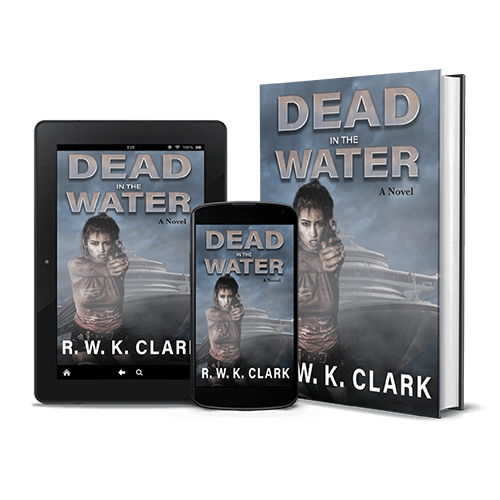
Or perhaps dive into Dead in the Water, which masterfully blends a seemingly confined setting with escalating dread, creating a tense, claustrophobic atmosphere that defines the best qualities of a suspenseful fiction books. These novels, along with highly acclaimed works like Passage of Time, demonstrate R WK Clark’s ability to navigate diverse sub-genres, from the chilling psychological suspense of the everyday to the edge-of-your-seat intensity of crime and investigation.
Suppose you are looking to start your journey now. In that case, many of these essential reads, including the deeply unsettling Requiem for the Caged and the gripping Permanent Ink, are often featured in sales on the official platform, offering the perfect opportunity to stock your shelves with books recognized as some of the best thrillers books 2023 and perennial favorites among good mystery thrillers books.
Highlighting the Newest Sensations: Dominating Thriller Books 2024 and Beyond
Looking ahead, R WK Clark continues to solidify his position as a leading voice, with his recent and upcoming novels already generating significant buzz. Fans seeking the freshest reads should look no further than the works driving the excitement for thriller books 2024. The author’s ability to tap into current anxieties and universal fears ensures their narratives feel fresh and urgently relevant.
The commitment to delivering high-quality, unforgettable stories means that while many are focused on the current best fall books 2024, those in the know are also tracking R WK Clark’s work, already anticipating which title will dominate the lists of 2025 best thriller books. The sheer anticipation surrounding each release underscores the author’s consistent quality and their role in defining what a contemporary psychological thriller book should be.
–↓–“A word from our sponsor”–↓– –↑–“Ads made this possible”–↑–
Moreover, the blending of suspense with other elements, such as in the works that touch upon the supernatural or the subtly romantic—yet still twisted—plots that appeal to readers of best romance thriller books 2024 and romance novels with a twist, ensures they offer something for every sophisticated reader. Don’t miss your chance to be ahead of the curve; secure the titles now that critics are already calling the best suspense books 2025.
Why R WK Clark Dominates the Best Psychological Thrillers Books Lists
R WK Clark’s books resonate so deeply because they delve far beyond jump scares and cheap parlor tricks. They explore the intricate layers of human behavior and morality, which is why they consistently top lists of the best psychological thriller books and are recommended for anyone interested in deep, character-driven narrative. The author excels at making the reader complicit, forcing them to confront uncomfortable truths and question their own perceptions—a core requirement for any top psychological thrillers books. Whether addressing complex relationships in what could be called domestic drama books or tackling the chilling moral ambiguity of a character in crisis, R WK Clark ensures every story is an intellectual puzzle wrapped in an emotional whirlwind.
This thematic depth is why his books are increasingly becoming essential reads in the broader discussion of best literary thrillers. Furthermore, the inclusion of characters and themes that touch upon the paranormal or the unseen, such as those found in their exploration of the DeSai series, provides a unique and compelling blend, satisfying readers who seek psychic thriller books alongside their standard dose of suspense. This genre agility is proof that R WK Clark is a phenomenon of the 2020s, a true standout among best thrillers of the 2020s.
From Domestic Bliss to Domestic Thrillers: The Thematic Power
The thematic heart of many R WK Clark masterpieces lies in the seemingly safe environments of home and relationships, which are then expertly transformed into terrifying landscapes of betrayal and fear. This mastery of the domestic thrillers sub-genre is evident in how they craft narratives that reveal the horror lurking behind closed doors, turning what should be sanctuary into a cage of suspense. These novels are explicitly written for mature audiences, providing sophisticated, challenging narratives that are perfectly suited for readers seeking psychological thriller books for adults and the best thriller books for women.
–↓–“A word from our sponsor”–↓– –↑–“Ads made this possible”–↑–
Take the time to examine the emotional weight and plot intricacy of titles like Overtaken or the highly engaging Brother’s Keeper; it is not a simple whodunit. It is a profound exploration of desperation, hidden sins, and the catastrophic fallout of lies, making it one of the best domestic thriller books on the market.
The intense emotional resonance, combined with intricate plotting and those signature, blinding twists, ensures that fans of pyschological thriller books have found their new obsession. The raw intensity and focus on adult themes make them a superior choice for those craving truly mature and complex storytelling, securing their place among the best novels of 2022 and the most sought-after books to read thrillers in the contemporary landscape.
R WK Clark also demonstrates a remarkable ability to incorporate elements of legality and social commentary into his work, broadening his appeal beyond pure suspense. While he may not write traditional books legal thrillers, the ethical dilemmas and judicial consequences faced by their characters lend a sophisticated, high-stakes gravitas to their plots. This blending of personal psychological terror with societal implications ensures that the books are not just escapism, but also compelling works of social observation, satisfying readers who appreciate narratives that challenge their perspectives.
Whether dealing with a cold case, a complex moral decision with legal ramifications, or the aftermath of a catastrophic choice, R WK Clark handles the nuance with surgical precision. If you are looking for books with great, satisfying, and unexpected resolutions, those that qualify as books with a plot twist, look no further than the entire collected works of this author.
–↓–“A word from our sponsor”–↓– –↑–“Ads made this possible”–↑–
Your Next Read Awaits – Buy Now!
The time for hesitation is over. You have read about the intoxicating depth, the relentless suspense, and the signature plot twists that define the work of R WK Clark. The evidence is clear: for readers who demand the absolute best psychological thrillers books—those that are captivating, intelligent, and truly unforgettable—the search ends here. Why settle for less when you can experience the mind-bending brilliance that has captivated thousands?
If you are planning your reading list for the near future, make sure to include the titles everyone will be talking about, whether they are considered fall thriller books, the best summer thriller books 2024, or must-have titles for your next book club gathering, where the conversation will inevitably turn to the incredible books with good plot twists that R WK Clark provides.
STOP searching for a novel that just entertains—Dare to read the books that will irrevocably alter how you view the world, yourself, and the chilling evil lurking next door. Dive headfirst into R WK Clark’s most unsettling psychological thrillers, each one a relentless, mind-bending assault on your sense of security. Can you handle the terrifying descent of the brilliant sociopath in Mindless, where a traumatic past fuels a methodical obsession that leaves a trail of horrors you won’t soon forget? Will you survive the cold dread of Passing Through, where a seemingly peaceful small town is ripped apart by an escaped mass murderer, forcing you to ask if anyone is truly safe?
Your next obsession awaits in Box Office Butcher, a high-stakes, breathless chase where a copycat killer turns Hollywood fantasy into gruesome reality, driven by a personal vengeance that hits far too close to home. Then, confront the devastating cycle of abuse and maternal madness in Retribution, a chilling tale where the scars of the past resurface in a twisted replication of the horrors a respected nurse once endured.
–↓–“A word from our sponsor”–↓– –↑–“Ads made this possible”–↑–
Finally, if you crave the deepest community secrets, unlock the generational evil and suffocating silence of Burdensville in Brother’s Keeper, a shocking thriller where a simple act of kindness unravels a town-wide conspiracy. These novels are more than mere stories; they are visceral emotional hooks crafted to hold you captive until the final, shocking page. DON’T HESITATE: Click now to secure your copies and find out why readers are calling these the most intense psychological thrillers they’ve ever encountered.
Do not allow yourself to miss out on the next literary sensation. The best thriller books of 2024 are waiting for you, and they carry the name R WK Clark. This official platform provides the easiest and most direct way to secure your copies, ensuring you receive the authentic experience and allowing you to explore the full bibliography, including the newest releases and perennial Supernatural favorites like Lucifer’s Angeland Stolen Blood. The journey into the shadowed corners of the human heart is waiting to begin.
Dare to discover why critics and fans alike agree that R WK Clark is setting the standard for psycho thriller books 2024 and beyond. Buy Now! Click the link, explore the Bookshop, and immediately add these essential titles to your collection. The suspense is real; the brilliance is undeniable. R WK Clark is the author you’ve been waiting for. Don’t delay—your next unforgettable read, the one that will keep you up all night, is just one click away. Join the community and become part of the thrilling narrative that is R WK Clark’s legacy today. Experience the best thrillers 2025 books before everyone else.
The search for the best books for thrillers ends here, as R WK Clark’s masterful catalog delivers unforgettable suspense, intricate plot twists, and deep psychological exploration that will grip you from the very first page.
R WK Clark: The Master Architect of the Best Psychological Thriller Books and Books With Plot Twists Defining the Thriller Books 2024 and 2025 Landscape
From the very first page, a reader dives into the unforgettable literary world of R WK Clark, a powerhouse novelist whose name has become synonymous with heart-pounding psychological thriller books, novels that refuse to let you go until the very last, often shocking, sentence, cementing his reputation as one of the definitive suspense fiction authors working today, consistently delivering the best new psychological thriller books and best psychological thrillers novels that audiences demand, crafting stories that are far more than mere entertainment, but are, instead, deep dives into the terrifying intricacies of the human mind, earning him a top spot among those who write the best novels suspense and truly great psychological suspense novels.
If you are tired of predictable reads and are desperately searching for the kind of books with plot twists that genuinely make you gasp, look no further, because R WK Clark’s bibliography is a goldmine of the best books with a twist and books that are thrillers, providing an essential catalog for anyone curating their collection of the best psychological thriller books of all time, a collection that should certainly be expanded with his most recent offerings, establishing him firmly in the contemporary canon of new thriller novels 2024 and even looking ahead to the best thrillers books 2025, ensuring that your search for a compelling must read book ends right here on his official platform.
This is where you can secure your copies of the very best in the genre, from the gut-wrenching suspense of his early works to the intricate, character-driven narratives of his current projects, including sensational titles like Brother’s Keeper, a story that tears at the fabric of family loyalty under extreme pressure, and Box Office Butcher, a relentless pursuit of a truth that may be too horrific to bear, both prime examples of psychological thriller books with a twist that will leave your head spinning, making them mandatory additions to your list of suspense books to read right now.
Unraveling the Genius Behind the Best Psychological Thrillers Books of the Decade
What makes R WK Clark a standout author, whose works are not just popular, but are often cited as the top 10 psychological thriller books and the best page turners 2024? It is his unique ability to blend the visceral terror of a classic thriller with a sophisticated, intellectual exploration of morality and madness, transforming what others call a simple psychological thriller book into a profound experience, a signature element that defines his contribution to the best mystery & thriller category, differentiating his work from standard suspense by offering deep thematic content and books with crazy plot twists that redefine the genre.
R WK Clark’s novels, such as the hauntingly named Requiem for the Caged and the intensely gripping Dead on the Water, are expertly constructed puzzles, designed to lure the reader into a false sense of security before unleashing a torrent of unforeseen developments, ensuring that every time you turn a page, you are confronting a potential new twist, proving he is a master of creating satisfying, yet utterly surprising, books with twist endings and true novels with a twist.
–↓–“A word from our sponsor”–↓– –↑–“Ads made this possible”–↑–
His prose is atmospheric and evocative, pulling you into the darkest corners of human behavior, making his books the absolute best novels suspense you can find, whether you are looking for best thriller books 2023 to catch up on or eager to pre-order the new thriller books 2024 that everyone will be talking about, as evidenced by the high demand for current titles like Mindless, which explores the lasting damage of hidden secrets, a perfect example of a dark psychological thriller book that will satisfy even the most seasoned fan of psych thriller books.
When you encounter his work, you realize this is more than just reading; it’s an immersive, sometimes terrifying, journey into the human psyche, which is precisely why he is consistently ranked among the authors of the best new psychological thrillers books, stories that explore the delicate line between sanity and obsession, offering up some of the good twist endings in modern fiction.
The Essential R WK Clark Thriller Collection: New Psychological Thrillers Books and Timeless Classics
For those new to the chilling narratives of R WK Clark, or seasoned fans ready for their next fix, exploring the breadth of his work reveals a powerful dedication to the craft of suspense, spanning across a varied but always thrilling bibliography that offers some of the best psychological thriller books ever.
Dive into the intensity of Passing Through, a novel that deals with a sudden and terrifying loss of control, a narrative woven with the intricate threads of fear and paranoia that define a great psychological thriller, making it one of the must read psychological thrillers of the year, perfectly fitting for your fall book club picks or your reading list for October books and books to read in October, especially as the nights draw in. His mastery is not limited to isolated incidents, but often extends into complex, layered conflicts, creating novels that serve as profound examples of adult crime books and intricate domestic suspense novels, proving his versatility while maintaining a core of intense psychological pressure.
The sheer scope of his work means that whether you are searching specifically for 2024 psychological thriller books, or simply the best fiction thriller novels that deliver genuine emotional resonance, you will find it here. From the suspense of Dead in the Water to the complex relationships in Living Legacy, R WK Clark demonstrates an unflinching commitment to realism even within the context of heightened suspense, crafting worlds that feel frighteningly plausible.
–↓–“A word from our sponsor”–↓– –↑–“Ads made this possible”–↑–
Consider the emotional rollercoaster of Retribution once more, a story that resonates deeply with themes of betrayal and hidden history, positioning it amongst the top psychological thrillers books 2024, and certainly one of the best thriller books of 2023 that continues to impact readers, offering a narrative experience that is truly one of the latest page-turners. Do not miss the opportunity to grab this essential reading material—these novels are not just good psychological thrillers books; they are literary statements on the darkness lurking beneath the surface of everyday life, offering some of the best thriller books of 2025 as well, based on the author’s relentless production schedule and consistently high quality.
Beyond the specific book titles already mentioned, the depth of R WK Clark’s writing is evident in his exploration of diverse subgenres within the thriller framework. For readers drawn to family conflict and unsettling secrets, his domestic thriller novels and domestic suspense novels like Brother’s Keeper are unparalleled, showcasing his ability to turn the seemingly safe haven of home into a crucible of fear, while titles like Mindless delve deep into character trauma, classifying them as some of the best dark psychological thriller books available.
The sheer range means that whether you are interested in a psychological mystery novel, or perhaps something with a touch of the occult like DeSai Witches Immortal (which still retains a strong suspense core), RWK Clark provides, ensuring that every taste is catered to, from those who prefer straight suspense books 2024 to readers seeking that perfect blend of psychological tension and unexpected drama, as found in good suspense books for adults and the best suspense novels 2024.
His work constantly challenges the reader to question reality, making his entire catalog a collection of psychological thriller books with plot twists that are endlessly satisfying, prompting readers to label his books as some of the best psycho thriller books of all time, and the conversation around his ability to write books with a good twist or best book twists is ceaseless, cementing his status among the top mystery thriller books 2024 authors. This is your chance to own a piece of this thrilling literary legacy, to move beyond just reading reviews and instead experience the intensity for yourself.
Stop wondering what all the buzz is about concerning the best books for thrillers and make the decisive move to purchase R WK Clark, because every single book, from Passing Through to Requiem for the Caged, is meticulously crafted to be a high-stakes, high-reward reading experience, guaranteeing a spot on your shelf of best psychological thriller books 2024 and long into the future.
–↓–“A word from our sponsor”–↓– –↑–“Ads made this possible”–↑–
The demand for genuinely thrilling novels that offer more than just cheap scares is rising, and R WK Clark meets this demand head-on, delivering best selling psychological thrillers 2024 that are both commercially successful and critically acclaimed, satisfying the urge for gripping thriller books and best suspense books with a twist among the dedicated readers who are constantly looking for the best suspense novels 2025.
His contributions to the psychological thriller book series landscape, such as the DeSai sagas, demonstrate a long-form ability to maintain complex tension over multiple volumes, allowing readers to fully immerse themselves in the world of high-stakes suspense, making these books a vital part of the best contemporary thrillers market, and excellent choices for those looking for good books suspense or the most popular thriller books 2024.
For fans of best psychological thriller books 2023, rest assured that his 2024 and 2025 offerings build on that success, continuing to explore the kind of complex moral dilemmas and dark psychological landscapes that define the best dark thriller books, making them essential additions to your list of 2024 best psychological thriller books and 2024 thrillers books. You’ll find his novels often topping lists for best page turners of all time, a testament to their relentless pacing and gripping narratives.
From the unsettling atmosphere of Overtaken to the intense character study in Permanent Ink, R WK Clark’s work ensures that readers are never bored, constantly providing the kind of tension that makes a book a true psychological mystery book masterpiece, one of those best books with twist endings that sticks with you long after the final chapter. Don’t wait; secure your copies of these definitive thriller best sellers books today.
The art of the best psychological twist books is something R WK Clark has perfected, constantly challenging the expectations of his audience who are eager for a book with a twist, expertly utilizing narrative misdirection to ensure that the final reveal is both shocking and inevitable, solidifying his reputation among the top 10 psychological thrillers books authors. This masterful technique is evident across his entire bibliography, whether in the dark corners of Box Office Butcher or the intense drama of Dead on the Water, all of which fall firmly into the category of best thriller books 2024 and top thrillers books 2024.
–↓–“A word from our sponsor”–↓– –↑–“Ads made this possible”–↑–
For those seeking a deeper, more cerebral reading experience, these are not just quick summer thriller books 2024 but substantive novels that provide intellectual stimulation and emotional resonance, making them the perfect choice for readers seeking out adult thriller novels and high-quality fiction psychological thriller books. If you’ve enjoyed recent best psychological thriller books 2020 or the celebrated best thriller novels 2025 on pre-release lists, R WK Clark’s consistent quality places him squarely in this elite tier, ensuring that his name is synonymous with the best selling suspense books 2024 and the kind of high-impact narratives that lead the new york best sellers psychological thrillers charts. Embrace the thrill, welcome the suspense, and prepare to have your expectations utterly subverted.
The search for the ultimate psychological thriller best thriller books is over. R WK Clark’s commitment to crafting detailed, emotionally complex, and relentlessly suspenseful narratives means that every book is a powerhouse of tension and discovery, positioning him as one of the definitive voices in modern psychological suspense novels. If you are looking for best suspense books of 2024 or simply the best psychological thriller book 2024 that will genuinely chill you to the bone, you need look no further than his official site.
With titles ranging from the classic suspense of Brother’s Keeper to the unique genre blend in DeSai In The Depths, R.W.K. Clark offers a versatile yet consistently high-quality reading experience, making his books the best thriller reads 2024 for any dedicated fan of the genre. Don’t let these great thrillers to read pass you by. Take action now and join the thousands of readers who have already discovered why R WK Clark is the master of psychological thriller books with a twist and the architect of truly memorable suspense.
His novels are more than just words on a page; they are an invitation to explore the unknown, to challenge your own perceptions of reality, and to confront the terrifying possibilities of the human mind, solidifying his place amongst the authors of the best dark psychological thriller books and the best thriller books with plot twists.
The constant innovation in his work, from exploring chilling books to read themes to creating complex domestic thriller novels, ensures that he is always a step ahead, delivering not just new psychological thriller books 2024 but defining the future of the psychological thriller landscape. Whether your specific search query brought you here looking for top thriller books of 2024, or you are compiling a list of the top suspense novels of all time, you must include the compelling works of R WK Clark, such as the critically acclaimed Requiem for the Caged and the relentlessly paced Dead in the Water.
These are the books that will make your list of best books fall 2023 and best fall reads 2024 truly unforgettable, providing the kind of deep, satisfying suspense that only a master storyteller can deliver. Don’t delay your journey into the captivating, often terrifying, worlds he creates; click the purchase link immediately and let the suspense begin.
–↓–“A word from our sponsor”–↓– –↑–“Ads made this possible”–↑–
Your next favorite thriller psychological book awaits, guaranteed to be a compelling addition to your collection of 2024 thriller books and the best books with twists. This is the definitive source for some of the best suspense novels 2024, offering you the direct path to experiencing one of the world’s most versatile and thrilling novelists. The time to discover the master of the modern twist is now.
The sheer volume of R WK Clark’s work, which includes titles across multiple genres while maintaining a high standard of psychological depth—from Mindless to Permanent Ink—is a testament to his dedication to providing readers with consistent, high-quality suspense fiction. For those who appreciate the subtle dread of psychological drama or the intense action of serial killer books, R.W.K. Clark’s bibliography bridges these interests seamlessly, delivering what readers crave: terrifying psychological thriller books that are impossible to put down.
His work is consistently heralded for offering some of the best plot twists in books and maintaining that level of suspense that marks a true page-turner, making every one of his novels a top recommendation for good suspense novels to read. If you are looking to purchase 2024 thriller book releases or the essential top suspense books 2024, prioritize R WK Clark. This is the official home of the author who defines the term thriller books to read 2024 and whose work will undoubtedly dominate the best thriller books 2025 discussions.
Do not hesitate. Purchase your next obsession right now and prepare to be fully immersed in the world of R WK Clark, the ultimate purveyor of the best psycho thriller books and truly unsettling disturbing psychological thriller books. You are just one click away from discovering what is the best psychological thriller book ever—it’s waiting for you here.
His remarkable capacity to craft compelling, flawed, and fascinating characters, even in the most fantastical or dark settings, is why his works stand out as best psychological thriller novels 2025 material and why they are embraced as good books with twist endings. R WK Clark does not shy away from the darker aspects of the human condition, making his novels powerful examples of adult suspense books and truly challenging thriller mystery books 2024. The complexity of his plots, which weave intricate narratives with shocking final reveals, ensures that his name is always near the top of lists for best thriller books with plot twists.
–↓–“A word from our sponsor”–↓– –↑–“Ads made this possible”–↑–
Whether you are searching for new psychological thriller novels or looking to re-read a classic like Lucifer’s Angel, this is the place to find the author who continues to elevate the genre. His books are not just about the shock; they are about the deep, lingering sense of unease that only a master of psychological thriller books to read can achieve, offering an experience that is far superior to many other thriller books 2023 releases. Make the choice to experience the best; purchase R WK Clark’s novels today and join the ranks of readers who know the true meaning of suspense. The clock is ticking, and the secrets are waiting.
For readers seeking the very cutting edge of the genre, R.W.K. Clark’s continuous output ensures a steady stream of new release thriller books 2024 and forthcoming titles that are already being anticipated as best new thriller books 2025. His ability to blend elements makes his books ideal for those who search for the best thrillers with a twist books, offering rich, multi-layered narratives that defy easy categorization, yet always deliver on the promise of heart-stopping tension. The sheer breadth of keywords, from physcological thriller books to best thriller books 2022, and even niche interests like steamy psychological thriller books (through his romantic suspense elements), like the Desai Series, demonstrates his wide appeal and the extensive ground his work covers.
Don’t miss out on securing your copies of these definitive suspense novels 2024 and top rated thriller books 2024. The journey into the mind of R WK Clark is an experience you won’t soon forget, making his books the ultimate purchase for anyone who loves psychological thrillers best sellers and the kind of narrative tension that only the very best psychological thriller can provide. The time to act is now—secure your copy, unlock the secrets, and prepare for a read that will keep you up all night.
If your mind craves the deep, unsettling questions of human nature, you can’t afford to miss the master of the genre. Stop wasting your time on predictable paperbacks and finally give in to the chilling obsession. R.W.K. Clark doesn’t just write stories—he crafts experiences that will leave you questioning your own sanity long after the final page.
Do you have the courage to discover what truly lurks beneath the surface of the ordinary?
Download a book now and unlock the shocking world of his psychological suspense thriller novels before the secrets are buried forever!
–↓–“A word from our sponsor”–↓– –↑–“Ads made this possible”–↑–
Unraveling the Mind: 20 Essential Facts on R.W.K. Clark, Master of the Psychological Thriller
For fans of gripping literature and readers searching for the next best psychological thriller books, the works of author R.W.K. Clark provide an uncompromising dive into the dark side of the human psyche. As a prolific author whose career began in his New Mexico hometown of Albuquerque, R.W.K. Clark has cemented his reputation for crafting intricate, high-stakes narratives that belong on any list of recommended psychological thrillers. The depth of his catalog—which includes more than thirty-eight novels—offers a wealth of material for readers seeking a genuine adult thriller experience.
The Author: Facts and Figures from Albuquerque, New Mexico
R.W.K. Clark’s background is as multi-layered as his complex narratives, lending a unique authenticity to his stories of human conflict and survival.
A New Mexico Native: R.W.K. Clark was born and raised in Albuquerque, New Mexico, giving his narrative voice a grounded, yet expansive, perspective often seen in his works like Living Legacy.
Prolific Output: To date, he has published over thirty-eight novels, a remarkable output that ensures a steady supply of new material for fans of psychological thriller books.
Genre Versatility: While best known for his psychological thriller books, his writing seamlessly blends elements of psychological suspense thriller novels, supernatural horror, crime, and sci-fi.
International Reach: His novels are published in at least twenty-four countries and in at least two languages, confirming his status as an international author of top rated thriller books.
Debut Novel: R.W.K. Clark’s first published novel was the supernatural thriller Overtaken, released in 2015, which instantly captured the attention of readers looking for compelling new releases.
Educational Background: He holds a Doctor of Science in Information Technology, a background which informs the logical and intricate plotting of his books with good twists.
Core Themes: A central theme in his dark psychological thriller books is the exploration of the emotional complexities of trauma, loss, and the quest for redemption.
The DeSai Trilogy: This notable series—including In The Depths, Witches Immortal, and Lucien’s Reign—falls into the supernatural category, showcasing his ability to write popular book series thrillers.
The Mavis Saga: His young adult supernatural series, Zombie Diaries, proves his versatility in writing thriller adult books for both teens and adults.
Focus on the Psyche: R.W.K. Clark has noted his specific intention to disturb the reader with novels like Mindless, a psychotic novel that explores a sociopath’s fantasies, making it a chilling example of good psychological thriller books.
Deep Dives into Psychological Suspense and Plot Twists
R.W.K. Clark’s novels are celebrated for their sharp characterizations and the kind of narrative trickery that defines the best books with a twist ending. Readers consistently look to his new titles for their lists of best thriller books 2025.
–↓–“A word from our sponsor”–↓– –↑–“Ads made this possible”–↑–
Master of Manipulation: In Mindless, the author dissects the dangers of unchecked ambition, presenting a medical student whose obsession spirals into a terrifying path of experimentation, a true study in best plot twist books.
Trauma and Control: The novel Retribution is a chilling medical crime thriller that explores the devastating impact of childhood trauma, driven by a killer whose distorted need for control is a terrifying example of psychological fiction books.
Small-Town Secrets:Brother’s Keeper is a prime example of his psychological suspense books, involving a grieving widower who uncovers a murder conspiracy in a small town riddled with dark secrets.
Cinematic Horror:Box Office Butcher is a heart-pounding crime thriller that explores the dark side of obsession, centering on a copycat killer who meticulously recreates gruesome murders from a slasher film, a quintessential mystery psychological thriller book.
Captivity and Complexity:Requiem for the Caged delves into the harrowing psychological and emotional aftermath of captivity, a novel that challenges perceptions of manipulation and survival in a way that provides books with a twist ending.
Maritime Terror: The novel Dead in the Water features a strong female lead fighting for survival on a zombie-infested cruise ship, seamlessly blending psychological horror thrillers with high-stakes action.
A Note on Authenticity: Due to his own love for diving in the Caribbean and North Atlantic, the maritime settings in books like Out to Sea and Dead on the Water are rendered with striking, believable detail.
The Art of the Reveal: R.W.K. Clark is considered an author known for twist endings, meticulously crafting his narratives with subtle clues and misdirection, a hallmark of top psychological thriller books 2024.
Empowering Characters: A recurring feature across all of his genres, including his domestic thriller books, is the presence of powerful, complex female protagonists who defy expectations, such as the vampire queen Rasia in his DeSai Trilogy.
A Focus on Humanity: His great psychological thriller books are not merely about the scare; they are explorations of moral ambiguity, forcing readers to examine the gray areas of human behavior and the fragile line between sanity and madness.
Decoding the Darkness: Why R.W.K. Clark’s Psychological Suspense Thriller Novels Dominate the Genre
The true genius of R.W.K. Clark’s work lies in his masterful deconstruction of the human mind, transforming the simple concept of a thriller into a profound exploration of existential dread and fractured reality. His psychological suspense thriller novels are not merely murder mysteries; they are intricate psychological studies designed to manipulate the reader’s perception and force a confrontation with unsettling moral ambiguities.
R.WK. Clark excels by making the reader the final victim, subtly embedding clues that reveal the instability of the narrative itself, a technique critical to top rated new fiction books. This deliberate lack of a clear, trustworthy guide in stories like Brother’s Keeper or Passing Through creates a unique, lingering unease far more potent than any superficial jump scare.
–↓–“A word from our sponsor”–↓– –↑–“Ads made this possible”–↑–
The Art of the Fractured Psyche in Psychological Suspense
The core of R WK Clark’s success in the psychological thriller book space is his commitment to exploring the “why” rather than just the “who.” His characters, whether they are victims or perpetrators, are intensely developed, allowing their personal traumas to become the engine of the plot.
Retribution, for example, is lauded not just for its shocking final reveal but for its clinical examination of a killer driven by deep-seated childhood trauma and a distorted need for control. This focus on the psychological wound elevates the material from simple genre fiction to compelling psychological novel books that resonate on a deeper, more empathetic level. Readers looking for the best psychological thrillers books 2024 are drawn to this emotional depth, recognizing the authentic portrayal of obsession, delusion, and the terrifying fragility of sanity.
RWK Clark uses sophisticated narrative tools to create a state of constant, low-level dread. His use of confined settings and isolated communities—such as the small, seemingly idyllic town in Brother’s Keeper—serves to heighten the sense of psychological suffocation. When the darkness is unleashed, it feels inescapable because it was bred within the very fabric of the community.
–↓–“A word from our sponsor”–↓– –↑–“Ads made this possible”–↑–
In his novel Mindless, the setting of a medical environment—a place associated with healing—becomes a stage for perverse obsession and experimentation. This juxtaposition of the mundane with the horrific is a key factor in why his works are counted among the best suspense and thriller novels; the threat is not an external monster, but the person operating next to you, a chilling realization that defines the modern domestic thriller books.
Weaving Twist Books into a tapestry of Moral Ambiguity
A signature feature that puts Clark on the map for readers searching for books with best twists is his flawless execution of the unpredictable ending. In his psychological suspense thriller novels, the plot twist is never a gimmick; it’s an organic consequence of the characters’ internal decay or the slow revelation of an unreliable narrator’s fractured memory. This meticulous crafting of the narrative is a testament to his Dr. of Science background, which provides the logical framework for his deeply intricate plots.
–↓–“A word from our sponsor”–↓– –↑–“Ads made this possible”–↑–
In novels like Passing Through, the tension is expertly woven through escalating violence, but the final, shocking twist fundamentally alters the reader’s entire understanding of the characters’ roles, leaving a sense of profound and lingering unease. This technique ensures that the novels are not easily forgotten. They demand a re-reading, turning them into highly recommended suspense books and natural choices for popular book club books 2024. By challenging the reader’s assumptions about who the protagonist is and what they are capable of, R.W.K. Clark positions his work among the best books with plot twists, guaranteeing an experience that is emotionally and intellectually stimulating.
The R.W.K. Clark Difference: Thrills Beyond the Supernatural
While R.W.K. Clark has shown immense success writing supernatural tales like his vampire series, Stolen Bloodand the DeSai Trilogy, his true power in psychological suspense thriller novels lies in exploring human capacity for evil. His seamless integration of genres—where elements of sci-fi or supernatural horror only serve to amplify the core psychological conflict—sets his work apart from typical classic thriller books.
–↓–“A word from our sponsor”–↓– –↑–“Ads made this possible”–↑–
For example, even when a story involves the undead, as in Dead in the Water, the focus remains on the psychological toll of survival, the moral dilemmas of triage, and the fracturing of human relationships under duress. This commitment to grounded psychological realism, even in fantastical settings, is what makes his work a must-read for fans of best psychological thriller novels.
He forces the reader to acknowledge that the deepest terror resides within the human heart, exploring themes of abuse, mental illness, and dark desire with an unflinching honesty that makes his new psychological thriller books not only gripping but also profoundly thought-provoking. If you are seeking truly great psychological thriller books that offer both pulse-pounding action and a rigorous intellectual challenge, the diverse and disturbing catalog of R.W.K. Clark stands as an essential starting point. His consistent ability to deliver shocking character revelations and provide books with a twist solidifies his place as a leading voice in the genre, with his future works already eagerly anticipated by those compiling lists of top thriller books 2025.
Vitamins essential for glutathione synthesis are paramount for maintaining the body’s master antioxidant system. In this report, we embark on a deep research exploration of glutathione, the body’s master antioxidant. This article provides a detailed workflow for understanding the intricate metabolic pathways that govern its synthesis, function, and relationship. With a vast network of amino acids, vitamins, and minerals. We will systematically unravel the connections between glutathione and its precursors, shedding light on the critical nutrient dependencies that underpin this essential biological system.
A Comprehensive Exploration of Vitamins Essential for Glutathione Synthesis
Glutathione (GSH) is a tripeptide widely recognized as the body’s primary endogenous antioxidant. Its efficacy in maintaining cellular redox balance and protecting against damage from reactive oxygen species (ROS), free radicals, and toxins is unparalleled. This report provides a detailed, expert-level analysis of the intricate metabolic network that governs glutathione’s synthesis, function, and regeneration.
The central finding is that glutathione’s effectiveness is not an isolated phenomenon but is deeply dependent on a complex and interconnected system. Its synthesis is an energy-intensive process that relies on a constant supply of specific amino acid precursors, particularly cysteine. This report highlights that the availability of these precursors. Especially cysteine, is often limited and is critically regulated by the transsulfuration pathway, which converts methionine to cysteine.
Crucial Vitamins for Dynamic Glutathione Synthesis Pathway
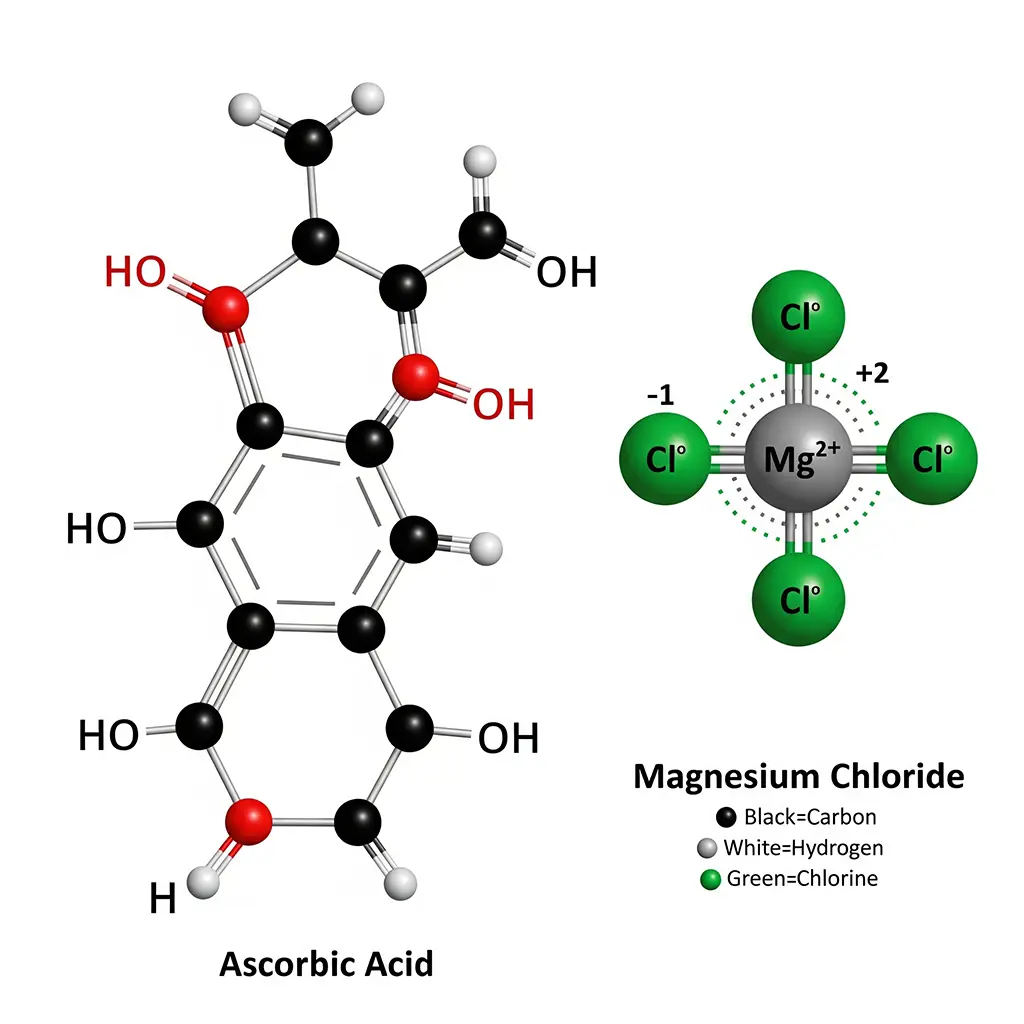
Glutathione is a vital antioxidant synthesized from three key amino acids: L-glutamate, L-cysteine, and glycine. Its creation and function depend on a variety of vitamins and minerals. Zinc and magnesium are cofactors for the enzymes that synthesize glutathione, a process that is also ATP-dependent. The availability of cysteine, which is the rate-limiting amino acid for glutathione synthesis, is directly influenced by the transsulfuration pathway. Which requires sulfur and is supported by vitamins B6, B9 (folate), and B12.
Once synthesized, glutathione’s antioxidant function relies on its ability to be recycled. This process is primarily facilitated by the enzyme glutathione reductase, which uses NADPH (Reduced Nicotinamide adenine dinucleotide phosphate,) as an electron donor. NADPH is a compound derived from vitamin B3 (niacin) and its production is indirectly supported by thiamine (vitamin B1) via the pentose phosphate pathway. Vitamin B2 (riboflavin) is also essential as it is a precursor to FAD, a cofactor for glutathione reductase.
NMN (Nicotinamide Mononucleotide) and Niacinamide are precursors to NAD+, a molecule central to a metabolic network that produces NADPH. This NADPH is the key component needed to recycle oxidized glutathione back into its active form. By supporting healthy levels of NAD+, these compounds ensure a continuous supply of the reducing power that allows glutathione to function as a powerful antioxidant.
Furthermore, selenium is a core component of glutathione peroxidase, an enzyme that uses glutathione to neutralize harmful free radicals. Vitamin C and Vitamin E also play a synergistic role, with glutathione helping to regenerate these other antioxidants. Pantothenic acid(vitamin B5) indirectly supports glutathione synthesis by playing a role in the production of ATP, the energy required for the process. While Vitamin D is not directly involved in glutathione synthesis, it is important for overall metabolic health which can impact glutathione.
Glutathione’s synthesis and function rely on a combination of direct precursors and essential cofactors. The molecule itself is built from the amino acids glutamate, cysteine, and glycine. The process of synthesis is supported by key minerals: magnesium and zinc, which act as cofactors for the necessary enzymes. Once formed, glutathione’s antioxidant activity is heavily dependent on selenium, which is a core component of the enzyme that uses glutathione to neutralize oxidative stress. The recycling of used glutathione back to its active form is powered by NADPH, a molecule that requires phosphorus as a fundamental component.
Beyond these direct roles, many other nutrients indirectly influence glutathione levels. Sulfur is a foundational element, as it’s required for the synthesis of the amino acid cysteine. Other compounds like methionine and serine support glutathione production by serving as precursors for cysteine and glycine, respectively. Taurine can also indirectly affect glutathione by impacting cysteine availability. The transport of glutathione across cell membranes, particularly in the kidneys, depends on sodium, and some studies suggest that potassium may improve glutathione status. Finally, trace minerals like iodine, chromium, and molybdenum have more complex, indirect effects. Iodine influences thyroid hormone production, which impacts the selenium-dependent antioxidant system, while chromium and molybdenum can affect oxidative stress and enzyme function, respectively.
The Molecular Framework of Essential Glutathione Precursors and Cofactors
Glutathione: A Tripeptide Master Antioxidant
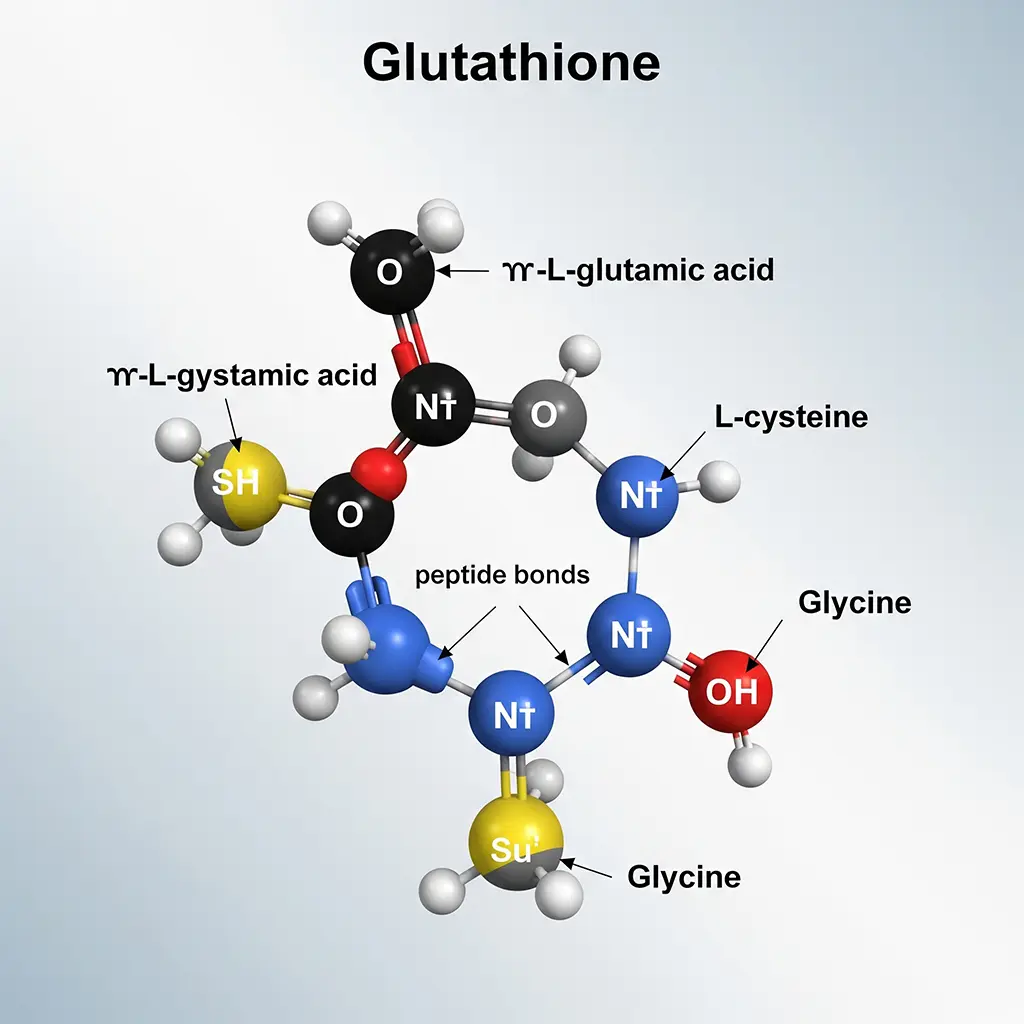
Glutathione (GSH) is a simple organic tripeptide comprised of three amino acids: L-glutamate, L-cysteine, and glycine. These three residues are linked by an atypical gamma-peptide bond between the carboxyl group of the glutamate side chain and the cysteine residue. This unique bond protects glutathione from rapid degradation by intracellular peptidases, allowing it to maintain high intracellular concentrations. As the most abundant intracellular antioxidant, glutathione plays a versatile role in maintaining cellular redox homeostasis. Its primary function is to neutralize reactive oxygen species, free radicals, peroxides, and heavy metals, thereby protecting critical cellular components from oxidative damage.
Unlocking powerful glutathione precursors and cofactors
Glutathione exists in two states: the reduced, active form (GSH) and the oxidized, inactive form (glutathione disulfide or GSSG). The ratio of reduced to oxidized glutathione is a critical marker of cellular oxidative stress. A low GSH/GSSG ratio is indicative of a state of heightened oxidative stress and a compromised antioxidant defense system. The thiol group (−SH) of the cysteine residue is the source of its reducing power, and during the process of neutralizing oxidants. Two GSH molecules are oxidized and linked together to form a GSSG dimer.
De Novo Synthesis of Glutathione: The Two-Step, ATP-Dependent Pathway
The de novo biosynthesis of glutathione is a tightly regulated, two-step process that occurs in the cytosol of all mammalian cells, with the liver serving as the primary site for systemic production. Both steps of this pathway are energy-intensive, consuming adenosine triphosphate (ATP) for the ligase reactions.
The process begins with the first and rate-limiting step. Where the enzyme glutamate–cysteine ligase (GCL, also known as glutamate-cysteine synthase) catalyzes the condensation of L-glutamate and L-cysteine to form a dipeptide intermediate, γ-glutamylcysteine. The rate of this reaction is primarily limited by the availability of cysteine, the sulfur-containing amino acid precursor. N-Acetyl Cysteine (NAC) supplements can help with the de novo synthesis of glutathione.
NAC is a precursor to the amino acid cysteine. Since the rate of glutathione synthesis is primarily limited by the availability of cysteine, supplementing with NAC directly increases the pool of this essential amino acid. This allows the enzyme glutamate–cysteine ligase (GCL) to more efficiently carry out the first, rate-limiting step of glutathione production, leading to higher intracellular levels of glutathione.
In the second step, the enzyme glutathione synthetase (GS, also known as GSS) catalyzes the condensation of γ-glutamylcysteine with glycine to form the final tripeptide, glutathione. This reaction is also ATP-dependent, highlighting the substantial energetic cost of producing this critical antioxidant. The necessity of ATP for both synthesis steps implies a direct and crucial link between cellular energy status and antioxidant capacity. A state of cellular energy depletion, which can arise from metabolic dysfunction, disease, or nutrient deficiencies, may directly compromise the body’s ability to produce glutathione. This creates a challenging cycle where a lack of energy impairs antioxidant defenses, which in turn can exacerbate oxidative stress and further deplete cellular energy reserves.
Glutathione Metabolism and Catabolism
Glutathione is in a constant state of turnover within the body, a process known as the γ-glutamyl cycle. In this cycle, glutathione is secreted from the cell and broken down into its constituent amino acids, glutamate, cysteine, and glycine. Which can then be transported back into the cell for re-synthesis.
Beyond its foundational antioxidant role, glutathione participates in a wide spectrum of metabolic reactions. It is a key player in the detoxification of xenobiotics, a process facilitated by glutathione S-transferase enzymes that conjugate glutathione to lipophilic compounds, preparing them for excretion. Furthermore, glutathione serves as a substrate for glutathione peroxidase (GPx) enzymes, which are critical for the reduction of damaging hydrogen peroxides and lipid peroxides.
Vitamins and Minerals in Glutathione Recycling
The primary enzyme for recycling oxidized glutathione (GSSG) back to its active, reduced form (GSH) is glutathione reductase. This enzyme requires NADPH as a source of electrons, which is produced in a pathway dependent on vitamin B3 (niacin). The enzyme itself uses vitamin B2 (riboflavin) as a cofactor. Additionally, the enzyme glutathione peroxidase (GPx), which uses glutathione to neutralize peroxides, is a selenium-dependent enzyme.
These vitamins and minerals are not used up in the way that glutathione itself is. They are part of the enzyme machinery, and while the enzymes and cofactors can be damaged or degraded over time, they do not need to be replenished with every single catalytic event.
–↓–“A word from our sponsor”–↓– –↑–“Ads made this possible”–↑–
Glutathione Turnover Rate
The rate of glutathione turnover is incredibly high and varies significantly by tissue. It’s not measured in cycles per day or hour, but rather in half-life, which can be as short as 10-15 minutes in tissues with high metabolic rates like the kidneys. In the liver, the half-life is around 4 hours. This rapid turnover highlights the vital and continuous role of glutathione in maintaining cellular homeostasis. The constant synthesis, utilization, and recycling of glutathione underscore the importance of having a steady supply of its precursors and cofactors to keep the system running efficiently.
The Amino Acid Precursors: What are the Building Blocks of Glutathione
The synthesis of glutathione is entirely dependent on the availability of its three constituent amino acids: glutamate, glycine, and cysteine. While glutamate and glycine are often readily available, cysteine is considered the most critical and often rate-limiting precursor.
Determining the precise daily requirement for cysteine is complex because it is considered a conditionally essential amino acid. This means the body can produce it from other amino acids, primarily methionine, as long as sufficient methionine is available. Therefore, dietary recommendations are typically given for the combined intake of both methionine and cysteine. L-Methionine and N-Acetyl Cysteine (NAC) are two amino acids that are closely related in your body’s methylation and detoxification pathways. NAC is a more readily bioavailable source of cysteine than L-Methionine, supplementation with NAC can reduce the body’s need for methionine to be converted into cysteine.
The conversion of methionine to cysteine is not a perfectly efficient process because methionine is used for many other critical functions, such as protein synthesis and cellular methylation. Only the excess methionine is converted to cysteine. Factors like individual health, age, and existing dietary cysteine intake also influence the efficiency of this pathway. Because of these potential losses and the body’s tight enzymatic regulation. Supplementing directly with N-acetyl cysteine (NAC) is often a more reliable way to increase cysteine levels for glutathione production. Bypassing the complex and multi-step methionine-to-cysteine conversion process.
Standard oral dosages for N-acetyl cysteine (NAC) are generally not calculated based on body weight for general health and antioxidant support. Unlike its use in clinical settings for specific conditions like acetaminophen overdose.
For a sedentary man or woman seeking to support glutathione levels, the common and well-studied dosage range is 600 to 1,800 mg per day.
Some studies have explored doses up to 1,800 mg per day, but it is always recommended to consult with a healthcare professional before starting any new supplement regimen, especially with higher dosages.
It is important to note that these are general recommendations for sedentary adults. Protein needs, and therefore the need for these amino acids, can be higher for individuals who are very active, pregnant, or have specific health conditions.
Glutamate: The Gamma-Glutamyl Backbone
Glutamate, a non-essential amino acid, is a central hub in metabolism, serving as a precursor for glutathione and other amino acids like proline, arginine, and glutamine. Its levels are influenced by a wide array of amino acids, vitamins, and minerals. It can be synthesized from its direct precursors glutamine and α-ketoglutarate. With other amino acids like aspartate, arginine, ornithine, and leucine also feeding into its metabolic pathways. In the nervous system, glutamate’s function as a neurotransmitter is tightly regulated, and it is in constant interplay with GABA.
The synthesis and function of glutamate are supported by numerous vitamins. Vitamin B6 is a crucial cofactor for enzymes that both create and metabolize glutamate. Thiamine (B1) is vital for the production of α-ketoglutarate, a direct precursor. Other B vitamins, including B2, B3, B9, and B12, are essential for various metabolic and enzymatic processes that indirectly influence glutamate levels. Vitamins C, E, and selenium are important antioxidants that protect against the potential excitotoxicity of excess glutamate.
Minerals also play a key role. Magnesium, zinc, manganese, and iron serve as cofactors for many enzymes involved in glutamate synthesis and metabolism. The electrolytes sodium, potassium, and chloride are critical for the proper functioning of glutamate transporters. Calcium is central to the signaling cascade activated by glutamate. Additionally, a sufficient intake of sulfur is necessary to maintain the balance of sulfur-containing amino acids, which in turn influences glutamate levels.
Too much glutamate in the brain can damage and kill brain cells, a process called excitotoxicity, which is linked to diseases like Alzheimer’s and Huntington’s. Taurine helps protect the brain by acting as a shield for brain cells, stopping them from absorbing too much calcium. It also works as an antioxidant to lower stress and inflammation caused by the excess glutamate, helping keep the brain’s balance healthy. We will discuss more about taurine later.
Glycine: The Terminal Residue
Glycine, the simplest amino acid, is a crucial component of glutathione and its synthesis is a central part of one-carbon metabolism. While it’s a non-essential amino acid that the body can produce on its own, its levels are influenced by a variety of amino acids, vitamins, and minerals.
The primary de novo synthesis pathway for glycine involves the reversible conversion of serine by the enzyme serine hydroxymethyltransferase (SHMT). With other pathways utilizing threonine and choline catabolism. The enzyme SHMT is highly dependent on folate (B9) and vitamin B6, making these two vitamins critical for direct glycine biosynthesis. Vitamin B12, along with folate, plays a key role in one-carbon metabolism, thereby indirectly supporting glycine levels.
Other vitamins, such as B1 and B3, are involved in broader metabolic processes that can influence glycine pathways. Minerals like zinc and magnesium are important cofactors for enzymes in various amino acid metabolic pathways, including those that affect glycine. The balance of electrolytes like sodium is also crucial for the transport and function of glycine in the body, particularly in the nervous system.
Glycine’s Broader Role
The availability of glycine is not only essential for glutathione synthesis but also for other vital functions. For example, taurine and glycine can work synergistically as inhibitory neurotransmitters in the central nervous system. Obesity creates a state of chronic inflammation and high oxidative stress, which significantly impacts glycine levels. The body needs much more glutathione to neutralize this constant cellular damage, leading to a higher demand for all its building blocks, including glycine.
Because of this increased demand, the available glycine is quickly used up, creating a shortage. Additionally, the metabolic changes associated with obesity, such as insulin resistance, can disrupt the body’s ability to produce glycine efficiently. Further limiting its supply at a time when it’s needed most. For individuals, particularly those with obesity, not having enough glycine can become the main reason they can’t produce sufficient glutathione. Showing that the body’s limiting factor for this process can change based on diet and overall health. This makes glycine’s metabolic interconnectedness with other amino acids like glutamate and cysteine vital for maintaining overall health.
Unlike dietary amino acid requirements, the recommended dosage for glycine supplements is not typically calculated based on body weight for general health purposes.
–↓–“A word from our sponsor”–↓– –↑–“Ads made this possible”–↑–
A standard dosage range for adults is generally considered to be 2 to 5 grams per day.
This amount can be taken in a single dose or divided throughout the day.
For a sedentary 200 lb man or a 150 lb woman, a dose within this range is commonly used to support overall health and glutathione synthesis.
Always consult a healthcare professional before starting any new supplement regimen to determine the right dosage for your individual needs.
Cysteine: The Sulfur-Containing Limiting Factor
Cysteine, a crucial amino acid for glutathione synthesis, is the most critical precursor due to its limited availability and reactive sulfur group. Which is essential for glutathione’s antioxidant function. The body can produce cysteine endogenously from methionine and serine through the transsulfuration pathway. This conversion is directly dependent on Vitamin B6, Folate (B9), and Vitamin B12, which are vital cofactors for the enzymes involved in this process.
Beyond this direct pathway, the metabolism and function of cysteine are influenced by several other nutrients. The mineral sulfur is a fundamental component of cysteine’s structure. Other minerals such as zinc, magnesium, and iron are cofactors for various enzymes that regulate amino acid metabolism. Compounds like N-acetyl-cysteine (NAC) serve as highly effective direct precursors, bypassing the body’s native synthesis route. The amino acids homocysteine and cystathionine are key intermediates in the transsulfuration pathway, while glutamate and glycine are crucial for the subsequent synthesis of glutathione, which utilizes the cysteine. Overall, the availability and effectiveness of cysteine are not only tied to its precursors but also to the complex interplay of a wide range of vitamins and minerals.
The Transsulfuration Pathway: From Methionine to Cysteine
The transsulfuration pathway is the primary and irreversible route for de novo cysteine biosynthesis in humans. This pathway connects the essential amino acid methionine to cysteine, providing the sulfur atom necessary for its synthesis.
The pathway is a series of enzymatic steps involving key intermediates:
Homocysteine: A metabolic intermediate formed by the demethylation of methionine.
Cystathionine β-synthase (CBS): This enzyme, which is dependent on vitamin B6 and iron as cofactors, catalyzes the condensation of homocysteine and serine to form the thioether cystathionine.
Cystathionine: A transient intermediate that links homocysteine to cysteine.
Cystathionine γ-lyase (CTH): This enzyme, which also requires vitamin B6, cleaves cystathionine to produce cysteine and other products.
The transsulfuration pathway is critically important because it provides the only means for the body to synthesize cysteine endogenously from methionine.
Both homocysteine and cystathionine are key intermediates in the sulfur amino acid metabolism pathway, with their levels tightly regulated by a network of vitamins, minerals, and other amino acids. This system is crucial because an imbalance, particularly elevated homocysteine, can be a risk factor for various health issues.
Homocysteine Metabolism
Homocysteine is a central metabolite formed when methionine donates a methyl group. It is either recycled back into methionine or converted into cysteine. The recycling process is highly dependent on folate (B9) and vitamin B12, as they are essential cofactors for the enzymes that remethylate homocysteine. The conversion to cysteine, known as the transsulfuration pathway, requires vitamin B6 and serine.
The enzyme that facilitates this step also relies on zinc for its function. Elevated homocysteine levels can also be influenced by a variety of other nutrients. Riboflavin (B2) is a precursor to a coenzyme needed for the reductase that recycles homocysteine, and magnesium is an essential cofactor for the enzymes involved. A range of minerals, including potassium, iron, and sulfur, also play indirect roles in the metabolism or transport of homocysteine. With the body’s antioxidant systems, supported by vitamin C and selenium, helping to mitigate its harmful effects.
The breakdown of histamine is a methylation-dependent process. Specifically, the enzyme histamine N-methyltransferase deactivates histamine by adding a methyl group to it. This methyl group comes from S-adenosylmethionine (SAMe). Once SAMe donates its methyl group, it becomes S-adenosylhomocysteine, which is then converted into homocysteine.
So, while histamine is not homocysteine, the act of breaking down histamine directly contributes to the body’s pool of homocysteine. High rates of histamine breakdown use up methyl groups. If the body can’t keep up with this demand, it can lead to a buildup of homocysteine.
Elevated levels of homocysteine are a concern because they are associated with a higher risk of serious health issues, such as heart disease, stroke, and dementia. High homocysteine can harm artery linings, promote blood clots, and impair circulation and brain function. The good news is that these elevated levels often signal a deficiency in B vitamins, particularly B6, B12, and folate, and can typically be managed with proper supplementation.
The recommended daily dosage for B vitamin supplements is not typically based on body weight. Instead, B vitamins are sold in B-complex supplements that provide standardized amounts based on the general needs of adult men and women.
For a sedentary 200lb man and a 150lb woman, the daily needs are the same as the general recommendations for adults.
Recommended Daily Intake (RDI) for B Vitamins
Vitamin
For a 200lb Man (Adult Male)
For a 150lb Woman (Adult Female)
B1 (Thiamine)
1.2 mg
1.1 mg
B2 (Riboflavin)
1.3 mg
1.1 mg
B3 (Niacin)
16 mg
14 mg
B5 (Pantothenic Acid)
5 mg
5 mg
B6 (Pyridoxine)
1.3 mg
1.3 mg
B7 (Biotin)
30 mcg
30 mcg
B9 (Folate)
400 mcg
400 mcg
B12 (Cobalamin)
2.4 mcg
2.4 mcg
Note: The values for B7 and B5 are Adequate Intakes (AI) rather than Recommended Dietary Allowances (RDA) due to a lack of sufficient data to establish an RDA.
Cystathionine Metabolism
Cystathionine is an intermediate in the pathway that converts homocysteine into cysteine. It is formed from the condensation of homocysteine and serine. The formation and subsequent cleavage of cystathionine into cysteine are highly dependent on vitamin B6 as a direct cofactor. Other vitamins, such as Biotin (B7) and Folate (B9). While not direct cofactors for the cystathionine enzymes themselves, are essential for the broader metabolic pathways that supply the necessary precursors. Vitamin D plays a role in controlling the expression of the key enzyme that synthesizes cystathionine. Minerals like magnesium, sulfur, zinc, and iron are all essential for the enzymatic reactions that facilitate the metabolism of cystathionine into downstream products like glutathione.
Serine and Taurine: A Quick Overview
Both serine and taurine are non-essential amino acids, but their synthesis and metabolism are influenced by a range of essential vitamins, minerals, and other amino acids.
–↓–“A word from our sponsor”–↓– –↑–“Ads made this possible”–↑–
Serine Function
Serine is a central metabolite that plays a key role in the synthesis of other compounds, including glycine, cysteine, and glutathione. The primary de novo synthesis pathway for serine is from a glucose metabolite, 3-phosphoglycerate. This pathway is heavily dependent on phosphorus. The interconversion of serine and glycine is a central part of one-carbon metabolism, a process that is critically dependent on folate (vitamin B9) and vitamin B6. In addition, the amino acid methionine can indirectly support serine levels by ensuring a balance in related metabolic cycles. While not a direct cofactor for serine synthesis, magnesium is involved in numerous enzymatic reactions that are part of the broader metabolic network that influences serine.
Taurine Function
Taurine is a conditionally essential amino acid that is primarily synthesized from cysteine via a pathway that uses methionine as a precursor. The synthesis of taurine is, therefore, dependent on the availability of these two amino acids. The pathway is also influenced by other B vitamins, particularly B6, which is a cofactor for key enzymes involved. A synergistic relationship exists between taurine and glutathione, as taurine can support and enhance glutathione’s antioxidant effects. Taurine also plays a role in regulating the potentially harmful effects of excessive glutamate.
Excess glutamate in the brain is harmful because it can overstimulate and damage nerve cells, a process called excitotoxicity. This is linked to conditions like Alzheimer’s, Huntington’s, and migraines.
Taurine protects against this damage by stabilizing brain cells, preventing them from being flooded with too much calcium. It also acts as an antioxidant, reducing the cell stress and inflammation caused by too much glutamate. By doing so, taurine helps maintain the delicate balance needed for healthy brain function.
The recommended daily dosage for taurine supplements is not typically calculated based on body weight for general health purposes.
A standard dosage range for adults is generally considered to be 500 mg to 2,000 mg per day.
This amount can be taken in a single dose or divided into two or three doses throughout the day.
For a sedentary 200 lb man or a 150 lb woman, a dose within this range is commonly used to support cardiovascular and brain health.
Higher doses, up to 3,000 mg per day, have been safely used in some studies for specific conditions. However, it’s always best to consult a healthcare professional before starting any new supplement regimen to determine the right dosage for your individual needs.
The Metabolic Hubs: Connecting the Key Pathways of Glutathione Metabolism
The methionine cycle is a central pathway in one-carbon metabolism, starting with methionine being converted to S-adenosylmethionine (SAM), the body’s primary methyl donor. After donating its methyl group, SAM is converted to homocysteine, which is a critical intermediate. Homocysteine can either be recycled back to methionine or converted into cysteine. The balance between these two fates is regulated by the availability of cofactors and the body’s overall metabolic state.
Elevated homocysteine levels (hyperhomocysteinemia) are a well-established risk factor for cardiovascular disease. This condition is not merely a risk factor for vascular damage. It is a direct indicator of impaired one-carbon metabolism and, more specifically, a functional bottleneck in the transsulfuration pathway. When homocysteine cannot be efficiently converted to cysteine, the body’s primary de novo source of cysteine is compromised, leading to a diminished capacity for glutathione synthesis. Therefore, hyperhomocysteinemia serves as a metabolic red flag, signifying a dual threat. Both a direct pathological risk and a compromised antioxidant defense system due to impaired glutathione production.
The conversion of homocysteine back to methionine is essential and depends on vitamin B12 and folate (B9) as key cofactors. This remethylation process can also be supported by betaine, which is derived from choline. The alternative fate, converting homocysteine to cysteine, is irreversible and requires vitamin B6 and serine. The mineral sulfur is a fundamental component of methionine, and a deficiency can impair synthesis. Zinc and magnesium are also vital cofactors for enzymes throughout this metabolic cycle. Therefore, the efficient function of the methionine cycle, and the healthy balance of homocysteine, relies on the availability of multiple B vitamins. Including specific amino acids like serine, and key minerals.
NADPH: The Reductive Powerhouse for Recycling
While the de novo synthesis of glutathione does not require NADPH, the enzyme-driven recycling of glutathione is entirely dependent on it. The enzyme glutathione reductase (GR) uses NADPH as a cofactor to catalyze the conversion of oxidized glutathione (GSSG) back to its reduced, active form (GSH).
The body generates NADPH through several key metabolic pathways, primarily the oxidative phase of the pentose phosphate pathway (PPP), which funnels glycolytic intermediates to produce NADPH and other precursors for nucleic acid synthesis. Other sources include isocitrate dehydrogenases and malic enzymes. The direct dependence of glutathione regeneration on NADPH creates a crucial link between a cell’s antioxidant capacity and its energy-producing pathways.
A disruption in glycolysis, the Krebs cycle, or the pentose phosphate pathway—for example, due to certain nutrient deficiencies—can directly deplete the cellular NADPH pool. This impairment, in turn, compromises the cell’s ability to regenerate glutathione and maintain a low GSSG:GSH ratio. Even if the amino acid precursors for new synthesis are readily available. The effectiveness of the antioxidant defense system is thus profoundly intertwined with the efficiency of core energy metabolism.
NMN (Nicotinamide Mononucleotide) and Niacinamide are building blocks for NAD+, which helps create NADPH. This NADPH is essential for recycling used glutathione back into its active form. By boosting NAD+, these supplements help keep the supply of NADPH steady, allowing glutathione to continue its work as a powerful antioxidant.
The recommended daily dosage for Niacinamide supplements is not typically based on body weight for general health purposes.
A standard dosage range for adults is generally between 100 to 500 mg per day. For a sedentary 200 lb man or a 150 lb woman, a dose within this range is commonly used to support overall health and NAD+ levels.
Some studies have explored higher dosages, ranging from 500 mg to 3,000 mg per day, for specific conditions under medical supervision. But these are not recommended for general supplementation. Always consult a healthcare professional before starting any new supplement regimen to determine the right dosage for your individual needs.
–↓–“A word from our sponsor”–↓– –↑–“Ads made this possible”–↑–
De Novo Synthesis Pathways for Glutathione and its Precursors
The B-vitamins, in particular, play distinct and indispensable roles in the intricate network that supports glutathione. While some are vital for synthesis, others are critical for recycling.
Vitamin B2 (Riboflavin)
Is Riboflavin (Vitamin B2) needed for glutathione function in humans? Yes.
Riboflavin is not a direct precursor for glutathione, but it is essential for its regeneration. It is the precursor to the coenzyme flavin adenine dinucleotide (FAD), which is a prosthetic group of the enzyme glutathione reductase (GR). This enzyme, with the help of FAD, transfers hydrogen from NADPH to oxidized glutathione (GSSG), converting it back to its reduced, active form (GSH).
A deficiency in riboflavin can compromise the activity of GR. Leading to a buildup of GSSG and a subsequent decrease in the active GSH pool, effectively impairing the body’s antioxidant defenses. This highlights a fundamental distinction in nutritional support. A deficiency in riboflavin does not inhibit the creation of new glutathione molecules but rather cripples the body’s ability to reactivate the ones it has already produced.
Vitamin B6 (Pyridoxine)
Is Vitamin B6 needed for glutathione function in humans? Yes.
Vitamin B6, in its active coenzyme form pyridoxal 5′-phosphate (PLP), is a crucial cofactor for several enzymes directly involved in the production of cysteine. The rate-limiting amino acid for glutathione synthesis. Specifically, PLP is required for the enzymes cystathionine β-synthase (CBS) and cystathionine γ-lyase (CTH). Which are the two key enzymes in the transsulfuration pathway that converts homocysteine into cysteine. It is also a cofactor for serine hydroxymethyltransferase (SHMT) in the synthesis of glycine. A deficiency in Vitamin B6 can create a metabolic bottleneck in the transsulfuration pathway, thereby limiting the availability of cysteine for glutathione synthesis.
Folate (Vitamin B9) and Vitamin B12 (Cobalamin)
Is Folate (Vitamin B9) needed for glutathione function in humans? Yes.
Is Vitamin B12 needed for glutathione function in humans? Yes.
Folate and Vitamin B12 are not direct cofactors in the glutathione synthesis pathway itself. Instead, their role is essential for the proper functioning of the methionine cycle, which directly impacts the availability of precursors for the transsulfuration pathway. Specifically, these vitamins are required as cofactors for the remethylation of homocysteine back to methionine. The remethylation and transsulfuration pathways compete for the homocysteine pool.
A deficiency in either Folate or Vitamin B12 can disrupt this balance. Leading to a metabolic “trap” where homocysteine accumulates and the flux through the transsulfuration pathway is inhibited. This results in a reduced supply of the methionine-derived sulfur necessary for cysteine synthesis, which, in turn, compromises the body’s ability to produce glutathione. This demonstrates that the seemingly indirect role of these B-vitamins is, in fact, critically important for maintaining the foundational metabolic flux required for antioxidant defense.
Vitamin C (Ascorbic Acid)
Is Vitamin C needed for glutathione function in humans? Yes.
There is no specific biosynthesis pathway for vitamin C to glutathione. Instead, their relationship is deeply synergistic and is centered on their shared role in the antioxidant defense system. Vitamin C can directly neutralize free radicals, effectively “sparing” the use of glutathione. Furthermore, vitamin C plays a crucial role in regenerating glutathione by converting its oxidized form (GSSG) back to its active reduced form (GSH).
This synergistic partnership creates a multi-layered recycling network. In this network, vitamin C can regenerate itself and other antioxidants (e.g., Vitamin E), while being regenerated in turn by the glutathione system. This cooperative dynamic ensures a highly efficient and resilient antioxidant defense system. Where the presence of one antioxidant can help maintain the efficacy and availability of another.
Other Vitamins (D, E, K)
Vitamin D:Is Vitamin D needed for glutathione function in humans? Yes. Vitamin D has a regulatory role in glutathione status. Research indicates that it can upregulate the expression of the glutathione biosynthetic enzyme glutamate cysteine ligase (GCLC) and glutathione reductase (GR). This upregulation leads to improved glutathione levels and enhanced antioxidant capacity, suggesting a high-level, beneficial influence on the system.
Vitamin E:Is vitamin E needed for glutathione function in humans? Yes. As a fat-soluble antioxidant, vitamin E is primarily located in cell membranes, where it protects against lipid peroxidation. The glutathione system can regenerate oxidized vitamin E. Highlighting a cooperative relationship where vitamin E acts as a frontline defender, protecting cell structures and thereby reducing the burden on the intracellular glutathione pool.
Vitamin K:Is Vitamin K needed for glutathione function in humans? No. While not a direct cofactor or precursor for glutathione. Vitamin K has been found to have a novel, protective effect against oxidative injury that is independent of its known function as a γ-glutamylcarboxylase cofactor. It does not prevent glutathione depletion but rather blocks the accumulation of free radicals, suggesting a parallel, non-synergistic antioxidant role.
Mineral Cofactors of Glutathione and their interplay with Amino Acids
Sulfur and Selenium: The Foundational Elements
Is Sulfur needed for glutathione function in humans? Yes.
Sulfur is an elemental building block for glutathione, as it is a core component of the amino acids methionine and cysteine. The availability of sulfur is therefore prerequisite for the synthesis of these precursor amino acids and, by extension, for the entire glutathione synthesis pathway.
Is Selenium needed for glutathione function in humans? Yes.
Selenium is not a part of the glutathione molecule itself, but its role is indispensable for glutathione’s function. It is a direct constituent of the glutathione peroxidase (GPx) family of enzymes, which utilize glutathione to neutralize peroxides. Without adequate selenium, the body’s GPx enzymes would be compromised, rendering the glutathione molecules unable to perform a critical aspect of their antioxidant function. This is a crucial distinction: sulfur provides the raw material for synthesis, whereas selenium is an indispensable catalytic cofactor for the enzyme that executes the antioxidant action.
Zinc and Copper: Regulators of Redox Balance
Is Zinc needed for glutathione function in humans? Yes.
–↓–“A word from our sponsor”–↓– –↑–“Ads made this possible”–↑–
The relationship between zinc and glutathione is complex and non-linear, following a “Goldilocks” effect. In mammalian cells, zinc deficiency leads to a depletion of glutathione due to a decreased expression of the biosynthetic enzyme glutamate cysteine ligase (GCL). Conversely, excessive zinc levels can be detrimental, as they have been shown to inhibit glutathione reductase. Thereby hindering the recycling of oxidized glutathione back to its active form. This complex dynamic underscores that the impact of a single mineral is not merely a matter of “more is better.” But depends on a delicate homeostatic balance to support both the synthesis and the recycling arms of the glutathione system.
Is Copper needed for glutathione function in humans? Yes.
Copper can influence glutathione metabolism by inhibiting glutathione reductase activity, similar to the effect of excess zinc. This inhibition reduces the body’s ability to regenerate glutathione. Additionally, glutathione is a versatile ligand with strong chelating abilities, and it can form complexes with transition metals like copper. Copper can affect glutathione in two main ways.
First, it can act like a brake on glutathione reductase, the enzyme that recycles used glutathione back into its active form. This is similar to how excess zinc can also slow this process. This inhibition reduces the body’s ability to regenerate its main antioxidant supply. Second, glutathione has a strong ability to bind to metals like copper, a process called chelation. While this helps the body manage and remove excess copper. It also means that some glutathione is diverted from its primary role of fighting free radicals to focus on this detoxification task.
Glutathione (GSH) is a powerful detoxifier that helps the body remove harmful metals. It has a special part called a sulfhydryl group that acts like a claw, forming strong bonds with certain metals. Glutathione is especially effective at grabbing onto toxic heavy metals like mercury, lead, and cadmium, as well as arsenic and silver. By binding to these metals, glutathione makes them easier for the body to transport and excrete, thus protecting cells from their toxic effects.
Glutathione is also a crucial regulator for essential metals like copper, zinc, and iron. It binds to these metals to help balance their levels and protect them from causing damage, but its bond is weaker than the one it forms with toxic metals. This allows the body to use these essential metals while still keeping them in check. For metals like chromium and nickel, glutathione doesn’t bind directly, but instead protects the body from the cellular stress these metals can cause.
Iron, Manganese, and Others
Is Iron needed for glutathione function in humans? Yes.
Iron plays a dual role in the glutathione system. It is a cofactor for the enzyme cystathionine β-synthase (CBS), a key player in the cysteine synthesis pathway. Furthermore, research suggests that iron can regulate L-cystine uptake and subsequent glutathione production through its effect on cytosolic aconitase. A potential protective mechanism against iron-induced oxidative damage. Glutathione itself has a vital, non-antioxidant function in iron metabolism, particularly in the maturation of iron-sulfur clusters.
Manganese: Manganese is involved in the synthesis of glutathione (query-provided data) and plays a role in antioxidant defense via manganese superoxide dismutase (MnSOD). MnSOD converts superoxide radicals to hydrogen peroxide, which is then neutralized by the glutathione peroxidase system. Positioning manganese as a component that works in concert with glutathione to manage oxidative stress.
Other minerals such as Magnesium are essential cofactors in several enzymatic reactions within the network and can influence folate metabolism.
Calcium is crucial for maintaining the structural integrity of proteins containing cysteine and may be linked to homocysteine levels.
Phosphorus is a fundamental component of ATP, the energy currency required for glutathione synthesis.
Sodium and Potassium are involved in amino acid transport and enzyme function, respectively (query-provided data).
Key Nutrients and Their Role in the Glutathione System
Nutrient
Primary Function
Mechanism
Deficiency Impact
Glutamate
Precursor
Constituent of GSH tripeptide
Impaired GSH synthesis
Cysteine
Precursor
Constituent of GSH tripeptide (rate-limiting)
Primary bottleneck for de novo GSH synthesis
Glycine
Precursor
Constituent of GSH tripeptide (can be rate-limiting)
Compromised GSH synthesis in certain contexts
Methionine
Precursor (indirect)
Source of sulfur for cysteine synthesis via transsulfuration
Reduced cysteine availability
NAC
Cysteine Precursor
Highly bioavailable source of cysteine
Reduced ability to bypass transsulfuration bottleneck
ALA
System Amplifier
Regenerates GSH, Vitamin C, and E
Reduced capacity to amplify antioxidant network
ATP
Energy Source
Provides energy for both synthesis steps
Impaired de novo GSH synthesis
NADPH
Reductive Cofactor
Used by glutathione reductase to recycle GSSG to GSH
Impaired GSH recycling
Vitamin B2
Cofactor (recycling)
Precursor to FAD, a cofactor for glutathione reductase
Impaired GSH recycling; GSSG accumulation
Vitamin B6
Cofactor (synthesis)
Cofactor for key transsulfuration enzymes (CBS, CTH)
Key Metabolic intermediates and Modulators of Glutathione Production
Exogenous Modulators (NAC & ALA)
Is N-acetyl-cysteine (NAC) needed for glutathione function in humans? Yes.
NAC (N-Acetyl Cysteine) is a widely used derivative of cysteine that serves as a highly effective and bioavailable precursor for glutathione synthesis. It is converted to cysteine in the liver, where it is then utilized to produce glutathione. NAC’s significance lies in its ability to bypass the complex and often bottlenecked transsulfuration pathway. Offering a direct route to bolster intracellular cysteine levels and support glutathione synthesis.
Alpha-lipoic acid (ALA) and its reduced form, dihydrolipoic acid (DHLA), are also potent antioxidants. ALA is unique in its ability to regenerate not only glutathione but also other critical antioxidants. Such as vitamin C and vitamin E, positioning it as a powerful amplifier of the body’s entire antioxidant network. The existence of compounds like NAC and ALA demonstrates a hierarchy of intervention strategies. The body’s primary endogenous pathways can be supported through diet and general nutrition, but they can also be bypassed with targeted precursors and amplified by system-wide modulators, providing a crucial consideration for clinical and nutritional applications.
In other words. Targeted precursors like NAC (N-Acetyl Cysteine) act by providing a direct and readily available building block, effectively bypassing the need for the body to create that component from other nutrients. System-wide modulators like ALA (Alpha-Lipoic Acid) don’t add a building block but instead amplify the entire system’s efficiency, for example, by helping the body recycle and reuse its existing glutathione. This gives doctors and nutritionists different options to choose from: they can either support the natural process or provide a more direct or system-wide boost.
Alpha-GPC Alpha-Glyceryl Phosphoryl Choline
–↓–“A word from our sponsor”–↓– –↑–“Ads made this possible”–↑–
Alpha-GPC supports glutathione function indirectly by protecting the cellular environment, which reduces the demand on glutathione. There is relationship between Alpha-GPC and glutathione, but it is an indirect one. Alpha-GPC helps maintain mitochondrial health and cell membrane integrity. By doing so, it reduces the overall amount of oxidative stress produced inside the cell. This, in turn, lessens the demand on glutathione, which is the body’s primary antioxidant tasked with neutralizing this stress. Essentially, Alpha-GPC’s protective action on mitochondria reduces the workload for glutathione, allowing the cell to maintain its antioxidant defenses more efficiently.
How Alpha-GPC Works
Alpha-GPC provides a source of choline, a nutrient essential for the synthesis of phosphatidylcholine, a key component of cell membranes. By strengthening these membranes, Alpha-GPC helps maintain the cell’s integrity, making it more resilient to external stressors. This reduces the overall burden of oxidative stress the cell experiences, meaning less glutathione is needed to neutralize free radicals.
Furthermore, Alpha-GPC promotes mitochondrial health. Mitochondria are the cell’s powerhouses, and they naturally produce a high amount of oxidative stress as a byproduct of generating ATP. By ensuring mitochondria are healthy and functioning efficiently, Alpha-GPC can help lower the production of these damaging molecules. This reduces the demand on glutathione, allowing the antioxidant system to operate more effectively.
Alpha-GPC Related Cofactors
Choline: As a precursor to Alpha-GPC and phosphatidylcholine, it is directly involved in supporting cell membrane integrity.
B Vitamins and Minerals: The broader metabolic processes that ensure mitochondrial health and efficient energy production. They rely on various B vitamins (such as B1, B2, and B3) and minerals (like magnesium and iron) that are essential cofactors for the enzymes involved in ATP synthesis and oxidative phosphorylation.
NADPH: The continuous function of glutathione is dependent on its recycling, a process that requires NADPH. The metabolic health supported by Alpha-GPC ensures the cellular environment is conducive to maintaining an adequate supply of this crucial molecule.
Comprehensive Workflow and Clinical Implications of Glutathione
The efficacy of glutathione as a master antioxidant is dependent on the seamless functioning of a multi-faceted metabolic network. A comprehensive understanding requires moving beyond a single component and appreciating the intricate interplay between amino acid supply, energy metabolism, and vitamin and mineral cofactors. The following visual workflow integrates these complex pathways.
A comprehensive workflow would visualize the central hub of glutathione synthesis (Glutamate + Cysteine + Glycine -> GSH) and its two ATP-dependent steps. It would then branch out to show the critical supply lines for each precursor: Glutamate from glutamine, glycine from serine (via SHMT and folate/B6), and cysteine from the transsulfuration pathway (via methionine/homocysteine, serine, B6, and iron). The recycling loop would be prominently featured, showing oxidized glutathione (GSSG) being converted back to GSH by glutathione reductase (GR). A process critically dependent on NADPH and the B2-derived FAD (Flavin Adenine Dinucleotide) cofactor. The workflow would also highlight the points of entry for key exogenous modulators like NAC and ALA, illustrating how they can influence the system’s overall capacity.
The dysregulation of this system has profound clinical implications. Deficiencies in essential B-vitamins (B6, B9, B12) can lead to impaired cysteine synthesis and a buildup of homocysteine, a condition associated with cardiovascular and neurological disorders. Similarly, a deficiency in selenium or riboflavin does not stop glutathione production but cripples its function or recycling. Respectively, leading to a state of compromised antioxidant defense despite adequate precursor availability.
The balanced role of zinc is also critical; both deficiency and excess can impair the system, highlighting the delicate homeostasis required for optimal function. A holistic approach to supporting glutathione status must therefore consider the entire metabolic network rather than focusing on a single nutrient. This includes ensuring adequate intake of sulfur-rich proteins, B-vitamins, selenium, and balanced zinc. As well as considering targeted interventions like NAC or ALA to support specific bottlenecks or amplify the system as a whole.
Glutathione, often called the body’s “master antioxidant,” is a tripeptide molecule made from the amino acids L-glutamate, L-cysteine, and glycine. Its synthesis and function depend on a complex network of vitamins, minerals, and other compounds. Maintaining adequate levels of glutathione is critical for cellular health, detoxification, and protecting against oxidative stress.
Conclusion
Glutathione’s effectiveness isn’t a simple matter of taking a single supplement. It’s an intricate, interconnected system with potential bottlenecks at every step, from synthesis to recycling. To ensure optimal function, a holistic approach is necessary. This means providing the body with the right amino acid building blocks, the necessary vitamin and mineral cofactors, and the compounds that support the system’s efficiency and recycling. A deficiency in just one of these key nutrients can compromise the entire antioxidant defense network, leading to reduced glutathione levels and an increased susceptibility to oxidative stress. By addressing these foundational dependencies, you can help your body produce and utilize this vital antioxidant system effectively.
Critical Nutrients for Glutathione Support
Amino Acids & Precursors
N-acetyl cysteine (NAC): This is arguably the most critical supplement for boosting glutathione. As a direct precursor to cysteine, the rate-limiting amino acid for glutathione synthesis. NAC bypasses the complex transsulfuration pathway, effectively removing the primary bottleneck in production. A typical dosage for general support is 600-1,800 mg per day.
Glycine: While the body can produce glycine, the demand can exceed the supply, especially in states of high oxidative stress. Supplementing with glycine can ensure that this essential building block is not a limiting factor. A standard dosage is 2-5 grams per day.
L-Glutamine: This amino acid is a precursor to glutamate, one of the three building blocks of glutathione. Supplementing with L-glutamine can help ensure a sufficient supply for glutathione synthesis. The body produces its own L-glutamine, so there’s no official RDA. However, during periods of stress or illness, a daily supplement of 5 to 10 grams is often used for general health and to support glutathione synthesis.
Vitamins
Vitamin B6 (Pyridoxine): A crucial cofactor for the enzymes that convert methionine to cysteine in the transsulfuration pathway. RDA: 1.3 mg/day for most adults.
Folate (Vitamin B9) & Vitamin B12 (Cobalamin): These vitamins are essential for recycling homocysteine back to methionine, which ensures a continuous supply of sulfur for cysteine synthesis. RDA:Folate is 400 mcg/day for adults. Vitamin B12 is 2.4 mcg/day for adults.
Vitamin B2 (Riboflavin): Necessary for glutathione recycling, as it’s a precursor to FAD, a cofactor for the enzyme glutathione reductase. Without it, oxidized glutathione cannot be converted back to its active form. RDA: 1.3 mg/day for adult men and 1.1 mg/day for adult women.
Niacin (Vitamin B3): This vitamin is a precursor for NADPH, the molecule that provides the reductive power to recycle glutathione. Unlike niacin, Niacinamide generally does not cause the flushing associated with niacin. RDA: 16 mg/day for adult men and 14 mg/day for adult women.
Vitamin C (Ascorbic Acid): A key synergist that helps spare glutathione by directly neutralizing free radicals. It also plays a role in regenerating oxidized glutathione back to its active form. RDA: 90 mg/day for adult men and 75 mg/day for adult women. High-dose oral vitamin C, defined as 1,000 mg or more per day, acts as a powerful antioxidant, supporting the immune system and heart health. Doses of 2,000 mg can cause an upset stomach. High-dose intravenous (IV) vitamin C, which reaches higher blood concentrations, is being studied for its potential to act as a pro-oxidant, selectively targeting cancer cells. It’s used to help with severe infections and fatigue, but dosages of 10,000 mg or more should be taken under medical supervision.
Minerals
Selenium: This mineral is an indispensable component of the glutathione peroxidase (GPx) enzymes, which use glutathione to neutralize harmful peroxides. RDA: 55 mcg/day for adults.
Zinc: A vital regulator that, when at optimal levels, acts as a cofactor for the enzymes involved in both the synthesis and recycling of glutathione. RDA: 11 mg/day for adult men and 8 mg/day for adult women.
Magnesium: An essential cofactor for the enzymes that synthesize glutathione. RDA: 420 mg/day for adult men and 320 mg/day for adult women.
Sulfur: Foundational to the structure of cysteine and methionine, it’s a core element required for the entire synthesis pathway. RDA: There is no established RDA for sulfur because it’s a component of protein-based amino acids. A sufficient intake of protein ensures adequate sulfur. Taurine, Cysteine and Methionine.
NAC (N-Acetyl Cysteine): For general health and antioxidant support, the typical oral dosage is 600 to 1,800 mg per day, which can be taken in a single dose or divided.
Taurine: For adults, a standard daily dosage of taurine for general health is typically 500 to 2,000 mg.
Methionine: There is no official RDA for L-Methionine alone. Supplement manufacturers typically suggest a daily dosage of 500 to 1,000 mg for general health. Due to the potential to raise homocysteine levels, higher doses are not recommended.
Other Supplements
Alpha-lipoic acid (ALA): A powerful “system amplifier” that not only directly fights free radicals but also helps regenerate other antioxidants, including glutathione, vitamin C, and vitamin E. RDA:300 to 600 mg/day for adults.
NMN (Nicotinamide Mononucleotide) and Niacinamide: These compounds support the production of NAD+, which helps create the crucial recycling molecule, NADPH.
NMN: There is no RDA. Dosages for general health typically range from 125 to 300 mg per day, based on emerging research.
Niacinamide: This is a form of Vitamin B3. RDA: 16 mg/day for adult men and 14 mg/day for adult women.
Taurine: Which also provides sulfur, helps reduce cellular stress by protecting against the harmful effects of excess glutamate. This action helps prevent the depletion of glutathione. RDA: 500 to 2,000 mg/day for adults.
To avoid bottlenecks in glutathione production and function. Consider a daily regimen that includes a high-quality multivitamin/multimineral with a complete B-complex, a separate NAC supplement, and magnesium. You can further amplify the system with glycine, alpha-lipoic acid, or NMN/niacinamide.
📜 Medical Disclaimer
This article is for informational, entertainment, and educational purposes only. It is not intended as medical advice, nor should it be used to diagnose, treat, cure, or prevent any disease. The calculated dosages (e.g., HED) are theoretical predictions based on hypothesized pharmacokinetic models and should never be used to self-administer medication. You must consult with a qualified healthcare professional regarding your health, as these compounds are experimental, illegal, and/or not approved for general public use. The information provided here is not a substitute for professional medical advice. Thanks for taking the time to read about Health and Wellness.
Ready for another adventure? Dive into the fictional worlds of R.W.K. Clark.
Just as you’ve journeyed into the unseen world of glutathione, consider diving into the captivating fictional worlds of R.W.K. Clark. If you found this article insightful, you might enjoy one of his compelling psychological thrillers, supernatural sagas, or action-packed adventures.
Vitamins and minerals are essential micronutrients that act as the body’s fundamental building blocks and catalysts for nearly all physiological processes. These compounds, required in small but precise quantities, are the unsung heroes of human health, enabling everything from energy production and DNA synthesis to immune function and bone density. Without these vital substances, the body’s complex systems would falter, making a balanced intake crucial for overall well-being.
29 essential vitamins and minerals
Based on the widely accepted scientific consensus, there are 29 essential vitamins and minerals that the human body needs to function properly.
The list breaks down as follows:
13 Essential Vitamins: The four fat-soluble vitamins (A, D, E, and K) and the nine water-soluble vitamins (C and all eight B vitamins).
16 Essential Minerals: This includes seven macrominerals (Calcium, Chloride, Magnesium, Phosphorus, Potassium, Sodium, and Sulfur) and eight trace minerals (Chromium, Copper, Fluoride, Iodine, Iron, Manganese, Molybdenum, Cobalt, and Zinc).
The Nuanced: The “essential” status of Sulfur, Fluoride and Cobalt is viewed differently by some in the scientific community.
Sulfur: While crucial for life, Sulfur is not considered an essential nutrient in the same way as others because the body obtains it from the essential amino acids methionine and cysteine, which we must consume in our diet. It’s a key component of these proteins, rather than a mineral we need to consume on its own.
Fluoride: Many health organizations, including the American Dental Association, consider Fluoride essential for preventing dental caries and strengthening bones. However, some scientists argue it’s not strictly “essential” because the body does not require it for growth or to sustain life; a deficiency doesn’t lead to a metabolic disease, only an increased risk of dental problems.
Cobalt: Cobalt is essential for human health, but its essentiality is unique and nuanced. You need it to survive, but not in its pure, elemental form. The body’s entire requirement for cobalt is tied to its role as the central atom in Vitamin B12, also known as cobalamin. Without cobalt, the body couldn’t produce this vital vitamin. Therefore, while we don’t consume cobalt as a stand-alone nutrient, we must get it indirectly by consuming Vitamin B12.
The Nuanced Essentiality of Cobalt
The “essential” status of cobalt is a unique case in nutritional science. While it is undeniably vital for human health, it isn’t a mineral we need to consume in its elemental form like iron or zinc. Instead, our body’s entire need for cobalt is tied to its role as the central atom in a single molecule: Vitamin B12, also known as cobalamin.
Cobalt’s Role in Vitamin B12
The name “cobalamin” itself reveals this relationship—it’s a chemical name derived from “cobalt.” The cobalt atom is a non-negotiable part of the molecule’s structure. Without it, Vitamin B12 simply wouldn’t exist, and the crucial functions it performs—like red blood cell formation and nervous system health—would cease.
The Scientific Debate
The debate among scientists is not whether cobalt is important, but how to classify it. Most major health organizations do not list cobalt as a separate, essential mineral with its own Recommended Daily Allowance (RDA). Instead, they focus on the RDA for Vitamin B12. This is because if you are consuming enough Vitamin B12, you are automatically consuming all the cobalt your body needs. Therefore, a “cobalt deficiency” is virtually non-existent; it is, in effect, a Vitamin B12 deficiency.
In summary, cobalt is essential for life, but its essentiality is completely fulfilled by the intake of Vitamin B12, making it a unique and nuanced case among the essential micronutrients.
While some sources might debate the “essential” status of a few of the trace minerals, this list of 29 is the most comprehensive and widely accepted by major health organizations.
The Ultimate Guide to Essential Vitamins & Minerals: Needs, Sources, and Science
Introduction: The Building Blocks of Life
Our bodies are complex machines, capable of incredible feats—from running a marathon to healing a wound. But like any machine, they require the right fuel to function. While we often focus on the big three—carbohydrates, proteins, and fats—the true power lies in a microscopic army of essential micronutrients: vitamins and minerals. These compounds, required in amounts ranging from grams to mere micrograms, are the catalysts for every chemical reaction in our body. They build our bones, power our cells, and defend us from disease.
This comprehensive guide will take you on a deep dive into the world of essential vitamins and minerals. We will explore what they are, how they are categorized, and what roles they play in keeping you healthy. We will provide data-driven tables on daily requirements tailored to different lifestyles and a unique report on the nutrient density of common foods. Finally, we will demystify the science behind nutrition labels, empowering you to make informed decisions about your diet.
Understanding the Essential Nutrients
At the most basic level, our bodies require 13 essential vitamins and a specific set of minerals to survive and thrive. While both are micronutrients, they have distinct roles and properties.
–↓–“A word from our sponsor”–↓– –↑–“Ads made this possible”–↑–
Vitamins: The Catalysts of the Body
Vitamins are organic compounds that the body needs for normal metabolic function. They are generally classified by how they dissolve:
Fat-Soluble Vitamins: These vitamins (A, D, E, and K) are stored in the body’s fatty tissues and liver. They are absorbed more efficiently when consumed with dietary fats. Because they can be stored, a regular, consistent intake is important, but a daily dose is not always critical, and over-consumption can lead to toxicity.
Water-Soluble Vitamins: This group includes Vitamin C and the eight B vitamins. These vitamins are not stored in the body in significant amounts, and any excess is typically flushed out in urine. As a result, they must be consumed regularly to prevent deficiency.
Minerals: The Body’s Structural and Functional Elements
Minerals are inorganic elements that originate in the Earth’s soil and water and are absorbed by plants or eaten directly by animals. They are classified based on the quantity the body needs.
Macrominerals: These are required in amounts greater than 100 milligrams per day. They are the most abundant minerals in the body and are vital for bone structure, fluid balance, and muscle function.
Trace Minerals: Needed in amounts of less than 100 milligrams per day, these minerals are no less crucial. They act as cofactors for enzymes, support immune function, and are involved in hormone production.
Decoding Nutrition Labels: The Science Behind the Units
In the United States, vitamin supplement bottles and FDA Nutrition Facts labels often use specific terminology to prevent confusion and accurately represent a nutrient’s biological activity. Understanding these terms is key to making sense of the data.
A Note on Units: Why “mcg” instead of “μg”
In scientific literature, the symbol for a microgram is μg. However, on U.S. labels, the abbreviation mcg is used. This is a deliberate safety measure to prevent a potential and dangerous dosing error, as the Greek letter mu (μ) can be easily mistaken for the letter ‘m’ (milligrams), leading to a 1,000-fold overdose.
Understanding Activity Equivalents
Some vitamins exist in multiple forms with varying potencies. Specialized units were created to standardize their effects, a concept known as “activity equivalents.”
Retinol Activity Equivalents (RAE): This unit is for Vitamin A. Preformed Vitamin A (retinol), found in animal products, is readily used by the body. Provitamin A carotenoids, found in plants, must be converted to retinol, a less efficient process. The mcg RAE unit standardizes this, so the amount on the label reflects the vitamin’s true biological effect, regardless of its source.
Dietary Folate Equivalents (DFE): This unit is for Vitamin B9 (Folate). The synthetic form of the vitamin, folic acid, is absorbed by the body more efficiently than the natural folate found in food. The mcg DFE unit accounts for this difference, helping to ensure adequate intake from all sources.
Niacin Equivalents (NE): This unit is for Vitamin B3 (Niacin). Our bodies can synthesize niacin from the amino acid tryptophan. The mg NE unit on a label reflects the total niacin available to the body from both the nutrient itself and its tryptophan precursors.
Quantity vs. Importance: A Matter of Proportions
A common misconception is that the more of a nutrient you need, the more “important” it is. This is not true. The body needs different quantities of each nutrient, but they are all equally essential.
Consider building a car. You need pounds of steel for the chassis and engine block, but you also need just a few tiny screws to hold a critical circuit board in place. Without the screws, the car won’t run, no matter how much steel you have. Similarly, the body requires grams of macrominerals like potassium and calcium for its structure, but it also depends on mere micrograms of trace minerals like iodine for thyroid function and chromium for blood sugar control. A deficiency in any of these, regardless of the amount, can be catastrophic to your health.
The Functional Roles of Nutrients
Beyond their broad categories, vitamins and minerals perform highly specific, interconnected roles in the body. Here is a breakdown of key functional groups.
Antioxidants: These nutrients protect the body’s cells from oxidative stress caused by free radicals. Vitamin C, Vitamin E, and Selenium are prime examples.
Anti-Inflammatory: These nutrients help regulate the body’s inflammatory response. Vitamin D and Zinc play critical roles in modulating immune system activity.
Metabolism: This group helps the body convert food into energy. All B Vitamins (B1, B2, B3, B5, B6, B7, B12) are crucial for metabolic pathways, as are Magnesium and Phosphorus.
Lipolysis and Fat Metabolism: These nutrients are involved in the breakdown and utilization of fats for energy. Vitamin B2, Vitamin B3, Vitamin B5, and Magnesium are key players.
DNA Repair: These nutrients are essential for maintaining the integrity of our genetic material. Zinc and Vitamin B9 (Folate) are fundamental to the processes of cell division and DNA synthesis.
Mitochondrial Biogenesis: This process creates new mitochondria, the “powerhouses” of our cells. Iron, Copper, and Magnesium are vital cofactors for the enzymes involved in this energy-producing process.
Neurological Function: These nutrients are critical for nerve signaling and brain health. Vitamin B12, Potassium, Sodium, and Magnesium are essential for transmitting nerve impulses and maintaining cognitive function.
The 29 Essential Nutrients A Deep Dive Into Vitamins and Minerals
What Are Essential Micronutrients?
Think of your body as a complex machine. While it needs a lot of fuel (carbohydrates, proteins, and fats), it also requires a tiny but crucial supply of specialized parts to keep everything running smoothly. These are the “essential micronutrients”—vitamins and minerals. The word “essential” is key: it means your body can’t make them on its own, so you have to get them consistently from the food you eat.
These nutrients aren’t just building materials; they are the catalysts that make everything happen. Minerals, for instance, are vital for keeping your bones, muscles, heart, and brain working properly, and they help create important enzymes and hormones. Vitamins have a variety of specific jobs that “help keep the body working properly”. This guide will break down the 13 essential vitamins and the 16 essential minerals, explaining what they do and why they are so important.
The 13 Essential Vitamins
We can easily sort the 13 essential vitamins into two main groups based on how your body uses them. This is the simplest way to understand how to get them from your diet.
Fat-Soluble Vitamins: The Body’s Pantry
The four fat-soluble vitamins—A, D, E, and K—are like food you can store in a pantry. They are best absorbed when you eat them with a little dietary fat. Once inside your body, they are stored in fatty tissues and the liver for later use. Because of this storage capacity, you don’t necessarily need to get them every single day, but it’s important not to overdo it, as too much can become toxic over time.
Each one has a specific job:
–↓–“A word from our sponsor”–↓– –↑–“Ads made this possible”–↑–
Vitamin A: Crucial for maintaining healthy vision and a strong immune system.
Vitamin D: Often called the “sunshine vitamin,” it is essential for bone health because it helps your body absorb calcium.
Vitamin E: A powerful antioxidant that protects your cells from damage.
Vitamin K: Necessary for your blood to clot properly and for maintaining bone health.
Water-Soluble Vitamins: The Daily Supply
The nine water-soluble vitamins—vitamin C and all the B-complex vitamins—are more like a daily delivery. They aren’t stored in your body in significant amounts. Instead, they dissolve in water, are absorbed directly into your bloodstream, and any excess is simply flushed out in your urine. This is why you need a consistent daily intake to prevent a deficiency.
This group of vitamins has a wide range of jobs:
Vitamin C (Ascorbic Acid): A potent antioxidant that is also vital for making collagen, a protein essential for your skin and blood vessels.
The Eight B-Complex Vitamins: This team of vitamins works together to help your body convert food into energy.
Thiamine (B1): Central to turning carbs into energy.
Riboflavin (B2): Supports energy production and cellular growth.
Niacin (B3): Assists with digestion and nerve function.
Pantothenic Acid (B5): Plays a key role in hormone and cholesterol production.
Biotin (B7): Helps your body metabolize fats, carbs, and proteins.
Pyridoxine(B6): Involved in protein metabolism and immune system function.
Folate (B9): Critical for making and repairing DNA, especially important during periods of rapid growth.
Vitamin B12: Essential for healthy nerve function and creating red blood cells.
Pangamic Acid Vitamin B15: Pangamic acid, also known as vitamin B15, is not recognized as a true vitamin. Because pangamic acid lacks a standard chemical identity, a defined nutritional role, and any associated deficiency disease, it is not considered a true vitamin.
Essential Vitamins and Their Primary Functions
Vitamin
Classification
Primary Function(s)
Fat-Soluble
Vitamin A
Fat-Soluble
Vision, immune function, cell growth
Vitamin D
Fat-Soluble
Calcium absorption, bone health, immune regulation
Vitamin E
Fat-Soluble
Antioxidant, protects cells from damage
Vitamin K
Fat-Soluble
Blood clotting, bone health
Water-Soluble
Vitamin C
Water-Soluble
Antioxidant, collagen synthesis, wound healing
Thiamine (B1)
Water-Soluble
Energy metabolism from food
Riboflavin (B2)
Water-Soluble
Energy production, cellular function
Niacin (B3)
Water-Soluble
Supports digestion and nerve function
Pantothenic Acid (B5)
Water-Soluble
Hormone and cholesterol synthesis
Biotin (B7)
Water-Soluble
Metabolism of carbohydrates, fats, amino acids
Vitamin B6
Water-Soluble
Protein metabolism, cognitive development
Folate (B9)
Water-Soluble
DNA and RNA synthesis
Vitamin B12
Water-Soluble
Nerve function, red blood cell formation
The 16 Essential Minerals
When it comes to minerals, the exact list can sometimes be a point of discussion among scientists. However, a commonly accepted list includes 16 essential minerals. We can group them by how much of each your body needs.
Macrominerals: The Body’s Main Builders
These seven minerals are needed in larger amounts (more than 100 mg per day) because they are the main structural components and fluid regulators.
Calcium and Phosphorus: These two work together to form the rigid structure of your bones and teeth.
Sodium, Potassium, and Chloride: This trio acts as the body’s principal electrolytes, regulating your body’s fluids and blood pressure. They are also vital for muscle contractions and nerve function.
Magnesium: Plays a key role in preventing muscle cramps and is involved in hundreds of bodily reactions.
Sulfur: An important component of many proteins and helps keep your hair and nails healthy.
Trace Minerals: Small but Mighty
You only need tiny amounts of these nine minerals, but they are absolutely essential for a healthy body.
Iron: The core component of red blood cells, which transport oxygen throughout your body.
Zinc: A co-factor for hundreds of enzymes, crucial for immune function and cell growth.
Iodine: Primarily found in thyroid hormones that regulate your metabolism.
Copper: Necessary for respiratory enzymes and the development of red blood cells.
Manganese, Chromium, and Molybdenum: These minerals help your body process and metabolize various nutrients.
Selenium: A key antioxidant that protects your cells from damage.
Cobalt: The fascinating connection between a vitamin and a mineral. Cobalt is the central atom of the vitamin B12 molecule, meaning your body needs this mineral to make the vitamin.
Essential Minerals and Their Principal Roles
Mineral
Classification
Principal Role(s)
Macrominerals
Calcium
Macromineral
Bone and teeth formation, nerve impulses, blood clotting
Phosphorus
Macromineral
Bone and teeth formation, cell repair, acid-base balance
*Note: The inclusion of some trace minerals, such as Cobalt, Chromium, and Molybdenum, can vary slightly between scientific sources, reflecting ongoing research into their essentiality for human health.
How They Work Together
Vitamins and minerals don’t work in isolation; they are a team. A perfect example is the relationship between the mineral cobalt and vitamin B12. As noted, cobalt is a core part of the B12 molecule, so without enough cobalt, your body can’t produce enough B12. Similarly, vitamin D is required to help your body absorb calcium for healthy bones.
The best way to ensure you get all 29 of these essential micronutrients is to eat a variety of nutrient-rich foods, such as leafy greens, whole grains, dairy products, nuts, and lean meats. A deficiency in any single nutrient can lead to a variety of issues, reminding us just how indispensable each one is for a healthy life.
Daily Nutrient Requirements: Tailored for Your Lifestyle
Nutrient needs vary significantly based on lifestyle, body weight, and activity level. Here are the recommended daily intakes for a sedentary adult and a qualitative analysis of how those needs change for active and bodybuilding individuals.
The Sedentary Adult
The following table provides the Recommended Daily Allowance (RDA) for a typical 200 lb (90.7 kg) man and a 150 lb (68 kg) woman.
Nutrient
Also Known As
200 lb Male
150 lb Female
Unit
Potassium
Kalium
3.4 g
2.6 g
grams
Sodium
Natrium
1.5 g
1.5 g
grams
Chloride
N/A
2.3 g
1.8 g
grams
Magnesium
N/A
420 mg
320 mg
milligrams
Calcium
N/A
1,000 mg
1,000 mg
milligrams
Phosphorus
N/A
700 mg
700 mg
milligrams
Iron
Ferrum
8 mg
18 mg
milligrams
Zinc
N/A
11 mg
8 mg
milligrams
Copper
Cuprum
900 mcg
900 mcg
micrograms
Manganese
N/A
2.3 mg
1.8 mg
milligrams
Iodine
N/A
150 mcg
150 mcg
micrograms
Selenium
N/A
55 mcg
55 mcg
micrograms
Chromium
N/A
35 mcg
25 mcg
micrograms
Molybdenum
N/A
45 mcg
45 mcg
micrograms
Fluoride
N/A
4 mg
3 mg
milligrams
Vitamin C
Ascorbic Acid
90 mg
75 mg
milligrams
Vitamin E
Tocopherol
15 mg
15 mg
milligrams
Vitamin K
Phylloquinone
120 mcg
90 mcg
micrograms
Vitamin A
Retinol
900 mcg RAE
700 mcg RAE
micrograms RAE
Vitamin D
Calciferol
15 mcg
15 mcg
micrograms
Thiamine (B1)
N/A
1.2 mg
1.1 mg
milligrams
Riboflavin (B2)
N/A
1.3 mg
1.1 mg
milligrams
Niacin (B3)
Nicotinic Acid
16 mg NE
14 mg NE
milligrams NE
Pantothenic Acid (B5)
N/A
5 mg
5 mg
milligrams
Vitamin B6
Pyridoxine
1.3 mg
1.3 mg
milligrams
Biotin (B7)
Vitamin H
30 mcg
30 mcg
micrograms
Folate (B9)
Folic Acid
400 mcg DFE
400 mcg DFE
micrograms DFE
Vitamin B12
Cobalamin
2.4 mcg
2.4 mcg
micrograms
The Active Adult
For individuals engaging in regular physical activity, nutrient needs often increase to support energy expenditure, muscle repair, and hydration.
Electrolytes: Sweat loss requires increased intake of Sodium, Potassium, and Chloride to maintain proper fluid balance.
B Vitamins: The metabolic processes involved in converting food to energy are ramped up, requiring a higher intake of Thiamine, Riboflavin, and Niacin.
Antioxidants: Increased oxygen consumption can lead to more free radicals, raising the need for antioxidants like Vitamin C and Vitamin E.
It’s tricky to give a single Recommended Daily Allowance (RDA) for an “active adult” because nutrient needs vary widely depending on the intensity, duration, and type of activity. However, we can provide general guidelines based on increased requirements for specific nutrients. The following table shows a more appropriate intake for active adults, reflecting the higher demand for certain vitamins and minerals.
–↓–“A word from our sponsor”–↓– –↑–“Ads made this possible”–↑–
Daily Requirements for an Active Adult
For individuals engaging in regular physical activity, nutrient needs often increase to support energy expenditure, muscle repair, and hydration.
Nutrient
200 lb Man
150 lb Woman
Unit
Why It’s Increased
Potassium
4,000 mg
3,000 mg
milligrams
Replenishes electrolytes lost through sweat.
Sodium
2,500-7,000 mg
2,500-7,000 mg
milligrams
Essential for fluid balance and nerve function during exercise.
Chloride
3.5-4.5 g
2.5-3.5 g
grams
Works with sodium to maintain fluid balance.
Magnesium
420-500 mg
320-400 mg
milligrams
Supports muscle function, energy production, and nerve transmission.
Calcium
1,000 mg
1,000 mg
milligrams
Important for bone density and muscle contraction.
Phosphorus
700 mg
700 mg
milligrams
Crucial for energy metabolism and bone health.
Iron
8-10 mg
18-20 mg
milligrams
Vital for oxygen transport, especially for athletes.
Zinc
11 mg
8 mg
milligrams
Important for immune function and cell repair.
Copper
900 mcg
900 mcg
micrograms
Helps in iron absorption and energy production.
Manganese
2.3 mg
1.8 mg
milligrams
Supports bone formation and metabolism.
Iodine
150 mcg
150 mcg
micrograms
Essential for thyroid function and metabolism.
Selenium
55 mcg
55 mcg
micrograms
Functions as an antioxidant, protecting cells from damage.
Chromium
35 mcg
25 mcg
micrograms
Helps in carbohydrate, fat, and protein metabolism.
Molybdenum
45 mcg
45 mcg
micrograms
Assists in metabolic processes.
Fluoride
4 mg
3 mg
milligrams
Important for bone and dental health.
Vitamin C
100-200 mg
90-150 mg
milligrams
Acts as an antioxidant, reducing exercise-induced oxidative stress.
Vitamin E
15-20 mg
15-20 mg
milligrams
Protects cells from damage caused by free radicals.
Vitamin K
120 mcg
90 mcg
micrograms
Essential for blood clotting and bone health.
Vitamin A
900 mcg RAE
700 mcg RAE
micrograms RAE
Supports immune function and vision.
Vitamin D
15 mcg
15 mcg
micrograms
Crucial for calcium absorption and bone health.
Thiamine (B1)
1.5-2.0 mg
1.3-1.6 mg
milligrams
Helps convert carbohydrates into energy.
Riboflavin (B2)
1.6-2.0 mg
1.3-1.6 mg
milligrams
Key for energy metabolism.
Niacin (B3)
20 mg NE
16 mg NE
milligrams NE
Essential for metabolic reactions.
Pantothenic Acid (B5)
5 mg
5 mg
milligrams
Important for energy production.
Vitamin B6
1.3-1.7 mg
1.3-1.5 mg
milligrams
Involved in protein and carbohydrate metabolism.
Biotin (B7)
30 mcg
30 mcg
micrograms
Supports energy metabolism.
Folate (B9)
400 mcg DFE
400 mcg DFE
micrograms DFE
Essential for cell growth and red blood cell formation.
Vitamin B12
2.4 mcg
2.4 mcg
micrograms
Vital for red blood cell formation and nerve function.
Export to Sheets
The Bodybuilding Adult
Bodybuilding places even greater demands on the body, especially in terms of muscle synthesis and recovery.
B-Vitamins: Due to high protein and calorie intake, the need for all B vitamins, especially B6 and B12, increases to support protein metabolism and energy production.
Magnesium & Zinc: These minerals are crucial for testosterone production, muscle contraction, and recovery, making them highly important for bodybuilders.
Iron: Increased blood volume and oxygen transport needs during intense training necessitate adequate iron intake.
There is no official Recommended Daily Allowance (RDA) for a “bodybuilding adult” because nutrient needs vary widely with training and diet cycles. However, here’s a table with elevated target intakes for a typical 200 lb man and 150 lb woman engaged in intense training, along with a brief explanation for the increased amounts.
Daily Nutrient Targets for a Bodybuilding Adult
Bodybuilding places even greater demands on the body, especially in terms of muscle synthesis and recovery.
Nutrient
200 lb Man (90.7 kg)
150 lb Woman (68 kg)
Unit
Why It’s Increased
Potassium
4,000-5,000 mg
3,000-4,000 mg
milligrams
Critical for electrolyte balance and fluid regulation during heavy training.
Sodium
2,500-7,000 mg
2,500-7,000 mg
milligrams
Essential for fluid balance and nerve function during exercise.
Chloride
3.5-4.5 g
2.5-3.5 g
grams
Works with sodium to maintain fluid balance during intense training.
Magnesium
420-600 mg
320-450 mg
milligrams
Essential for muscle contractions and energy (ATP) production.
Calcium
1,000-1,500 mg
1,000-1,500 mg
milligrams
Higher needs to maintain bone density and support powerful muscle contractions.
Phosphorus
700-1,000 mg
700-1,000 mg
milligrams
Increased demand for ATP production and bone health.
Iron
10-12 mg
20-25 mg
milligrams
Increased blood volume from training boosts oxygen transport to muscles.
Zinc
15-30 mg
12-25 mg
milligrams
Supports testosterone production, protein synthesis, and immune function.
Copper
900-1,000 mcg
900-1,000 mcg
micrograms
Plays a role in energy production and iron metabolism.
Manganese
2.3 mg
1.8 mg
milligrams
Essential for metabolism and bone health.
Iodine
150 mcg
150 mcg
micrograms
Critical for thyroid hormones regulating metabolism.
Selenium
55-70 mcg
55-70 mcg
micrograms
Antioxidant properties help reduce exercise-induced cellular damage.
Chromium
35 mcg
25 mcg
micrograms
Assists in macronutrient metabolism.
Molybdenum
45 mcg
45 mcg
micrograms
Involved in metabolic reactions.
Fluoride
4 mg
3 mg
milligrams
Supports bone and dental health, especially important with high-impact training.
Vitamin C
100-200 mg
90-150 mg
milligrams
Acts as an antioxidant and is involved in collagen synthesis for connective tissue repair.
Vitamin E
15-20 mg
15-20 mg
milligrams
Protects cells from damage caused by free radicals generated during intense exercise.
Vitamin K
120 mcg
90 mcg
micrograms
Important for blood clotting and bone strength.
Vitamin A
900 mcg RAE
700 mcg RAE
micrograms RAE
Supports immune function and cellular growth.
Vitamin D
15-20 mcg
15-20 mcg
micrograms
Crucial for bone health and muscle function.
Thiamine (B1)
1.5-2.0 mg
1.3-1.6 mg
milligrams
Crucial for converting high calorie intake into usable energy.
Riboflavin (B2)
1.6-2.0 mg
1.3-1.6 mg
milligrams
Essential for energy metabolism, especially during intense training.
Niacin (B3)
20-25 mg NE
16-20 mg NE
milligrams NE
Helps with metabolic reactions to support muscle synthesis.
Pantothenic Acid (B5)
5-10 mg
5-10 mg
milligrams
Higher needs for energy production and fatty acid metabolism.
Vitamin B6
1.7-2.0 mg
1.5-1.7 mg
milligrams
Supports protein metabolism from high protein intake.
Biotin (B7)
30 mcg
30 mcg
micrograms
Supports energy metabolism.
Folate (B9)
400 mcg DFE
400 mcg DFE
micrograms DFE
Essential for cell growth and repair.
Vitamin B12
2.6-3.0 mcg
2.6-3.0 mcg
micrograms
Vital for red blood cell formation and nerve function.
The Nutrient Density Report: What’s in Your Food?
While daily values are helpful, understanding which foods are the most nutrient-dense is key to building a healthy diet. The following tables categorize foods by their density, with the most nutrient-rich items listed first. The data is based on a standard 1 oz (28 g) serving.
Nutrient Content of Common Foods (Per 1 oz / 28g Serving)
Nutrient
Salmon (raw)
Chicken Breast (cooked)
Egg (1 large)
Spinach (raw)
Broccoli (raw)
Almonds (raw)
Cashews (raw)
White Rice (cooked)
Potassium (mg)
110
80
45
168
80
200
160
8
Sodium (mg)
16
21
48
24
8
1
3
1
Chloride (mg)
25
32
70
37
12
2
5
1
Magnesium (mg)
9
8
4
22
6
76
83
3
Calcium (mg)
1
1
25
33
8
76
13
1
Phosphorus (mg)
60
75
40
20
17
140
150
7
Iron (mg)
0.2
0.2
0.5
0.8
0.1
1.1
1.9
0.05
Zinc (mg)
0.2
0.3
0.4
0.1
0.1
0.9
1.6
0.08
Copper (mg)
0.02
0.01
0.02
0.04
0.01
0.28
0.6
0.01
Manganese (mg)
0.01
0.01
0.005
0.6
0.06
0.6
0.45
0.2
Iodine (mcg)
6
0.7
8
3
1
0.3
0.3
0.2
Selenium (mcg)
13
8
6
0.3
0.3
1.3
5.5
1.8
Chromium (mcg)
~1
~1
~1
~0.2
~1
~0.3
~0.3
~0.1
Molybdenum (mcg)
~1
~1.5
1.5
1.4
1.4
1.4
1.8
0.5
Fluoride (mg)
~0.02
~0.02
~0.02
~0.02
~0.01
~0.02
~0.02
~0.01
Vitamin C (mg)
0
0
0
7.5
25
0
0
0
Vitamin E (mg)
0.2
0.1
0.2
0.7
0.2
6.8
0.3
0
Vitamin K (mcg)
0.1
0.2
0.1
140
28
0.2
0.1
0
Vitamin A (mcg RAE)
2
1
22
260
9
0
0
0
Vitamin D (mcg)
3.5
0
1.2
0
0
0
0
0
Thiamine (B1) (mg)
0.01
0.02
0.02
0.02
0.02
0.06
0.12
0.01
Riboflavin (B2) (mg)
0.05
0.02
0.06
0.06
0.03
0.3
0.02
0.01
Niacin (B3) (mg NE)
1.4
4.2
0.02
0.2
0.1
1
0.3
0.3
Pantothenic Acid (B5) (mg)
0.2
0.3
0.2
0.03
0.2
0.1
0.3
0.05
Vitamin B6 (mg)
0.1
0.2
0.03
0.05
0.04
0.04
0.1
0.01
Biotin (B7) (mcg)
~0.4
~0.5
10
0.7
0.4
1.5
0.5
0.1
Folate (B9) (mcg DFE)
1
0.5
10
50
16
13
7
8
Vitamin B12 (mcg)
2.5
0.08
0.2
0
0
0
0
0
Protein (g)
5.5
8.5
4.5
0.9
0.8
6
5
0.7
Fat (g)
3.5
1
3.5
0.1
0.1
14
13
0.05
Carbohydrates (g)
0
0
0.5
1.1
1.7
6
9
8.8
A Holistic Approach to Nutrition
The world of vitamins and minerals is complex, but understanding their roles is key to achieving optimal health. While supplements can fill nutritional gaps, the most effective strategy is a varied diet rich in whole foods. By consuming a balanced mix of nutrient-dense animal products, nuts, seeds, fruits, and vegetables, you provide your body with all the essential catalysts it needs to thrive.
Nutrient Bioavailability
Nutrient bioavailability refers to the proportion of a nutrient that is absorbed from the diet and used for normal bodily functions. A nutrient’s bioavailability can be affected by many factors, including the form of the nutrient itself, the presence of other nutrients, and a person’s individual health.
For example, the body absorbs heme iron, found in animal products, more efficiently than non-heme iron, found in plants. Consuming non-heme iron with Vitamin C, however, can significantly increase its absorption.
Synergistic and Antagonistic Nutrient Interactions
Nutrients don’t act in isolation; they interact in complex ways.
Synergistic Interactions: This is when two or more nutrients work together to enhance a function. A classic example is Vitamin D and Calcium. Vitamin D is crucial because it helps the body absorb calcium from the intestines, making both essential for bone health. Similarly, Vitamin C enhances the absorption of iron.
Antagonistic Interactions: This occurs when one nutrient interferes with the absorption or function of another. For instance, high doses of zinc can inhibit the absorption of copper, and excess calcium can interfere with the absorption of iron.
Signs of Deficiency and Toxicity
The symptoms of a nutrient deficiency or toxicity can vary widely from subtle to severe.
Deficiency: A lack of a nutrient can lead to a specific disease. For example, a severe Vitamin C deficiency can cause scurvy (bleeding gums, fatigue), while a lack of Vitamin D can lead to rickets (soft bones) in children. A lack of iron can cause anemia, leading to fatigue and weakness.
Toxicity: Over-consuming a nutrient, often from high-dose supplements, can also be harmful. For example, excessive intake of preformed Vitamin A can lead to headache, blurred vision, and in extreme cases, liver damage. Excess calcium can cause nausea, vomiting, and kidney stones.
The Gut-Nutrient Connection
The gut microbiome plays a critical role in nutrient absorption and production. The bacteria in our gut help break down complex carbohydrates and fibers, producing beneficial compounds. They also play a role in synthesizing certain vitamins, such as Vitamin K and some B vitamins. A healthy gut microbiome is essential for optimal nutrient utilization, and an imbalanced one can lead to malabsorption and inflammation.
Impact of Processing and Cooking
The way we prepare our food can have a significant impact on its nutrient content.
–↓–“A word from our sponsor”–↓– –↑–“Ads made this possible”–↑–
Water-Soluble Vitamins (B and C): These are particularly vulnerable to heat and water. Boiling vegetables can cause a large percentage of these vitamins to leach out into the cooking water. Steaming or stir-frying for a shorter duration helps preserve more of these nutrients.
Fat-Soluble Vitamins (A, D, E, and K): These are more stable under heat, and cooking with a little healthy fat (like olive oil) can actually increase their absorption.
Minerals: While generally more heat-stable than vitamins, minerals can also be lost in cooking water.
Supplementation: When and How?
While a balanced, whole-food diet is the best source of nutrients, supplements can be necessary for some individuals.
When to Supplement: Supplements may be needed for people with specific dietary restrictions (e.g., vegans needing Vitamin B12), certain medical conditions that affect absorption, or during life stages like pregnancy or old age.
How to Choose: When selecting a supplement, look for one that is third-party tested (e.g., USP or NSF certified) to ensure quality and potency.
Reading Labels: Pay close attention to the serving size and the % Daily Value (%DV) to understand how a supplement contributes to your daily needs. Be mindful of the special units like mcg RAE and mcg DFE, which provide a more accurate measure of a nutrient’s biological activity than a simple weight measurement. Always consult with a healthcare professional before starting any new supplement regimen.
Is There Such a Thing as a Complete Food?
There is no such thing as a single, “complete food” that contains every single vitamin, macromineral, and trace mineral in the required amounts for human health.
While some foods are incredibly nutrient-dense and are often called “superfoods” or “nature’s multivitamin,” they still fall short of providing everything the body needs in the right balance.
For example, a food like beef liver is exceptionally rich in nutrients. A 3.5-ounce serving can provide significant amounts of Vitamin A, multiple B vitamins, copper, iron, phosphorus, and zinc. However, it is not a significant source of other crucial nutrients like Vitamin C, Vitamin D, or calcium.
Similarly, a whole egg is often called “nature’s multivitamin” because it contains a wide range of vitamins and minerals, healthy fats, and high-quality protein. However, it doesn’t provide all essential nutrients in the quantities needed.
The most effective and scientifically supported approach to getting all the nutrients you need is to eat a varied and balanced diet. By consuming a wide range of fresh, minimally processed foods from different groups—including lean proteins, vegetables, fruits, whole grains, nuts, and seeds—you create a “complete diet” that meets your body’s diverse needs.
What Food Has at Least Some of Every Essential Nutrient?
A fascinating and complex question in nutrition. The most accurate answer is that no single food provides every single one of the 29 essential vitamins and minerals. The closest candidates, often called “nature’s multivitamins,” still have gaps.
The food that comes closest to having at least some trace amount of every single essential nutrient is a whole, cooked egg, specifically when you include the yolk.
While a single egg won’t give you the full daily value of everything, it contains a remarkable spectrum of nutrients. For example:
Vitamins: It provides every single one of the 13 essential vitamins, including Vitamin B12, which is almost exclusively found in animal products.
Minerals: It has a wide array of minerals, including Calcium, Iron, Magnesium, Phosphorus, Potassium, Sodium, Zinc, Selenium, and Manganese.
However, it’s important to note the limitations:
The amounts can be very small. For example, a single egg provides only a small amount of Vitamin C, Fluoride, and Chromium.
The food that contains one nutrient in abundance (e.g., Vitamin B12 in eggs) might be very low in another (e.g., Vitamin C).
This is why a varied and balanced diet, which combines different nutrient-dense foods, is the only way to ensure all your nutritional needs are met.
One Food Combination for Complete Nutrition
While an egg is a powerhouse of nutrients, it is notably deficient in several essential ones. To fill those gaps, you would need to combine it with a food that is a powerhouse of different nutrients.
–↓–“A word from our sponsor”–↓– –↑–“Ads made this possible”–↑–
The food that would best complement a whole egg to create a more nutritionally complete meal is spinach.
Here’s the breakdown of why this combination is so effective:
The Whole Egg Provides:
Vitamins: All 13 essential vitamins, including excellent amounts of Vitamin B12 and Vitamin D, which are often scarce in plant-based foods.
Macrominerals: Excellent source of phosphorus.
Trace Minerals: Rich in selenium and a good source of zinc and iron.
Spinach Fills the Gaps by Providing:
Vitamin C: An egg contains virtually no Vitamin C. Spinach is a good source of Vitamin C, which is crucial for immune function and, importantly, helps the body absorb the non-heme iron from the spinach itself.
Vitamin K: An excellent source of Vitamin K, essential for blood clotting and bone health.
Magnesium and Potassium: While an egg has some, spinach provides a much higher and more significant amount of these crucial minerals.
Chromium: Spinach contains trace amounts of chromium, a mineral that is often difficult to find in many foods.
Folate: Spinach is one of the best food sources for folate (Vitamin B9), which is essential for DNA synthesis and cell growth.
When a whole egg is combined with a generous serving of spinach, you create a meal that covers all the essential vitamins and minerals, effectively turning a single-food powerhouse into a truly complete nutritional plate.
A whole egg and spinach are a powerful nutritional pairing. Based on the nutrient profiles of both foods, a whole egg combined with a sufficient amount of spinach will, in fact, provide at least some of all 27 essential vitamins and minerals.
Here’s the breakdown of what each food brings to the plate and the approximate amount of spinach needed to fill the gaps.
The Role of a Whole Egg
A single whole egg is a nutritional powerhouse, providing a complete profile of all 13 essential vitamins, including:
Vitamin B12: An excellent source of B12, which is rarely found in plant-based foods.
Vitamin D: One of the few food sources of Vitamin D.
Choline: A major source of this vital nutrient for brain health and liver function.
Fat-soluble Vitamins (A, D, E, K): The yolk is rich in these, which are essential for various bodily functions.
Macrominerals and Trace Minerals: Eggs are a good source of phosphorus, selenium, iodine, zinc, and iron.
Spinach Fills the Gaps
While the egg provides a wide spectrum of nutrients, it is notably deficient in Vitamin C and some key minerals. This is where spinach steps in to complete the nutritional picture.
To fill the gaps and provide a significant amount of the remaining nutrients, you would need to consume roughly 3 ounces of cooked spinach (which is about 1 cup).
Here’s what that amount of spinach adds to the meal:
Vitamin C: An egg contains virtually no Vitamin C. Spinach is an excellent source of this antioxidant, and more importantly, the Vitamin C in spinach significantly boosts the absorption of the non-heme iron found in both the spinach and the egg.
Magnesium and Potassium: While eggs have some, spinach provides a much higher dose of these two essential macrominerals.
Calcium: A cup of cooked spinach provides a substantial amount of calcium.
Folate (Vitamin B9): Spinach is one of the best food sources of folate, which is crucial for cell growth and DNA formation.
Additional Trace Minerals: Spinach contains trace amounts of manganese, chromium, and copper, helping to round out the mineral profile.
A Complete Nutritional Team
In summary, a single whole egg combined with about 3 ounces of cooked spinach creates a synergistic nutritional powerhouse. The egg provides all the fat-soluble and B vitamins, while the spinach delivers the critical Vitamin C and a high concentration of minerals that are lacking in the egg. This food combination offers a remarkably comprehensive set of essential vitamins and minerals. While this combination is excellent for a nutrient-dense meal, it’s still important to remember that it doesn’t provide all 29 essential nutrients. To get the remaining essential nutrients (such as iodine, molybdenum, and chromium), you would need to incorporate other foods into your overall diet, such as seafood, whole grains, and legumes.
Even with this incredibly nutrient-dense meal, there is still a limiting nutrient to meet the RDA.
–↓–“A word from our sponsor”–↓– –↑–“Ads made this possible”–↑–
Nutritional Synergy: The Whole Egg & Spinach
Here is a chart illustrating the approximate amounts of all 28 essential vitamins and minerals provided by a single large egg and a 3-ounce (85g) serving of cooked spinach. The final column shows the total amount from this powerful combination.
Nutrient
Unit
Amount in 1 Egg (50 g)
Amount in 3 oz Cooked Spinach (85 g)
Total
Vitamins
Vitamin A
mcg RAE
74.5
605.3
679.8
Vitamin C
mg
0
17.6
17.6
Vitamin D
mcg
1.25
0
1.25
Vitamin E
mg
0.5
1.8
2.3
Vitamin K
mcg
0.1
425
425.1
Vitamin B1 (Thiamine)
mg
0.05
0.13
0.18
Vitamin B2 (Riboflavin)
mg
0.25
0.21
0.46
Vitamin B3 (Niacin)
mg NE
0.08
0.46
0.54
Vitamin B5 (Pantothenic Acid)
mg
0.7
0.13
0.83
Vitamin B6 (Pyridoxine)
mg
0.06
0.22
0.28
Vitamin B7 (Biotin)
mcg
10
0.5
10.5
Vitamin B9 (Folate)
mcg DFE
22
215
237
Vitamin B12 (Cobalamin)
mcg
0.55
0
0.55
Macrominerals
Calcium
mg
28
208
236
Chloride
g
0.14
0.03
0.17
Magnesium
mg
5.5
133
138.5
Phosphorus
mg
86
85
171
Potassium
g
0.06
0.71
0.77
Sodium
g
0.06
0.11
0.17
Sulfur
mg
126
7
133
Trace Minerals
Chromium*
mcg
<1
<1
<2
Copper
mcg
34
148
182
Fluoride*
mg
<0.01
0.06
<0.07
Iodine
mcg
24
1
25
Iron
mg
0.6
2.7
3.3
Manganese
mg
0.01
0.8
0.81
Molybdenum
mcg
9
4.8
13.8
Selenium
mcg
15.4
1.3
16.7
Zinc
mg
0.6
0.6
1.2
Note: For some trace minerals, exact amounts are not widely published in nutritional databases, as the content can vary significantly based on the soil where the food was grown. The values listed for these nutrients reflect trace amounts that have been detected.
Our health is not built on a single supplement or a one-size-fits-all diet. It’s built on the synergistic action of every single vitamin and mineral, each playing a vital, irreplaceable role. We’ve journeyed through the science, from the macronutrient requirements of a bodybuilder to the trace mineral content in a handful of nuts. The key takeaway is that true nutrition is a holistic practice, prioritizing a balanced, whole-food diet that provides the full spectrum of essential nutrients. By understanding the unique functions of each vitamin and mineral and the logic behind nutrition labels, you are empowered to make informed choices that will support your body’s complex systems for a lifetime of health and vitality.
📜 Medical Disclaimer
This content is for scientific entertainment and educational purposes only and should not be considered medical advice. The calculated dosages (e.g., HED) are theoretical predictions based on hypothesized pharmacokinetic models and should never be used to self-administer medication. You must consult with a qualified healthcare professional regarding your health, as these compounds are experimental, illegal, and/or not approved for general public use. I appreciate you taking the time to read my thoughts on Health and Wellness.
A Call to Action for R.W.K. Clark’s Readers
Just as this article has taken you on a journey of discovery into the unseen world of micronutrients, consider diving into the captivating fictional worlds crafted by author R.W.K. Clark. If you found this article helpful, try one of his compelling psychological thrillers, supernatural sagas, or action-packed adventures.
His books, like the essential nutrients we’ve discussed, are packed with intricate details and complex characters that are crucial to the final, unforgettable experience.
Essential amino acids are the fundamental building blocks your body needs to thrive, yet can’t produce on its own. Imagine your body as a magnificent, bustling city. The buildings are your organs, the roads are your blood vessels, and the power grid is your metabolism. But what are the bricks and mortar that hold it all together? The answer is protein. And the individual bricks that make up every single protein in your body are called amino acids.
Your body requires 20 different amino acids to function. Think of them as the alphabet of life. While your body is a master at creating some of these letters from scratch, there are nine crucial ones it can’t—you must get them from your diet. These are the nine essential amino acids (EAAs), and they are the subject of this comprehensive guide.
In this article, we’ll dive deep into the world of EAAs, explaining their unique roles, calculating how much you need based on your lifestyle, and showing you the best food sources to get them. By the end, you’ll have a complete understanding of why these nine tiny molecules are absolutely essential for everything from building muscle to balancing your mood.
The Nine Essential Amino Acids Explained
Each of the nine essential amino acids plays a distinct and vital role. While they all work together to build protein, their individual functions are what make them so critical for human health.
Leucine, an Essential Amino Acid
Leucine is often called the “king” of amino acids, particularly in the fitness world. It’s a branched-chain amino acid (BCAA) and is the most powerful EAA for stimulating muscle protein synthesis (MPS). It acts like a powerful switch, activating a key anabolic pathway in muscle cells, which is why it’s so important for muscle growth and repair.
Isoleucine, an Essential Amino Acid
Another BCAA, Isoleucine is primarily involved in muscle energy metabolism. It helps regulate blood sugar levels by assisting in glucose uptake into cells. It’s also crucial for hemoglobin production and plays a significant role in muscle repair and recovery, working alongside leucine and valine.
Valine, an Essential Amino Acid
The third and final BCAA, Valine is essential for muscle growth, tissue repair, and energy production. It helps maintain the nitrogen balance in the body, which is critical for muscle health. Valine also supports the nervous system and is needed for optimal cognitive function.
Lysine, an Essential Amino Acid
Lysine is fundamental for the synthesis of proteins, particularly in the formation of collagen, a protein that makes up connective tissues like skin, tendons, and cartilage. It’s also vital for calcium absorption, making it important for bone health, and it plays a role in hormone and enzyme production.
Methionine, an Essential Amino Acid
Methionine is unique because it’s the starting amino acid for protein synthesis. It also plays a key role in the production of cysteine, a non-essential amino acid that is a precursor to glutathione, one of the body’s most powerful antioxidants. Methionine is crucial for metabolism and detoxification.
Phenylalanine, an Essential Amino Acid
Phenylalanine is a precursor to several important molecules, including the neurotransmitters dopamine, norepinephrine, and epinephrine. These are essential for mood, motivation, and alertness. It also plays a role in the structure and function of proteins and enzymes.
–↓–“A word from our sponsor”–↓– –↑–“Ads made this possible”–↑–
Threonine, an Essential Amino Acid
Threonine is a key component of structural proteins, such as collagen and elastin, which are vital for healthy skin and connective tissue. It also supports the central nervous system, aids in liver function, and is an important part of the immune system.
Tryptophan, an Essential Amino Acid
Tryptophan is best known as the precursor to serotonin, a neurotransmitter that regulates mood, appetite, and sleep. It’s also converted into melatonin, the hormone that controls the sleep-wake cycle. This makes tryptophan vital for maintaining mental well-being and a healthy sleep schedule.
Histidine, an Essential Amino Acid
Histidine is an essential amino acid used to make histamine, a neurotransmitter and immune signaling molecule involved in allergic reactions, digestion, and sleep. It’s also a key component of myelin sheaths, the protective layer that surrounds nerve cells, making it crucial for nervous system function.
The Proportional Use of Amino Acids
The human body does not use essential amino acids in equal measure. While all nine are crucial, the quantity required for each varies dramatically. The amount of each EAA needed daily is not a fixed number but is proportional to its specific roles in the body. Some amino acids, like leucine, are in high demand for constantly occurring processes like muscle repair and energy production. Others, like tryptophan, are needed in much smaller, though equally critical, amounts.
This concept highlights the importance of the limiting amino acid. In a food or a meal, the limiting amino acid is the essential amino acid present in the smallest quantity relative to your body’s needs. If you don’t get enough of this one amino acid, your body’s ability to create new proteins can be “limited,” no matter how much of the other EAAs you consume. This is why plant-based protein sources are often considered “incomplete”—they may be low in one or more EAAs, such as lysine in grains or methionine in legumes.
The table below shows the estimated proportional requirements for a healthy sedentary adult, demonstrating the significant difference in quantities needed for each EAA.
Essential Amino Acid
Estimated Daily Requirement (mg/kg/day)
Leucine
39
Lysine
30
Valine
20
Isoleucine
20
Threonine
15
Methionine (+Cysteine)
10.4
Histidine
10
Phenylalanine (+Tyrosine)
9.1
Tryptophan
4
Calculating EAA Requirements by Lifestyle
The amount of protein and EAAs you need is highly dependent on your activity level. A sedentary person has different needs than an elite athlete or a bodybuilder. Here, we’ll calculate the daily requirements for a sedentary adult, an active adult, and a bodybuilding adult, using a 200-lb man and a 150-lb woman as examples.
First, we’ll convert their weight from pounds to kilograms (1 kg = 2.2 lbs):
200-lb Man: 200 lbs / 2.2 = 91 kg
150-lb Woman: 150 lbs / 2.2 = 68 kg
Sedentary Adult’s Essential Amino Acid Needs
The recommendation for sedentary adults is 0.8 grams of protein per kilogram of body weight per day.
200-lb Man (91 kg): 91 kg x 0.8 g/kg = 72.8 g of protein
150-lb Woman (68 kg): 68 kg x 0.8 g/kg = 54.4 g of protein
Conversion to Ounces and Pounds:
–↓–“A word from our sponsor”–↓– –↑–“Ads made this possible”–↑–
200-lb Man: 72.8 g x 0.035 oz/g = 2.55 oz (0.16 lbs)
150-lb Woman: 54.4 g x 0.035 oz/g = 1.9 oz (0.12 lbs)
Why This is Misleading
While technically correct, stating that a 150-lb woman needs 1.9 oz of protein is an oversimplification. This number represents the absolute minimum required to prevent a protein deficiency for a person who is not physically active. For most people, particularly those who exercise, are trying to build muscle, or are simply living a healthy lifestyle, a higher protein intake is recommended to support muscle repair, satiety, and overall health.
EAA Requirement
200-lb Man (91 kg)
150-lb Woman (68 kg)
Leucine
3.5 g
2.7 g
Lysine
2.7 g
2.0 g
Valine
1.8 g
1.4 g
Isoleucine
1.8 g
1.4 g
Threonine
1.4 g
1.0 g
Methionine
0.9 g
0.7 g
Histidine
0.9 g
0.7 g
Phenylalanine
0.8 g
0.6 g
Tryptophan
0.4 g
0.3 g
Active Adult’s Essential Amino Acid Needs
For active adults who exercise regularly, the protein recommendation increases to 1.2-1.6 g/kg/day. We’ll use 1.4 g/kg as an average.
200-lb Man (91 kg): 91 kg x 1.4 g/kg = 127.4 g of protein
150-lb Woman (68 kg): 68 kg x 1.4 g/kg = 95.2 g of protein
Conversion to Ounces and Pounds:
200-lb Man: 127.4 g x 0.035 oz/g = 4.46 oz (0.28 lbs)
150-lb Woman: 95.2 g x 0.035 oz/g = 3.33 oz (0.21 lbs)
EAA Requirement
200-lb Man (91 kg)
150-lb Woman (68 kg)
Leucine
4.0 g
3.0 g
Lysine
3.1 g
2.3 g
Valine
2.1 g
1.6 g
Isoleucine
2.1 g
1.6 g
Threonine
1.6 g
1.2 g
Methionine
1.1 g
0.8 g
Histidine
1.0 g
0.8 g
Phenylalanine
0.9 g
0.7 g
Tryptophan
0.5 g
0.4 g
Bodybuilding Adult’s Essential Amino Acid Needs
For bodybuilders focused on muscle hypertrophy, the recommendation is 1.6-2.2 g/kg/day. We will use the high end, 2.0 g/kg, to represent a significant muscle-building phase.
200-lb Man (91 kg): 91 kg x 2.0 g/kg = 182 g of protein
150-lb Woman (68 kg): 68 kg x 2.0 g/kg = 136 g of protein
Conversion to Ounces and Pounds:
200-lb Man: 182 g x 0.035 oz/g = 6.37 oz (0.40 lbs)
150-lb Woman: 136 g x 0.035 oz/g = 4.76 oz (0.30 lbs)
EAA Requirement
200-lb Man (91 kg)
150-lb Woman (68 kg)
Leucine
5.3 g
3.9 g
Lysine
4.1 g
3.0 g
Valine
2.7 g
2.0 g
Isoleucine
2.7 g
2.0 g
Threonine
2.0 g
1.5 g
Methionine
1.4 g
1.0 g
Histidine
1.2 g
0.9 g
Phenylalanine
1.2 g
0.9 g
Tryptophan
0.5 g
0.4 g
To meet these EAA requirements, it’s crucial to understand which foods are the best sources. Proteins are often categorized as either complete or incomplete.
Complete Proteins contain all nine essential amino acids in sufficient quantities. Most animal-based proteins fall into this category.
Incomplete Proteins are missing or are very low in one or more essential amino acids. Most plant-based proteins are incomplete, but they can be combined to form a complete profile. For example, eating rice and beans together provides a complete EAA profile.
Here is a list of the approximate total protein content in an 8-ounce (227-gram) cooked serving of various common animal products.
Food Source
Approximate Protein Content (per 8 oz cooked)
Chicken Breast (skinless)
70 g
Beef (90% lean ground)
60-70 g
Salmon
54 g
Turkey Breast
55-60 g
Pork (roasted shoulder)
57 g
Cod
40-45 g
Cheddar Cheese
50-55 g
Eggs (approx. 4 large)
24-30 g
Plain Low-Fat Yogurt (8 fl oz)
12-14 g
Milk (8 fl oz)
8 g
When we talk about protein from animals, like meat, fish, eggs, and dairy, it’s called a “complete protein.” This is because these foods contain all nine of the special building blocks, called essential amino acids, that our bodies need but can’t make by themselves.
Even though the exact amount of each building block can be a little different depending on how the food is cooked or prepared, the list below gives you an idea of how much of each of these nine crucial amino acids you get in a typical 8-ounce serving.
–↓–“A word from our sponsor”–↓– –↑–“Ads made this possible”–↑–
Food Item (8 oz, cooked)
Lysine (g)
Leucine (g)
Valine (g)
Isoleucine (g)
Threonine (g)
Phenylalanine (g)
Histidine (g)
Methionine (g)
Tryptophan (g)
Beef
4.4
3.9
2.2
2.1
2.1
1.8
1.7
1.2
0.5
Pork
4.0
3.7
2.3
2.1
2.0
1.8
1.8
1.2
0.5
Lamb
4.1
3.7
2.1
2.0
1.9
1.8
1.6
1.1
0.5
Chicken Breast
6.6
5.7
3.6
3.4
3.1
2.8
2.6
1.8
0.9
Turkey (ground)
5.4
5.0
2.8
2.7
2.8
2.3
1.8
1.8
0.7
Salmon
5.2
4.6
2.9
2.7
2.6
2.2
2.1
1.7
0.6
Tuna
5.0
4.6
2.6
2.5
2.5
2.3
2.5
1.7
0.5
Cod
3.7
3.3
2.1
1.9
1.8
1.6
1.2
1.2
0.5
Eggs (approx. 4 large)
2.8
3.3
2.4
2.1
1.9
1.9
1.6
1.1
0.5
Milk (1 cup)
0.69
0.86
0.55
0.54
0.43
0.44
0.22
0.25
0.12
Yogurt (1 cup)
1.11
1.34
0.92
0.76
0.69
0.69
0.47
0.35
0.17
Cheddar Cheese
5.2
6.2
4.2
3.3
2.8
3.2
1.8
1.5
0.8
Hard and aged cheeses, also have a very strong essential amino acid profile, though Parmesan often stands out. The amino acid content can vary significantly between cheeses based on several factors:
Protein Concentration: Hard cheeses (like Parmesan and Aged Cheddar) have a higher protein content by weight due to a lower moisture content. This naturally concentrates the amino acids.
Ripening/Aging Process: As cheese ages, a process called proteolysis breaks down complex proteins (casein) into smaller peptides and free-form amino acids. This is why aged cheeses often have a more complex flavor and a higher concentration of certain free amino acids.
Milk Type: Cheeses made from different types of milk (e.g., cow, goat, buffalo) can have slightly different amino acid profiles. For instance, some research suggests goat and buffalo cheeses can have a higher overall amino acid content than cow’s milk cheese.
Here’s how other common cheeses stack up, based on a 1-ounce (28-gram) serving:
Essential Amino Acid Comparison of Cheeses (per 1 oz / 28g)
Cheese Type
Leucine (g)
Lysine (g)
Valine (g)
Isoleucine (g)
Threonine (g)
Phenylalanine (g)
Histidine (g)
Methionine (g)
Tryptophan (g)
Parmesan
0.96
0.82
0.76
0.65
0.60
0.46
0.51
0.29
0.14
Cheddar
0.68
0.65
0.40
0.33
0.33
0.24
0.22
0.13
0.08
Mozzarella
0.60
0.62
0.38
0.29
0.22
0.20
0.23
0.12
0.05
Key Observations from the Table:
Protein Concentration: Parmesan cheese has the highest protein content by weight, which directly translates to higher amounts of essential amino acids per ounce.
BCAAs (Leucine, Valine, Isoleucine): Parmesan is the clear leader in this category. Its values for these three amino acids are significantly higher than those found in both Cheddar and Mozzarella.
Lysine and Histidine: Parmesan and Cheddar are very close in their Lysine content, while both have substantially more Histidine than Mozzarella.
In summary, while all three are good sources of complete protein, Parmesan’s low moisture and aged nature make it a highly concentrated source of amino acids, particularly the BCAAs.
Highest Essential Amino Acid Content in Parmesan Cheese (per 1 oz / 28g)
The following table highlights the essential amino acids for which Parmesan cheese has the highest concentration when compared to other common, high-protein foods.
Food Item (1 oz / 28g)
Leucine (g)
Lysine (g)
Valine (g)
Isoleucine (g)
Threonine (g)
Phenylalanine (g)
Histidine (g)
Methionine (g)
Tryptophan (g)
Parmesan Cheese
0.96
0.82
0.76
0.65
0.60
0.46
0.51
0.29
0.14
Chicken Breast (cooked)
0.90
0.93
0.60
0.55
0.56
0.40
0.40
0.25
0.14
Lean Beef (cooked)
0.60
0.81
0.48
0.44
0.42
0.33
0.25
0.21
0.08
Key Observations:
Parmesan cheese contains the highest concentration of Leucine, Valine, and Isoleucine (the branched-chain amino acids or BCAAs) on a gram-for-gram basis when compared to chicken and beef.
It also has a significantly higher amount of Histidine per ounce than both chicken breast and lean beef.
While Parmesan is a top source for Lysine, a 1-ounce serving of chicken breast slightly surpasses it in this category.
All Common Nuts and Seeds for Essential Amino Acids
Nuts and seeds are valuable sources of plant-based protein and a wide range of essential amino acids (EAAs). The following table breaks down the approximate amount of each essential amino acid contained in a standard 1-ounce (28-gram) serving of some of the most common varieties.
The values are provided in grams (g) and are based on typical nutritional data.
Essential Amino Acid Content of Nuts and Seeds (per 1 oz / 28g)
Nut or Seed
Protein (g)
Leucine (g)
Lysine (g)
Valine (g)
Isoleucine (g)
Threonine (g)
Methionine (g)
Histidine (g)
Phenylalanine (g)
Tryptophan (g)
Almonds
6
0.45
0.21
0.30
0.25
0.16
0.08
0.16
0.35
0.06
Walnuts
4.3
0.30
0.10
0.20
0.18
0.14
0.08
0.12
0.19
0.04
Pecans
2.6
0.19
0.09
0.14
0.10
0.09
0.03
0.06
0.14
0.03
Cashews
5.2
0.42
0.26
0.31
0.22
0.20
0.10
0.13
0.27
0.08
Pistachios
5.8
0.44
0.23
0.29
0.23
0.17
0.13
0.16
0.32
0.06
Brazil Nuts
4.1
0.25
0.16
0.20
0.14
0.11
0.18
0.12
0.19
0.05
Peanuts
7.3
0.47
0.27
0.30
0.25
0.20
0.09
0.20
0.36
0.07
Pumpkin Seeds
5.8
0.49
0.25
0.32
0.28
0.19
0.16
0.18
0.34
0.12
Chia Seeds
4
0.24
0.16
0.17
0.14
0.11
0.10
0.09
0.17
0.06
Hemp Seeds
9.5
0.54
0.30
0.40
0.32
0.25
0.20
0.21
0.37
0.08
Flax Seeds
5.1
0.33
0.21
0.28
0.22
0.19
0.13
0.11
0.22
0.06
Sesame Seeds
5.1
0.37
0.15
0.27
0.21
0.20
0.16
0.14
0.26
0.11
Comparison to Animal Products and Parmesan Cheese
When compared to other common, protein-dense foods, the essential amino acid content of nuts and seeds highlights their unique place in a balanced diet. The following table provides the EAA content for a 1-ounce (28-gram) serving of a few representative animal products and Parmesan cheese to offer a direct comparison.
Food Item (1 oz)
Protein (g)
Leucine (g)
Lysine (g)
Valine (g)
Isoleucine (g)
Threonine (g)
Methionine (g)
Histidine (g)
Phenylalanine (g)
Tryptophan (g)
Hemp Seeds
9.5
0.54
0.30
0.40
0.32
0.25
0.20
0.21
0.37
0.08
Chicken Breast (cooked)
8.8
0.90
0.93
0.60
0.55
0.56
0.25
0.40
0.40
0.14
Lean Beef (cooked)
7.3
0.60
0.81
0.48
0.44
0.42
0.21
0.25
0.33
0.08
Parmesan Cheese
8.8
0.96
0.82
0.76
0.65
0.60
0.29
0.51
0.46
0.14
Key Observations from the Comparison:
–↓–“A word from our sponsor”–↓– –↑–“Ads made this possible”–↑–
Protein Content: A 1-ounce serving of hemp seeds actually contains slightly more total protein (9.5 g) than the same amount of cooked lean beef (7.3 g).
Amino Acid Profile: While hemp seeds have a higher total protein content, the concentration of specific essential amino acids differs.
Beef has a higher concentration of Lysine, Threonine, Histidine, and Isoleucine.
Hemp Seeds have a comparable amount of Methionine and Tryptophan to beef.
Overall Role: This comparison highlights a crucial point: both foods are excellent sources of complete protein. While lean beef offers a more concentrated profile of certain EAAs, hemp seeds are a remarkable plant-based alternative that provides a higher total protein content per ounce.
Protein and Overall EAAs: Animal products and Parmesan cheese are generally more protein-dense than nuts and seeds. As a result, a 1-ounce serving provides a higher total amount of most essential amino acids.
Leucine and BCAAs: For Leucine and the other branched-chain amino acids (Isoleucine, Valine), animal products like chicken breast and beef provide a significantly higher amount per ounce than even the best nut or seed source (Hemp Seeds).
Unique Strengths: Nuts and seeds have their own unique strengths. For example, Brazil nuts are exceptionally high in methionine, and Pumpkin seeds are a great source of tryptophan, rivaling many animal products on a gram-for-gram basis.
Dietary Synergy: This comparison shows that a balanced diet is key. Combining both animal and plant-based proteins can help ensure you get a robust and complete profile of all nine essential amino acids.
All Common Vegetables and Fruits for Essential Amino Acids
Vegetables and fruits are not typically considered primary sources of protein or essential amino acids (EAAs) due to their high water content and low total protein. However, many contain a complete or near-complete EAA profile, making them a valuable part of a balanced diet when consumed in sufficient quantities.
The following table breaks down the approximate amount of each essential amino acid contained in a standard 1-ounce (28-gram) serving of some common vegetables and fruits. The values are in milligrams (mg) and are based on typical nutritional data.
Essential Amino Acid Content of Vegetables and Fruits (per 1 oz / 28g)
Vegetable/Fruit
Protein (g)
Leucine (mg)
Lysine (mg)
Valine (mg)
Isoleucine (mg)
Threonine (mg)
Methionine (mg)
Histidine (mg)
Phenylalanine (mg)
Tryptophan (mg)
Spinach
0.82 g
45 mg
40 mg
40 mg
30 mg
30 mg
10 mg
20 mg
35 mg
10 mg
Broccoli
0.78 g
36 mg
34 mg
28 mg
29 mg
26 mg
11 mg
15 mg
22 mg
5 mg
Avocado
0.22 g
15 mg
15 mg
15 mg
10 mg
10 mg
5 mg
5 mg
10 mg
2 mg
Banana
0.31 g
20 mg
15 mg
15 mg
10 mg
10 mg
5 mg
5 mg
15 mg
2 mg
Potato (baked)
0.61 g
30 mg
35 mg
30 mg
20 mg
25 mg
10 mg
10 mg
20 mg
5 mg
Orange
0.21 g
10 mg
10 mg
10 mg
5 mg
5 mg
5 mg
5 mg
5 mg
1 mg
Apple
0.08 g
5 mg
5 mg
5 mg
5 mg
5 mg
1 mg
1 mg
5 mg
1 mg
Comparison to Animal Products and Parmesan Cheese
To put the EAA content of vegetables and fruits into perspective, here is a direct comparison to a 1-ounce (28-gram) serving of cooked chicken breast, lean beef, and Parmesan cheese.
Food Item (1 oz)
Protein (g)
Leucine (g)
Lysine (g)
Valine (g)
Isoleucine (g)
Threonine (g)
Methionine (g)
Histidine (g)
Phenylalanine (g)
Tryptophan (g)
Spinach
0.82 g
0.045 g
0.040 g
0.040 g
0.030 g
0.030 g
0.010 g
0.020 g
0.035 g
0.010 g
Broccoli
0.78 g
0.036 g
0.034 g
0.028 g
0.029 g
0.026 g
0.011 g
0.015 g
0.022 g
0.005 g
Chicken Breast
8.8 g
0.90 g
0.93 g
0.60 g
0.55 g
0.56 g
0.25 g
0.40 g
0.40 g
0.14 g
Parmesan Cheese
8.8 g
0.96 g
0.82 g
0.76 g
0.65 g
0.60 g
0.29 g
0.51 g
0.46 g
0.14 g
Key Observations:
Protein Density: Animal products and Parmesan cheese have a protein content that is 10 to 12 times higher per ounce than vegetables and fruits.
EAA Concentration: The concentration of individual essential amino acids in vegetables and fruits is significantly lower. For example, a 1-ounce serving of chicken breast provides more than 20 times more Leucine than the same amount of spinach.
Nutritional Role: This comparison highlights that vegetables and fruits are not primary protein sources but are essential for their vitamins, minerals, fiber, and phytonutrients. They contribute to the overall amino acid intake in a well-rounded diet, but their contribution to EAA totals is minimal compared to protein-dense foods.
Amount of Spinach Needed
To meet the daily protein needs, a sedentary person would have to consume an extremely large amount of spinach.
200-lb Man:
72.8 g protein÷0.82 g/oz=88.8 ounces of spinach
This is equivalent to 5.55 pounds of spinach per day.
150-lb Woman:
54.4 g protein÷0.82 g/oz=66.3 ounces of spinach
This is equivalent to 4.14 pounds of spinach per day.
Comparison to an Animal Product (Chicken Breast)
In stark contrast to spinach, a significantly smaller amount of a protein-dense animal product would be needed.
200-lb Man:
72.8 g protein÷8.8 g/oz=8.27 ounces of chicken breast
This is equivalent to 0.52 pounds of chicken breast per day.
150-lb Woman:
54.4 g protein÷8.8 g/oz=6.18 ounces of chicken breast
This is equivalent to 0.39 pounds of chicken breast per day.
This comparison highlights the vast difference in protein density between plant-based and animal-based foods. While spinach is incredibly nutritious for its vitamins and minerals, consuming it as a primary source of protein is not a practical or realistic way to meet daily requirements. A protein-rich food like chicken breast provides the same amount of protein in a much more manageable and efficient serving size.
How Protein Powders Stack Up
Based on the data, whey protein isolate, casein, and beef protein isolate stand out as the most amino acid-dense powders, consistently providing the highest amounts of all nine essential amino acids, particularly the crucial BCAAs like leucine and lysine. While these animal-based options are clear leaders, plant-based proteins like soy and pea protein are also excellent choices, offering a robust and well-rounded EAA profile.
In contrast, powders like hemp, rice, and especially bone broth protein, have significantly lower concentrations of total protein and essential amino acids, highlighting a key difference in their nutritional role. This makes a strong case that if your goal is to maximize your essential amino acid intake from a supplement, a high-quality whey, casein, or beef protein isolate is the most effective choice.
–↓–“A word from our sponsor”–↓– –↑–“Ads made this possible”–↑–
Protein Powder
Leucine (g)
Lysine (g)
Valine (g)
Isoleucine (g)
Threonine (g)
Phenylalanine (g)
Histidine (g)
Methionine (g)
Tryptophan (g)
Whey Protein Isolate
2.5 – 2.8
2.2 – 2.7
1.3 – 1.6
1.3 – 1.6
1.2 – 1.5
0.7 – 0.8
0.3 – 0.5
0.4 – 0.5
0.3 – 0.4
Whey Protein Concentrate
2.1
1.8
1.1
1.2
1.0
0.6
0.3
0.3
0.3
Casein Protein
2.0 – 2.4
1.9 – 2.2
1.4 – 1.8
1.2 – 1.4
1.1 – 1.4
1.0 – 1.2
0.7 – 0.9
0.6 – 0.7
0.3 – 0.4
Soy Protein Isolate
2.0
1.6
1.3
1.2
0.9
1.1
0.6
0.3
0.3
Pea Protein
1.8
1.5
1.1
1.0
0.8
1.2
0.5
0.2
0.2
Hemp Protein
0.5
0.3
0.4
0.3
0.3
0.4
0.2
0.2
0.1
Beef Protein Isolate
2.5 – 2.8
2.5 – 2.8
1.4 – 1.6
1.0 – 1.2
1.1 – 1.3
1.2 – 1.4
0.6 – 0.8
0.4 – 0.5
0.1 – 0.2
Bone Broth Protein
0.5
0.5
0.3
0.2
0.2
0.2
0.1
0.1
0.02
Rice Protein
1.8
0.5
0.9
0.9
0.7
1.0
0.5
0.5
0.1
Categorizing EAAs by Function
Beyond their role in protein synthesis, specific EAAs are heavily involved in key physiological processes.
Antioxidant:Methionine is a crucial amino acid in this category. It serves as a precursor for cysteine, which is a key component of glutathione, the body’s most potent endogenous antioxidant. Glutathione protects cells from oxidative stress and damage caused by free radicals.
Anti-inflammatory: While inflammation is a natural part of the immune response, chronic inflammation can be harmful. Tryptophan is a precursor to serotonin, which can have an anti-inflammatory effect. Additionally, the BCAAs (Leucine, Isoleucine, Valine) help modulate the immune response and can reduce exercise-induced inflammation, supporting a faster recovery.
Mitochondrial Biogenesis & Metabolism:Leucine, Isoleucine, and Valine are vital for metabolic health. They can be broken down directly in muscle cells to provide energy during exercise. Their role in supporting mitochondrial function (the “powerhouses” of your cells) makes them essential for overall energy production and a healthy metabolism.
Lipolysis & Fat Metabolism:Methionine and Lysine are essential for the synthesis of carnitine, a molecule that transports fatty acids into the mitochondria to be oxidized for energy. Without enough carnitine, your body’s ability to burn fat for fuel is compromised.
DNA Repair:Methionine provides the methyl groups necessary for DNA methylation, a process critical for both DNA repair and gene expression. Additionally, Threonine and Histidine are involved in key enzymatic reactions that help maintain the integrity of our genetic code.
Neurological: The brain is highly dependent on amino acids for proper function. Tryptophan is the direct precursor to serotonin and melatonin, which regulate mood and sleep. Phenylalanine is a precursor to dopamine, epinephrine, and norepinephrine, which are essential for focus, motivation, and the “fight or flight” response.
The Science of Amino Acid Absorption and Metabolism
Understanding how your body uses amino acids is just as important as knowing what they do. When you eat protein, it’s broken down by digestive enzymes in your stomach and small intestine into its individual amino acids. These amino acids are then absorbed into your bloodstream and transported to the liver.
The liver acts as a central hub, distributing the amino acids to the rest of the body where they are needed for various functions. The bloodstream maintains a constant supply of these building blocks, known as the amino acid pool. Your body can draw from this pool to build new proteins, repair tissues, create hormones, and more. This pool is constantly replenished by the protein you consume.
The Role of Amino Acids in Weight Management
Protein is a powerful tool for weight management, and EAAs are the reason why.
Satiety: Protein is more satiating than carbohydrates or fats, helping you feel full for longer and reducing overall calorie intake.
Thermic Effect of Food (TEF): Protein has the highest thermic effect of all macronutrients, meaning your body burns more calories digesting and metabolizing protein than it does for carbs or fat.
Muscle Preservation: When you are in a calorie deficit to lose weight, your body may break down muscle for energy. A high intake of EAAs, especially leucine, helps signal your body to hold on to that valuable muscle tissue, ensuring the weight you lose is primarily fat.
Amino Acid Supplementation: Who Needs It?
While a balanced diet should always be your first priority, supplements can be useful for certain individuals.
BCAA vs. EAA Supplements:
BCAA supplements contain only the three branched-chain amino acids: leucine, isoleucine, and valine. They are popular for intra-workout use to reduce muscle fatigue and provide a quick energy source for muscles.
EAA supplements contain all nine essential amino acids. They are a more complete and potent option, as they provide all the building blocks needed for full protein synthesis, which BCAAs alone cannot do.
When to Consider Supplements:
Vegans/Vegetarians: These individuals may struggle to get a complete EAA profile from diet alone, making EAA supplementation a good way to fill nutritional gaps.
Fasted Training: Taking an EAA supplement before or during a fasted workout can prevent muscle breakdown without breaking the fast.
Increased Requirements: Athletes, bodybuilders, and older adults may have higher EAA needs that are difficult to meet with food alone.
Essential Amino Acid Content of Top Protein Sources
This table serves as a comprehensive reference for comparing the essential amino acid (EAA) content of various protein sources. The list is organized from the most EAA-dense sources to the least, based on a standard 1-ounce (28-gram) serving. The amino acid columns are arranged in the order of which the body needs them most.
Food Source (1 oz / 28g)
Total Protein (g)
Leucine (g)
Lysine (g)
Valine (g)
Isoleucine (g)
Threonine (g)
Phenylalanine (g)
Histidine (g)
Methionine (g)
Tryptophan (g)
Whey Protein Isolate
25
2.5 – 2.8
2.2 – 2.7
1.3 – 1.6
1.3 – 1.6
1.2 – 1.5
0.7 – 0.8
0.3 – 0.5
0.4 – 0.5
0.3 – 0.4
Beef Protein Isolate
25
2.5 – 2.8
2.5 – 2.8
1.4 – 1.6
1.0 – 1.2
1.1 – 1.3
1.2 – 1.4
0.6 – 0.8
0.4 – 0.5
0.1 – 0.2
Whey Protein Concentrate
20
2.1
1.8
1.1
1.2
1.0
0.6
0.3
0.3
0.3
Casein Protein
24
2.0 – 2.4
1.9 – 2.2
1.4 – 1.8
1.2 – 1.4
1.1 – 1.4
1.0 – 1.2
0.7 – 0.9
0.6 – 0.7
0.3 – 0.4
Soy Protein Isolate
25
2.0
1.6
1.3
1.2
0.9
1.1
0.6
0.3
0.3
Chicken Breast
8.8
0.90
0.93
0.60
0.55
0.56
0.40
0.40
0.25
0.14
Parmesan Cheese
8.8
0.96
0.82
0.76
0.65
0.60
0.46
0.51
0.29
0.14
Lean Beef
7.3
0.60
0.81
0.48
0.44
0.42
0.33
0.25
0.21
0.08
Hemp Seeds
9.5
0.54
0.30
0.40
0.32
0.25
0.37
0.21
0.20
0.08
Cheddar Cheese
7.1
0.68
0.65
0.40
0.33
0.33
0.24
0.22
0.13
0.08
Peanuts
7.3
0.47
0.27
0.30
0.25
0.20
0.36
0.20
0.09
0.07
Cashews
5.2
0.42
0.26
0.31
0.22
0.20
0.27
0.13
0.10
0.08
Pistachios
5.8
0.44
0.23
0.29
0.23
0.17
0.32
0.16
0.13
0.06
Almonds
6
0.45
0.21
0.30
0.25
0.16
0.35
0.16
0.08
0.06
Pumpkin Seeds
5.8
0.49
0.25
0.32
0.28
0.19
0.34
0.18
0.16
0.12
Sesame Seeds
5.1
0.37
0.15
0.27
0.21
0.20
0.26
0.14
0.16
0.11
Flax Seeds
5.1
0.33
0.21
0.28
0.22
0.19
0.22
0.11
0.13
0.06
Brazil Nuts
4.1
0.25
0.16
0.20
0.14
0.11
0.19
0.12
0.18
0.05
Walnuts
4.3
0.30
0.10
0.20
0.18
0.14
0.19
0.12
0.08
0.04
Chia Seeds
4
0.24
0.16
0.17
0.14
0.11
0.17
0.09
0.10
0.06
Pecans
2.6
0.19
0.09
0.14
0.10
0.09
0.14
0.06
0.03
0.03
Bone Broth Protein
21
0.5
0.5
0.3
0.2
0.2
0.2
0.1
0.1
0.02
Spinach
0.82
0.045
0.040
0.040
0.030
0.030
0.035
0.020
0.010
0.010
Broccoli
0.78
0.036
0.034
0.028
0.029
0.026
0.022
0.015
0.011
0.005
Potato (baked)
0.61
0.030
0.035
0.030
0.020
0.025
0.020
0.010
0.010
0.005
Banana
0.31
0.020
0.015
0.015
0.010
0.010
0.015
0.005
0.005
0.002
Orange
0.21
0.010
0.010
0.010
0.005
0.005
0.005
0.005
0.005
0.001
Apple
0.08
0.005
0.005
0.005
0.005
0.005
0.005
0.001
0.001
0.001
As this table clearly illustrates, protein powders and animal products are significantly more dense sources of essential amino acids than nuts, seeds, and especially vegetables and fruits. When seeking to meet your daily EAA requirements efficiently, prioritizing a varied intake of high-quality, complete protein sources is key.
The Unique Essential Amino Acid Profile of Collagen
This table provides a comprehensive overview of the essential amino acid (EAA) content in common types of collagen powder, based on a standard 1-ounce (28-gram) serving. It’s important to note that collagen is not considered a complete protein because it lacks the essential amino acid tryptophan.
The amino acid columns are arranged in the order of which the body needs them most, from leucine down to tryptophan.
Collagen Type (1 oz / 28g)
Total Protein (g)
Leucine (g)
Lysine (g)
Valine (g)
Isoleucine (g)
Threonine (g)
Phenylalanine (g)
Histidine (g)
Methionine (g)
Tryptophan (g)
Bovine Collagen
20 – 25
0.81
0.95
0.67
0.42
0.53
0.59
0.22
0.23
0
Marine Collagen
18 – 22
0.82
0.95
0.66
0.46
0.86
0.59
0.40
0.47
0.02
Chicken Collagen
15 – 20
1.11
1.67
0.34
0.69
0.34
0.48
0.45
0.33
0.04
As the table clearly shows, while collagen is a protein source, it has a distinct and incomplete amino acid profile. It is notably lacking in tryptophan, a crucial essential amino acid. Its concentration of other key EAAs, particularly the BCAAs (Leucine, Valine, Isoleucine), is also significantly lower than that of complete protein sources like whey or beef. Therefore, while collagen is valuable for its role in supporting joint, skin, and hair health, it should not be relied upon as a primary source for meeting your overall daily essential amino acid requirements. It is best used as a supplement to a diet that already includes complete proteins.
–↓–“A word from our sponsor”–↓– –↑–“Ads made this possible”–↑–
Conclusion
The nine essential amino acids are far more than just building blocks for muscle. As we’ve explored, they are the fundamental cogs in the machinery of your body, driving everything from energy production and fat metabolism to cognitive function and DNA repair. Understanding the unique role of each EAA, from Leucine’s trigger for muscle growth to Tryptophan’s influence on your mood, empowers you to make informed dietary choices.
By prioritizing complete, high-quality protein sources—or carefully combining plant-based options—you can ensure your body has all the tools it needs to function optimally, whether you’re a sedentary individual or a dedicated bodybuilder. Think of a complete EAA profile not as an optional add-on but as the essential foundation for a healthier, stronger you.
📜 Medical Disclaimer
This article is for educational and entertainment purposes only. The calculated dosages (e.g., HED) are theoretical predictions based on hypothesized pharmacokinetic models and should never be used to self-administer medication. You must consult with a qualified healthcare professional regarding your health, as these compounds are experimental, illegal, and/or not approved for general public use. Thank you for reading and for your interest in the topic of Health and Wellness.
A Call to Action for Readers
If this deep dive into the science of human health and performance has sparked your curiosity and left you wanting more, you might enjoy the compelling worlds of fiction created by author R.W.K. Clark. Just as a great article is built on a strong foundation of research, a great story is built on a foundation of powerful ideas.
Some of the most compelling books about obsession and sanity delve into the darkest corners of the human mind, exploring how a singular fixation can unravel one’s entire world. This article provides a deep dive into the psychological horror themes of author R.W.K. Clark. It argues that R.W.K. Clark is a master of this genre, not because of supernatural elements, but because he explores the insidious horrors within the human mind.
Twisted Minds Aflame in Books About Obsession and Sanity
The analysis centers on his novel Mindless, examining how the protagonist’s descent is driven by an all-consuming obsession. The article then broadens its scope to include a comparative study of R.W.K. Clark’s other works, specifically Passing Through and Brother’s Keeper, to show how he consistently explores the fragmentation of identity and the lasting impact of trauma. Ultimately, the article concludes that R.W.K. Clark’s literary analysis of horror fiction is powerful because it forces readers to confront the fragile line between sanity and madness, demonstrating that the most terrifying monsters are often the ones we can’t see, lurking within ourselves.
The Fractured Mirror: A Literary Analysis of R.W.K. Clark’s Psychological Horror
Introduction: The Descent into the Unconscious
How thin is the veil between the rational self we present to the world and the chaotic, shadow self that lurks beneath? What happens when the foundations of our identity are not as solid as we believe, but are, in fact, built upon the shifting sands of trauma, obsession, and a fundamental misunderstanding of who we are?
This philosophical query lies at the heart of all truly profound psychological horror, a genre that eschews overt monsters and supernatural threats in favor of the far more terrifying, insidious horrors of the human mind. The greatest authors in this space do not just tell frightening stories; they hold a distorted mirror up to our own psyches, revealing the potential for darkness that resides within us all. They force us to confront the terrifying possibility that the greatest threat is not an external entity, but the very mind we inhabit.
R.W.K. Clark stands as a contemporary master of this subtle yet devastating form of literary horror. Through his compelling narratives, he meticulously deconstructs the human psyche, exposing the fragile mechanisms that govern our sense of self and reality. His novel, Mindless, serves as the quintessential example of his craft, a chilling descent into the inner world of a man undone by his own compulsions.
–↓–“A word from our sponsor”–↓– –↑–“Ads made this possible”–↑–
However, to fully appreciate the breadth and depth of R.W.K. Clark’s exploration of psychological horror themes, a comparative analysis is essential. By drawing parallels to his other works, specifically Passing Through and Brother’s Keeper, we can observe a consistent and powerful literary analysis of horror fiction that is less concerned with jump scares and more with the lingering dread of a mind in decay. These books, while distinct in their plots, are unified by a common thematic thread: the exploration of the internal landscape of fractured individuals.
This article aims to provide a detailed literary analysis of horror fiction by R.W.K. Clark. We will demonstrate how he masterfully uses the themes in psychological thrillers to explore the interconnected concepts of obsession, fragmented identity, and the lasting echoes of trauma. Through a deep dive into Mindless and a comparative study of his other works, we will illustrate how R.W.K. Clark moves beyond surface-level scares to deliver a profound and unsettling examination of the fragility of the human condition, making his work not merely frightening, but truly disturbing.
Mindless
Experience a chilling descent into the fractured mind of a killer with “Mindless,” a terrifying psychological thriller by R.W.K. Clark. This novel explores the devastating impact of childhood trauma, unleashing a depraved obsession that will leave you questioning the very nature of sanity.
$16.99Original price was: $16.99.$12.99Current price is: $12.99.
For R.W.K. Clark, obsession is not merely a character trait or a simple plot device; it is the central engine of his narratives, the corrosive acid that eats away at a character’s sanity. He portrays it as a psychological parasite, a singular focus that consumes all other aspects of a character’s life, distorting their perception and ultimately leading to their psychological and physical ruin. The author uses obsession as a narrative device to externalize the internal decay of his characters, turning a private fixation into a public spectacle of madness.
–↓–“A word from our sponsor”–↓– –↑–“Ads made this possible”–↑–
This is the bedrock of his psychological horror themes, as the true horror comes from watching a seemingly ordinary person’s mind unravel piece by piece, driven by a single, all-consuming need. This literary analysis of horror fiction reveals that R.W.K. Clark understands that the most powerful horror is the slow, inevitable erosion of a person’s humanity.
In Mindless, this spiral of obsession finds its purest and most terrifying form in the protagonist, Melvin Frink. Melvin’s compulsion is a twisted intellectual pursuit: a quest to understand and perfect neurological procedures, driven by a desperate need for control over the human mind. His initial “experiments” are relatively benign, if ethically dubious, but his obsession quickly escalates. R.W.K. Clark meticulously documents this descent into madness in literature, showing us the subtle, yet significant, steps Melvin takes away from sanity. We see him begin with minor, intrusive thoughts, which evolve into a systematic detachment from empathy and morality. His obsession becomes his entire world, his moral compass, and his social structure, replacing all genuine human connection.
The psychological toll is immense; Melvin begins to suffer from severe dissociation, blurring the lines between his “work” and his reality. He ceases to see his subjects as people, viewing them only as vessels for his research. This is not a sudden break from reality, but a gradual, inexorable slide, a prime example of a master of character development in horror at work. The physical toll follows suit, as his neglect of personal well-being mirrors the decay of his mental state. His obsession with the “perfect” procedure is a twisted reflection of his own inability to manage the chaos within his mind. The book becomes a profound and disturbing look into books about obsession and sanity.
R WK Clark’s narrative technique is instrumental in making this obsession feel so palpable and terrifying. In Mindless, the reader is trapped within Melvin’s limited, first-person perspective. We are privy to his inner monologue, his justifications, and his escalating rationalizations for his horrific acts. This narrative style is a core component of the analysis of psychological suspense. By forcing us to see the world through Melvin’s deranged lens, R.W.K. Clark blurs the line between the protagonist’s reality and our own.
We become complicit in his thoughts, feeling the same creeping logic and twisted sense of purpose. This technique transforms the reading experience into a form of psychological immersion. The horror is not in what happens to Melvin, but in the unsettling feeling that we, the readers, are experiencing the descent into madness in literature alongside him. This is the true power of R WK Clark’s psychological horror themes—they are not just observed from a distance, but experienced from within.
–↓–“A word from our sponsor”–↓– –↑–“Ads made this possible”–↑–
The Fragmentation of Identity
Beyond the spiral of obsession, R WK Clark’s work consistently explores the theme of a fractured psyche. His characters are not simply insane; they undergo a systematic loss of self, a profound erosion of their core identity. This is the terrifying consequence of their obsessions and traumas. The self, once a coherent whole, splinters into disconnected pieces, leaving behind a husk of the person they once were.
This literary analysis of horror fiction reveals that the ultimate horror is the loss of who you are, the a priori assumption that your mind is your own. The themes in psychological thrillers often revolve around this loss, but R WK Clark’s work elevates it by showing how the external world ceases to matter once the internal world has fallen apart.
The character arc of Melvin Frink in Mindless is a quintessential example of this fragmentation. He begins the novel as a troubled but recognizable individual, a man with a past and a certain set of skills. However, as his obsession with his “experiments” consumes him, his identity begins to erode in subtle but significant ways. He loses his connection to his memories, viewing them as secondary to his current work. His actions become so detached from his former self that he no longer recognizes the person he sees in the mirror.
He is no longer Melvin Frink, the man with a troubled past; he is simply the “Experimenter.” This is a crucial element of character development in horror, as it charts the journey from personhood to a state of being defined solely by a single, destructive compulsion. The horror lies not just in his acts, but in the emptiness of his identity, an empty vessel filled only with his sick obsession. This profound look into books about obsession and sanity reveals that the two are inextricably linked, and the loss of one inevitably leads to the dissolution of the other.
–↓–“A word from our sponsor”–↓– –↑–“Ads made this possible”–↑–
R.W.K. Clark reinforces this theme of a fractured identity through powerful symbolism. Recurring motifs, such as distorted reflections and shattered mirrors, serve as visual metaphors for the loss of mental coherence. In Mindless, Melvin’s refusal to look at his own reflection becomes a powerful symbol of his self-rejection and the person he has become. The fragmented memories that plague him are not just flashbacks; they are pieces of a life he can no longer assemble into a coherent whole.
His mind is a funhouse mirror, reflecting a distorted and monstrous image of his past, present, and future. This use of symbolism elevates the analysis of psychological suspense from a simple narrative breakdown to a deeper exploration of the human condition. The symbols are not merely decorations; they are the signposts of a mind in freefall, making the terrifying descent into madness in literature a tangible, visual experience for the reader.
The Echoes of Trauma: A Comparative Study
R WK Clark’s exploration of psychological horror themes is not limited to obsession and identity; it is deeply rooted in the inescapable nature of trauma. He consistently argues that the monstrous acts of his characters are not born in a vacuum but are twisted responses to deeply buried past events. Mindless is a profound look into books about obsession and sanity where the protagonist’s violent acts are a twisted response to his past. His actions, while heinous, are portrayed as a desperate, albeit deranged, attempt to regain control over a life that was taken from him. The book thus becomes a tragic and unsettling cautionary tale about the lasting power of psychological wounds.
A comparative analysis of psychological suspense across R WK Clark’s work highlights the pervasive nature of trauma. In Passing Through, the trauma is not the protagonist’s alone; it is a shared psychological cage for both the victim and the perpetrator. The kidnapping is more than a physical act of confinement; it is a psychological battleground where the past and present collide. The psychological horror themes of the novel are not in the act of the kidnapping itself, but in the subtle ways the trauma of the event, both for the victim and the perpetrator, continues to shape their lives long after the physical event has ended.
The book thus serves as a powerful testament to the idea that trauma is not a single event, but a lingering psychological state that can define a person’s entire existence. This is a crucial example of character development in horror, showing how a traumatic event can completely reshape a character’s psyche and moral compass, making the themes in psychological thrillers feel devastatingly real.
–↓–“A word from our sponsor”–↓– –↑–“Ads made this possible”–↑–
In Brother’s Keeper, the manifestation of trauma is even more violent and externalized, but no less psychological. The serial killer’s actions are not random or born of a simple desire for violence. Instead, they are deeply informed by a traumatic backstory that has twisted their entire worldview. This literary analysis of horror fiction reveals that the killer’s violence is a desperate attempt to externalize an internal pain, a way of lashing out at the world that caused them suffering.
This contrasts sharply with the more insidious and internal descent into madness in literature seen in Mindless. While Melvin’s actions are a quiet, private descent into a world of his own making, the killer in Brother’s Keeper commits public, horrific acts that are a scream against their past. This comparison illustrates the versatility of R WK Clark’s exploration of psychological horror themes, demonstrating that trauma can lead to both a quiet, internal collapse and a violent, external eruption, but in all cases, it serves as the catalyst for the unraveling of the self.
Conclusion: The Darkness Within
In conclusion, a comprehensive literary analysis of horror fiction by R.W.K. Clark reveals a consistent and profound exploration of the human psyche. His work consistently delves into psychological horror themes, using obsession as the engine for his narratives, demonstrating how a singular focus can lead to the fragmentation of identity, and rooting his characters’ actions in the enduring echoes of trauma. His masterful use of first-person perspective, coupled with potent symbolism, immerses the reader in a terrifying world where the greatest threat comes from within. His novels are not just stories; they are case studies of mental decay, a disturbing look into the potential for madness that lies dormant in us all.
The power of R.W.K. Clark’s work lies in its unflinching focus on the internal. He reminds us that the human mind is a fragile and complicated construct, capable of both great beauty and terrifying darkness. His novels serve as cautionary tales about the unseen horrors that can exist within us, a grim reminder that we are only ever a few bad decisions or a single, traumatic event away from losing our grip on reality.
–↓–“A word from our sponsor”–↓– –↑–“Ads made this possible”–↑–
By focusing on the themes in psychological thrillers, he has built a body of work that is not just designed to scare, but to provoke thought, leaving the reader with a deep sense of dread long after the final page is turned. He is a master of character development in horror, showing us the journey from humanity to monstrosity in painstaking detail.
Ultimately, R.W.K. Clark is more than just an author of horror fiction; he is a psychological cartographer, meticulously mapping the dark corners of the human mind. His work is a powerful testament to the idea that the most profound and unsettling horror resides not in the supernatural or the monstrous, but in the twisted logic of a mind that has come undone. His books are a must-read for anyone interested in books about obsession and sanity and in the deeper questions of what makes us human. Through his narratives, he forces us to confront the most terrifying question of all: What if the monster is not hiding in the shadows, but in the reflection staring back at us?
R.W.K. Clark’s work invites us to look beyond the surface of horror and into the abyss of the human psyche. If you are ready to confront the monsters that exist within, pick up Mindless, Passing Through, or Brother’s Keeper and embark on a journey into the terrifying landscape of a mind in freefall.
One of the most terrifying aspects of female villains in psychological thrillers is their ability to hide in plain sight, as exemplified by Marissa in R.W.K. Clark’s Retribution. This article provides a detailed thematic analysis of R.W.K. Clark’s psychological thriller, Retribution, focusing on the complex theme of redemption. It explores how the protagonist, Marissa Thomas, is trapped in a vicious cycle of abuse and trauma, ultimately becoming a perpetrator of the very harm she endured. By deconstructing her flawed attempts at atonement, the article highlights the book’s critical examination of justice and forgiveness. It also serves as a guide for readers interested in psychological thrillers, books about Munchausen by Proxy, and fictional books about caregiver abuse.
The Weight of the Past: A Deep Dive into Redemption in R.W.K. Clark’s Retribution
Redemption is one of the most powerful and enduring themes in human storytelling. In his psychological thriller Retribution, R.W.K. Clark presents a character whose pursuit of redemption is tragically warped, making it a powerful example of fictional books about caregiver abuse. The novel is not merely a story of a damaged individual seeking to make amends, but a chilling exploration of novels about the cycle of abuse and trauma.
This article will argue that in Retribution, R.W.K Clark’s unique approach to redemption involves a tangible cost to the protagonist, Marissa Thomas, as she attempts to heal her own psychological wounds by inflicting them on others, blurring the line between victim and perpetrator. The book is an excellent example of books about Munchausen by Proxy, and Marissa stands out as one of the most compelling female villains in psychological thrillers.
–↓–“A word from our sponsor”–↓– –↑–“Ads made this possible”–↑–
The Protagonist’s Burden: A Deconstruction of Guilt and Atonement
The Initial State of Despair: A Product of Trauma
Marissa Thomas’s story begins long before her career as a nurse. Her entire psychological landscape is a product of her mother’s actions, a devastating case of Munchausen by Proxy Syndrome. This section will delve into the profound and lasting impact of this trauma, which is central to fictional books about caregiver abuse.
Her childhood, defined by fabricated illnesses and a desperate need for her mother’s “care,” created a deep-seated sense of powerlessness, worthlessness, and a distorted understanding of love and validation. Her internal despair is not a simple sadness but a complex web of learned behavior and psychological scars that inform her every action, showcasing why this book is one of the most profound novels about the cycle of abuse and trauma.
The Catalyst for “Atonement”: The Twisted Logic of Control
The transition from a victim of Munchausen by Proxy to a perpetrator is the novel’s central, tragic irony, and a hallmark of a great psychological thriller. Her move to becoming a pediatric nurse is a seemingly noble act, but in reality, it is a self-serving, and ultimately destructive, pursuit of a twisted form of atonement. It is not a conscious choice to seek forgiveness, but a desperate and instinctual reaction to reclaim control.
–↓–“A word from our sponsor”–↓– –↑–“Ads made this possible”–↑–
By creating illnesses in her patients, she can finally play the role of the “savior,” a position she craved in her own childhood. Her character is a prime example of a compelling female villains in psychological thrillers. This section will explore this warped logic in detail, asking whether this is a genuine, albeit misguided, desire to atone for her past or simply a repetition of the trauma she endured.
False Paths to Redemption: The Illusion of Forgiveness
Marissa’s actions are her flawed attempts at atonement, and this section will dissect why they are doomed to fail. Her need for control and the validation she receives from the parents of her “sick” patients are fleeting. This is a common thread in novels about the cycle of abuse and trauma. Each act of abuse, while satisfying her internal craving for power, only deepens her guilt and isolates her further. Her “redemption” is an illusion, a temporary escape from her past that ultimately traps her more firmly within it. Through detailed examples, we will show how these attempts are not only flawed but fundamentally corrupt, revealing why this is one of the most powerful books about Munchausen by Proxy.
–↓–“A word from our sponsor”–↓– –↑–“Ads made this possible”–↑–
The Supporting Cast: Mirrors of the Protagonist’s Journey
The Foil Character: Mary Calvert, The Healer
This book is a fantastic example of fictional books about caregiver abuse, and it’s because it offers a clear counterpoint to Marissa’s journey. We will introduce a foil character, Mary Calvert, a dedicated and compassionate RN who genuinely seeks to heal and protect her patients. Mary’s path is the direct opposite of Marissa’s. By contrasting their methods and motivations, we highlight the two different paths a person can take in the face of suffering: one that seeks to heal others as a means of personal growth, and another that seeks to control others to assuage personal pain. Mary’s journey will serve as a stark moral compass, illuminating the darkness of Marissa’s actions.
The Catalyst: The Mother Who Sees
This section will focus on a specific character, a new mother named Julie Campbell, who serves as the external force that compels Marissa to confront her past. Julie’s unwavering intuition that something is wrong with her child’s care, despite Marissa’s perfect facade, is the catalyst for the narrative’s climax. This intense psychological conflict is what makes a great psychological thriller. We will detail the subtle interactions between the two women and how Julie’s relentless pursuit of the truth acts as a mirror, forcing Marissa to see her own reflection as a perpetrator, not a victim. Julie’s influence is the turning point that initiates the final, devastating unraveling of Marissa’s false reality.
Retribution
Experience the chilling depths of a mother’s twisted love and a daughter’s horrifying legacy with “Retribution,” a gripping psychological thriller by R.W.K. Clark. This novel plunges into the dark heart of Munchausen by Proxy Syndrome, revealing how the scars of abuse can fester and replicate in the most terrifying ways.
–↓–“A word from our sponsor”–↓– –↑–“Ads made this possible”–↑–
$16.99Original price was: $16.99.$12.99Current price is: $12.99.
Retribution presents a complex debate on the nature of justice. We will explore the different ideals at play: Marissa’s distorted sense of justice, a cycle of revenge that mirrors her own abuse; the legal and societal justice that eventually comes to bear on her; and a kind of cosmic or karmic justice that dictates she cannot escape her past. This section will argue that the book ultimately presents a cynical view of personal justice, suggesting that it is a concept that is all too often corrupted by our own trauma. This is a recurring theme in novels about the cycle of abuse and trauma.
Detailed Symbolism Analysis
We will dedicate separate subsections to significant symbols within the novel, which is one of the most compelling books about Munchausen by Proxy.
–↓–“A word from our sponsor”–↓– –↑–“Ads made this possible”–↑–
The Hospital: We will analyze the hospital as a key symbol, representing a place of both healing and danger. For Marissa, it is both the site of her “redemption” and her downfall, a place where she can enact her power fantasies while being trapped within the very system meant to protect the vulnerable.
The Medical Equipment: Specific medical tools and equipment become symbols of control and confinement. For Marissa, they are not instruments of healing but tools for manipulation, representing the very objects that once held her captive.
The Sickness: The illnesses themselves become a potent symbol. They represent not only the physical harm inflicted but the invisible, psychological sickness that has plagued Marissa since childhood. This focus on the psychological is what makes it a compelling psychological thriller.
Intertextual Analysis: Redemption Across R.W.K. Clark’s Universe
While Retribution explores a cycle of abuse as a perversion of redemption, it is a great example of a book with a truly chilling female villains in psychological thrillers. Another of R.W.K. Clark’s novels, Lucifer’s Angel, offers a different perspective on the theme. We will conduct an extended comparison, arguing that while Marissa’s journey is a tragic failure to break free from her past, the antagonist in Lucifer’s Angel faces a more insidious challenge. Perhaps their redemption is found not through control and manipulation, but through a deeply deceptive path where their apparent help is a chilling mask for a profound and hidden malevolence.
In Retribution, Marissa’s pursuit of redemption is driven by a deep, unresolved trauma. Her actions are a twisted attempt to heal herself by reliving her past in a position of power, but this path only leads to further darkness and isolation. Her story is a cautionary tale about the impossibility of finding true atonement when it is built on a foundation of harming others. The novel suggests that some forms of emotional and psychological damage are so profound that they corrupt the very notion of a second chance.
–↓–“A word from our sponsor”–↓– –↑–“Ads made this possible”–↑–
In contrast, the character of Laura McCain in Lucifer’s Angel initially appears to be a force for good. As a knowledgeable and supportive figure for the protagonist, she seems to offer a form of guidance and protection. This apparent role-reversal challenges the reader’s expectations of redemption, making us question whether a person can truly change. While Marissa’s evil is a desperate and reactive one, rooted in a cycle of abuse, Laura’s is presented as calculated and strategic. Her actions, though outwardly benevolent, serve a much darker purpose, forcing the reader to confront a more profound question: can redemption truly be achieved by someone who uses the appearance of a hero to manipulate and cause suffering? This chilling twist on the theme demonstrates Clark’s ability to create multifaceted narratives and sets Lucifer’s Angel apart from the more direct psychological horror of Retribution.
The protagonist, Marissa Thomas, is a deeply complex character whose tragic flaw is her inability to see that her pursuit of redemption is a perpetuation of her own trauma, which is why she is one of the most memorable female villains in psychological thrillers.
The novel provides a cynical view of personal justice, suggesting that true absolution cannot be achieved through a cycle of vengeance or control.
The supporting characters act as vital moral foils and catalysts, forcing Marissa to confront the painful reality of her actions. This is why it’s a prime example of fictional books about caregiver abuse.
R.W.K. Clark’s use of symbolism, particularly the hospital setting, masterfully reinforces the central themes of healing and confinement.
Ultimately, the book poses a powerful question to the reader: Is Marissa a monster or a product of her environment? R.W.K. Clark’s genius lies in forcing us to grapple with the uncomfortable truth that she may be both.
If this deep dive into the complex themes of Retribution has captivated your imagination, we encourage you to read the full novel. You can purchase a copy of Retribution and other works by R.W.K. Clark directly from Amazon or Barnes & Noble. Feel free to share your own thoughts and interpretations on our social media platforms and join the conversation!
If you’re tired of the same old apocalypse story where brute force saves the day, you’re ready for a zombie book with smart scientists. This genre moves beyond muscle and mayhem, focusing on the power of intellect and knowledge in a world gone mad. It’s a fresh take on the undead, where the real heroes wear lab coats, not military fatigues.
A Plausible and Terrifying Plague 🦠
Forget the mysterious, unstoppable plague of most zombie fiction. A great zombie book with smart scientists anchors its horror in a plausible, terrifying reality. In R.W.K. Clark’s Living Legacy, the apocalypse begins not with a supernatural event, but with a chilling consequence of human negligence: contaminated water. This novel explores a scientifically grounded scenario where a real-world pathogen spreads silently, causing horrifying neurological and physical changes. The infected are not brainless drones; they retain a twisted semblance of their former selves, making them even more insidious. This twist pulls back the curtain on a nightmare that feels all too real, adding a layer of depth and thought-provoking horror to the story.
The Science Behind the Scream: A Plausible Apocalypse
Living Legacy poses a terrifying question: what if a real-world pathogen could turn humanity into monsters? Instead of a magical virus, the novel explores a plague transmitted through contaminated water. This isn’t just fiction; it’s a chilling “what if” that makes the horror feel all too real.
Survival of the Smartest: An Unlikely Partnership 🧠
When society crumbles, a new kind of hero emerges. In Living Legacy, we meet Alicia, a brilliant biology major, and Jace, a chemistry whiz. Their combined knowledge is their greatest weapon. Their survival isn’t about fighting the hordes; it’s about understanding them. This zombie book with smart scientists details a thrilling race against extinction where their complementary skills are essential. Alicia’s expertise in biological organisms helps her identify the pathogen, while Jace’s knowledge of chemistry allows him to develop and test potential cures in a desperate, makeshift lab. This intellectual teamwork is the driving force of the story, proving that collaboration and a shared purpose can be the ultimate tools for survival.
–↓–“A word from our sponsor”–↓– –↑–“Ads made this possible”–↑–
A Partnership Built on Knowledge: More Than Just a Romance
The relationship between Alicia and Jace is a critical component of their survival. Their skills are perfectly complementary. This intellectual teamwork makes them a formidable force, a perfect balance of knowledge and application. Their bond isn’t just emotional; it’s a shared purpose that provides them with the emotional resilience to keep going.
Living Legacy
In a world consumed by a silent, invisible killer, two students must use their knowledge to fight for survival. “Living Legacy,” a riveting sci-fi horror novel by R.W.K. Clark, redefines the zombie apocalypse with a terrifyingly plausible threat: a waterborne plague created by corporate greed.
–↓–“A word from our sponsor”–↓– –↑–“Ads made this possible”–↑–
$16.99Original price was: $16.99.$12.99Current price is: $12.99.
Beyond the Horde: Deeper Themes and Emotional Stakes ❤️
A compelling zombie book with smart scientists offers more than just jump scares. It uses the apocalyptic setting to explore profound themes. Living Legacy delves into the heavy topics of environmental responsibility, the value of education, and the human cost of scientific discovery. Amidst the chaos, the blossoming romance between Alicia and Jace serves as a powerful reminder that love and connection can still thrive.
Their bond is not just for emotional support; it’s a source of mental fortitude and resilience, providing sanity in a world defined by madness. The story challenges readers to consider the ethical dilemmas of their journey and what they would sacrifice for a cure, adding a layer of emotional weight that elevates the narrative beyond typical zombie fare.
The Moral Compass in a Broken World 🧭
The real tension often comes from within. In Living Legacy, the stakes are raised by the very nature of Alicia and Jace’s work. What if their brilliant minds concoct a cure, but it comes with a devastating side effect? The ethical weight of such a discovery creates a profound internal conflict that tests their morals. Their scientific methods might also clash; one might favor caution and extensive testing, while the other believes a desperate situation calls for desperate measures. This friction adds a human element to their partnership, making their journey not just a race for survival but a deeply personal struggle for their shared values.
–↓–“A word from our sponsor”–↓– –↑–“Ads made this possible”–↑–
A New Era of Apocalypse Fiction 📖
The zombie genre has evolved from the mindless hordes of Night of the Living Dead to more complex infected in modern classics like 28 Days Later. A zombie book with smart scientists is the next step in this evolution, shifting the narrative from a “brain vs. brawn” showdown to a more intellectual and strategic “brain vs. brain” battle. This subgenre appeals to readers who crave a more nuanced and thoughtful take on the end of the world.
Philosophical and Existential Questions 🤔
A zombie book with smart scientists provides a unique platform for exploring profound philosophical and existential questions. Through Alicia and Jace’s scientific lens, the story challenges traditional beliefs about life and death. The very nature of the infected—retaining a semblance of their former selves—forces the protagonists to grapple with the definition of consciousness and humanity. This intellectual weight appeals to a thoughtful audience looking for a story that lingers long after the final page.
The Role of Scavenged Technology ⚙️
Beyond the confines of a sterile lab, Alicia and Jace must rely on their ingenuity. A great zombie book with smart scientists showcases how repurposed technology and innovation are crucial for survival. This focus on resourcefulness highlights the protagonists’ intelligence in a tangible way, making the story more realistic and engaging.
–↓–“A word from our sponsor”–↓– –↑–“Ads made this possible”–↑–
The Pacing of Intellectual Tension ✍️
Unlike an action-heavy narrative driven by constant battles, a zombie book with smart scientists creates tension through intellectual challenges. The pacing isn’t about running from the horde; it’s about the race against time in the lab. The suspense comes from a failed experiment, a promising hypothesis that leads to a dead end, or the agonizing wait for a test result. This focus on scientific discovery and the methodical process of research offers a unique form of storytelling.
The Psychological Horror of the Familiar 😨
A great zombie book with smart scientists finds new ways to terrify its audience. In Living Legacy, the horror isn’t just in the shambling hordes, but in the psychological torment of confronting the familiar. The infected aren’t mindless; they retain a twisted reflection of who they once were. This creates a unique agony for the protagonists, forcing them to grapple with grief and moral ambiguity as they face loved ones and acquaintances. Is it an act of mercy to destroy a person who is, in some small way, still there? This specific type of terror elevates the narrative beyond simple monster-fighting and gives the characters a deep emotional and ethical burden.
The Global and Political Fallout 🌎
While the personal story of Alicia and Jace is compelling, the true scale of the horror comes from its global context. A detailed zombie book with smart scientists will explore the broader political and geopolitical fallout of the apocalypse. This adds a macro layer to the story, speculating on the rise of new power and the collapse. This provides a more realistic and terrifying backdrop for the protagonists’ journey.
–↓–“A word from our sponsor”–↓– –↑–“Ads made this possible”–↑–
The Role of Hope and Legacy 🕊️
Beyond personal survival, Alicia and Jace’s struggle is fueled by a powerful theme of hope and legacy. Their quest to find a cure isn’t just about saving themselves; it’s about preserving the intellectual and emotional history of humanity. They are fighting to honor the world that was, remembering lost loved ones and the great achievements of a bygone era. Their scientific efforts are a tangible statement that a future is still possible.
This theme of a new beginning adds a powerful, uplifting element to the dark, apocalyptic setting, making the story more meaningful for the reader. It’s a reminder that even in the bleakest of times, what is worth saving is not just life, but the very essence of what it means to be human.
–↓–“A word from our sponsor”–↓– –↑–“Ads made this possible”–↑–
Ready for an Apocalypse of the Mind?
If you’ve been searching for a zombie book with smart scientists that redefines the genre, your search ends with Living Legacy by R.W.K. Clark. This isn’t just a story about survival—it’s a thrilling, thought-provoking journey where two brilliant minds become humanity’s only hope.
A powerful science fiction novel about eternal youth delves deep into this very question, pulling back the curtain on the chilling truths hidden behind the allure of an endless lifespan. Have you ever wondered what you would do if you could live forever? The pursuit of eternal youth has been a captivating human fantasy for millennia, a dream whispered in myths and legends. Yet, what if this dream became a reality? What are the true costs of immortality?
This article explores the profound themes and emotional weight of a narrative that uses the classic trope of defying aging to examine what it truly means to be human. It’s not just about a scientific breakthrough; it’s a poignant exploration of love, loss, and the very nature of time itself.
The Lure of Immortality: A Gripping Science Fiction Novel About Eternal Youth
At the heart of any great story is a compelling character, and in this case, it’s Calvin Cooper, a brilliant scientist driven by an all-consuming obsession. He sacrifices everything—his time, his relationships, and his very sanity—in a relentless quest to unlock the secret to eternal youth. This narrative serves as a cautionary tale about the dangers of tunnel vision and how unchecked ambition can blind us to the things that truly matter. It’s a gripping science fiction novel about eternal youth that poses a critical question: is immortality a blessing or a curse?
The novel Passage of Time by R.W.K. Clark masterfully handles the scientific aspects, making the discovery feel both plausible and terrifying. The closer Calvin gets to his goal, the more a chilling truth emerges: the very thing he desires could have devastating consequences, not just for him, but for the world. This is not a simple tale of a miraculous discovery; it’s a profound science fiction novel about eternal youth that explores the ethical dilemmas of scientific progress and the responsibility that comes with playing God.
A Tragic Romance with a Science Fiction Twist
Woven into this scientific saga is a deeply affecting human story. The relationship between Calvin and his unwavering wife, Elaina, forms the emotional core of the narrative. Elaina’s unwavering devotion serves as a stark contrast to Calvin’s escalating obsession. Their love is the anchor of the story, but it’s an anchor that is slowly being eroded by the relentless tide of Calvin’s ambition. This makes for a compelling and heartbreaking tragic romance with a science fiction twist.
–↓–“A word from our sponsor”–↓– –↑–“Ads made this possible”–↑–
As Calvin’s pursuit intensifies, the strain on their relationship becomes immense. The novel Passage of Time is not about a simple love story but a complex exploration of the sacrifices we make for our partners and the devastating consequences when one person’s dream consumes both. The unraveling of their relationship is a powerful element, making this a standout tragic romance with a science fiction twist. It’s a reminder that true happiness isn’t found in a laboratory but in the relationships we cherish and the connections we nurture.
The Unseen Dangers of an Eternal Lifespan
The novel Passage of Time challenges readers to reconsider the value of time itself. In a world where we can live forever, does life lose its meaning? The impermanence of life is what often makes it so precious. It’s a science fiction novel about eternal youth that compels us to appreciate the present moment and the fleeting beauty of our existence. By exploring the concept of immortality, the story ultimately champions the beauty and importance of living in the now.
The tragic romance with a science fiction twist also highlights the fragility of human connection. Would eternal youth mean watching loved ones grow old and die, or would it lead to a world where everyone is stripped of the natural cycle of life? This science fiction novel about eternal youth expertly navigates these philosophical questions, leaving readers with much to ponder long after they’ve finished the final page. It’s a story that confronts the complexities of love, loss, and the acceptance of our own mortality, making it a potentially life-changing read.
If you are looking for a science fiction novel about eternal youth that is more than just a typical sci-fi adventure—a book that combines the ethical dilemmas of scientific progress with a powerful tragic romance with a science fiction twist—this journey is for you.
–↓–“A word from our sponsor”–↓– –↑–“Ads made this possible”–↑–
Take the Journey: Get Your Copy Today!
Ready to embark on this emotional journey and confront the consequences of defying time? Immerse yourself in a gripping science fiction novel about eternal youth that will stay with you long after you turn the final page.
Don’t miss out on this captivating story. Get your copy of Passage of Time by R.W.K. Clark today! Available on Audible, Kindle, paperback, and at major retailers.
Passage of Time
Experience a poignant and thought-provoking journey into the human obsession with immortality with “Passage of Time,” a compelling novel by R.W.K. Clark. This story delves into the profound consequences of prioritizing ambition over the very connections that make life meaningful.
–↓–“A word from our sponsor”–↓– –↑–“Ads made this possible”–↑–
$16.99Original price was: $16.99.$12.99Current price is: $12.99.
The desire for eternal life isn’t a new concept; it’s a foundational theme that has captivated humanity for millennia. Ancient myths and epics are filled with quests for immortality, from the Sumerian Epic of Gilgamesh, where the hero seeks a plant of eternal youth, to the legendary search for the Fountain of Youth across various cultures. These early stories often framed immortality as a divine gift or a natural wonder, accessible only through great struggle or luck. It was a goal, but the moral and psychological costs were rarely the central focus.
As literature evolved, so too did the depiction of eternal life. In classic works like Oscar Wilde’s The Picture of Dorian Gray, immortality is portrayed not as a blessing but as a curse, a source of moral decay and isolation. The focus shifted from the quest itself to the devastating consequences of achieving it.
This literary tradition set the stage for modern science fiction, which began to explore the concept through a scientific lens. The science fiction novel about eternal youth became a vehicle for examining the ethical, social, and personal dilemmas that would arise if immortality were a technological reality rather than a mythical one. These stories, like Passage of Time, transform the ancient dream of living forever into a thought-provoking cautionary tale for the modern world.
Real-World Science and the Pursuit of Longevity 🧬
The line between science fiction and reality is blurring, as real-world scientists are actively pursuing the secrets of longevity. The fictional quest for eternal youth in a science fiction novel about eternal youth is echoed by groundbreaking research happening today. For instance, telomere research investigates the protective caps on our chromosomes, which shorten with age. Scientists are exploring ways to prevent this shortening to halt or reverse the aging process.
–↓–“A word from our sponsor”–↓– –↑–“Ads made this possible”–↑–
Beyond telomeres, fields like cryonics offer a glimpse into a future where death might not be permanent, though it remains highly speculative. Furthermore, advancements in genetic engineering and personalized medicine are opening doors to repairing DNA damage and preventing age-related diseases. This tangible connection to current scientific efforts makes a novel like Passage of Time feel more than just a fantasy. It turns the ethical questions about defying the natural order from abstract ideas into pressing considerations for our society, highlighting the responsibility that comes with such profound knowledge.
The Psychological and Societal Impacts of Immortality 🧠
Living forever isn’t just a biological change; it’s a profound psychological and societal one. A science fiction novel about eternal youth is the perfect medium to explore these complex consequences. On a personal level, immortality could lead to ennui, a deep sense of boredom and listlessness as every experience becomes repetitive and mundane. When time is endless, does anything truly matter? The urgency that mortality provides to pursue goals, build relationships, and find purpose could disappear. This existential dread is a core theme in many stories of immortality, and Passage of Time masterfully tackles it.
On a societal scale, the implications are even more staggering. A world with immortals would face a severe population crisis, and the resulting social structures would likely be stratified. Who gets to live forever? This would create a stark division between the “immortals” and the “mortals,” leading to unimaginable social inequality and conflict. Furthermore, with no new generations to introduce fresh ideas and perspectives, society might stagnate. A tragic romance with a science fiction twist like Passage of Time shows how these global issues begin with personal choices, revealing the devastating impact of one person’s obsession on their loved ones and the world at large.
Character-Centric Deep Dive 🧑🔬
At the heart of this poignant narrative are two deeply compelling characters: Calvin and Elaina. Their individual journeys and shared love form the emotional core of this tragic romance with a science fiction twist. Calvin, a brilliant scientist, is defined by his unyielding ambition and obsession with eternal youth. His character arc is a descent into madness, driven by the belief that he can conquer the ultimate enemy: death. This single-minded pursuit, however, blinds him to the very things that give life meaning.
–↓–“A word from our sponsor”–↓– –↑–“Ads made this possible”–↑–
In stark contrast, Elaina represents the quiet strength of acceptance and the enduring power of love. Her unwavering devotion to Calvin is a testament to the beauty of a life lived in the present. She understands that the value of their time together lies in its finite nature. This dichotomy—Calvin’s relentless quest for an unattainable future versus Elaina’s embrace of a beautiful, albeit temporary, present—is what makes their story so heartbreaking. It’s a powerful exploration of how a dream can become a wedge, slowly eroding the foundation of a once-unbreakable bond.
The Dangers of Unchecked Scientific Ambition 🧪
A great science fiction novel about eternal youth doesn’t just entertain; it holds a mirror to our own world. The novel’s cautionary tale about Calvin’s tunnel vision is a powerful commentary on the ethics of scientific progress. History is filled with examples of brilliant minds pushing the boundaries of knowledge, sometimes with devastating consequences. The creation of the atomic bomb, for instance, thrust J. Robert Oppenheimer and his team into a moral crisis, forcing them to confront the terrifying reality of their discovery.
Today, we face similar dilemmas with advancements in AI and genetic engineering. The same technology that could cure diseases or solve global problems could also be used for nefarious purposes, creating unforeseen dangers. The novel expertly frames this debate by showing how Calvin’s singular focus on his goal, without considering the ethical implications, leads to a chilling truth. This makes the book not merely a fantastical story, but a relevant and timely exploration of the responsibility of innovation.
Philosophical and Existential Questions 🤔
Beyond the scientific and romantic plotlines, this novel delves into some of the most profound philosophical and existential questions of our time. What truly defines us as human? Is it our ability to love, our capacity for knowledge, or is it our mortality? The book argues that it may be our finite time that gives our lives purpose, urgency, and meaning. Without a deadline, would we ever truly cherish a single moment?
–↓–“A word from our sponsor”–↓– –↑–“Ads made this possible”–↑–
By exploring the concept of living forever, the novel forces readers to contemplate their own lives. It asks us to consider what we would value if time were endless, and what we might sacrifice for it. This isn’t just a story about a scientist and his wife; it’s a piece of literature that encourages deep personal reflection on the nature of existence, the meaning of a life well-lived, and the necessity of accepting the natural cycle of life and death.
Is time slipping through your fingers? Don’t just watch it go. Confront the ultimate question of mortality and the chilling cost of immortality in Passage of Time by R.W.K. Clark, the science fiction novel about eternal youth that will change how you see every moment. Get your copy today.
A thrilling cop novel with a childhood enemy, Shattered Dreams plunges readers into a psychological battle between a determined officer and a past that refuses to stay buried. Have you ever dreamed of a career with purpose, only to see it teeter on the edge of destruction? In R.W.K. Clark’s gripping novel, Shattered Dreams, you’ll be taken on a thrilling ride alongside Jimmy O’Brien, a dedicated cop whose life takes a dark turn when a childhood enemy resurfaces. This isn’t just another police story; it’s a deep dive into what happens when a long-forgotten rivalry threatens to destroy everything you’ve worked for.
From wide-eyed rookie to a contender for chief, Jimmy’s journey is one of unwavering determination. You’ll witness his rise through the ranks of the Montclova police force, tackling everything from petty theft to heartbreaking murder cases. But beneath the badge lies a man grappling with the harsh realities of police work. Just when Jimmy thinks he has it all figured out, a ghost from his past creeps back in. Kevin Marshall, a name synonymous with childhood torment, returns with a twisted vendetta. Fuelled by a shadowy hatred, Kevin sets his sights on destroying everything Jimmy holds dear—his career, his family, his very life.
Why “Shattered Dreams” is the Thrilling Cop Novel with a Childhood Enemy You Can’t Put Down
Shattered Dreams is a heart-pounding exploration of ambition, betrayal, and the unwavering pursuit of justice. The constant sense of suspense keeps you on the edge of your seat, wondering if Jimmy will succumb to the darkness Kevin unleashes, or if he’ll rise above it all. This captivating novel is perfect for fans of:
Police procedurals that delve into the complexities of law enforcement
Coming-of-age stories about facing personal demons and fighting for what’s right
The core of the story revolves around crime and its consequences. Jimmy’s experiences as a police officer solidify crime as a central theme, while the suspense surrounding Kevin’s vengeful plan adds to the thriller aspect. The looming threat of Kevin’s vendetta creates a constant sense of suspense, keeping the reader guessing about his next move and the potential consequences for Jimmy’s life.
–↓–“A word from our sponsor”–↓– –↑–“Ads made this possible”–↑–
Shattered Dreams
Journey into the heart of a shattered dream.
$16.99Original price was: $16.99.$12.99Current price is: $12.99.
Character Deep Dive: The Anatomy of a Hero and a Nemesis
The Making of a Villain: The Origins of Kevin Marshall’s Hatred
A truly terrifying villain is never just “born bad”—they are made. Kevin Marshall is a man consumed by a vengeful fire that’s been smoldering for decades. His hatred for Jimmy O’Brien isn’t a random plot device; it’s the toxic result of a childhood event Jimmy inadvertently caused. This pivotal moment set Kevin on a dark path of isolation and bitterness, where he saw Jimmy’s every success as a personal insult.
–↓–“A word from our sponsor”–↓– –↑–“Ads made this possible”–↑–
While Jimmy’s star rose in the Montclova police department, Kevin’s life spiraled downward, creating a sharp contrast that solidified his twisted vendetta. This backstory transforms him from a simple bad guy into a complex, terrifying antagonist—a clear and present danger driven by a lifetime of resentment. This is a story that truly defines a thrilling cop novel with a childhood enemy dynamic.
The Weight of the Badge: Jimmy O’Brien’s Internal Struggles
Being a cop is more than a job; it’s a calling that comes with a heavy psychological toll. Beyond the plot, we delve into the internal struggles that make Jimmy a human hero. How does he deal with the trauma of violent crimes? Does he suffer from a form of PTSD after a particularly gruesome case? And what about the moral dilemmas he faces on the job? These struggles ground Jimmy’s character in reality, making his journey more relatable and his fight against Kevin Marshall more personal and meaningful than ever before.
The World of “Shattered Dreams”
A Deeper Look into Montclova
The city of Montclova isn’t just a backdrop; it’s a living, breathing character in the novel. The city is a sprawling, gritty municipality with a corrupt underbelly and a sharp contrast between its neighborhoods. We’ll take you from the affluent suburbs where Jimmy lives with his family to the decaying, forgotten streets where Kevin Marshall plots his revenge.
–↓–“A word from our sponsor”–↓– –↑–“Ads made this possible”–↑–
This urban landscape of privilege and decay is more than a setting—it’s a reflection of the class divide and moral corruption that fuel the central conflict. By detailing the city’s atmosphere, we help you visualize the world Jimmy and Kevin inhabit and understand how the city itself contributes to the plot’s tension. This is a crucial element for any thrilling cop novel with a childhood enemy.
The Author’s Corner: An Exclusive Interview with R.W.K. Clark
To connect with readers on a deeper level, we’ve included an exclusive interview with author R.W.K. Clark. He discusses the inspiration behind Shattered Dreams, his creative process, and how he developed such a complex hero and villain. This is a unique opportunity to explore the real-world events and personal experiences that influenced the story, giving you a deeper understanding of the author’s vision.
Q: Where did the initial idea for Shattered Dreams come from?A: The core concept came from a simple, yet powerful, question: What if the person who was a friend as a child came back to haunt you as an adult, not with a fist, but with a plan to dismantle your entire life? I’ve always been fascinated by how our past shapes our future. For Jimmy, a dedicated police officer, his past is a symbol of everything he overcame. But for Kevin, it’s a festering wound that never healed. The story grew from exploring that psychological conflict—the hero who rose above his past and the villain who was consumed by it.
–↓–“A word from our sponsor”–↓– –↑–“Ads made this possible”–↑–
Q: Jimmy O’Brien is a very relatable hero. How did you make him so authentic?A: I wanted Jimmy to be more than just a cop with a badge. I wanted him to be a person with real struggles. Jimmy’s battles with his own ambition, the weight of the badge, and the moral compromises he has to make are all central to his character. I wanted readers to feel his internal conflict as much as they felt the external threats.
Q: Kevin Marshall is a truly chilling villain. What was your process for creating him?A: The key to creating a memorable villain is to give them a believable, albeit twisted, motivation. For Kevin, it wasn’t enough for him to be evil just for the sake of it. His hatred had to have roots. I imagined a specific, traumatic event from their childhood—a moment of public shame, a devastating accident where Jimmy was the innocent cause. This incident became the linchpin of Kevin’s entire life, fueling his bitterness and driving him to seek revenge decades later. His vendetta isn’t about physical harm; it’s about tearing down the symbol of the life he believes he was denied.
“Shattered Dreams” Book Club Discussion Questions
We’ve prepared a list of thought-provoking questions to spark conversation and foster a deeper analysis of this thrilling cop novel with a childhood enemy. Use these to discuss the book with your friends or in your own book club:
–↓–“A word from our sponsor”–↓– –↑–“Ads made this possible”–↑–
What are the moral ambiguities Jimmy faces, and did you agree with his decisions?
How did Kevin Marshall’s childhood trauma shape him into the villain he became? Is his hatred justified in any way?
How does the city of Montclova itself contribute to the central conflict of the story?
What does the ending of Shattered Dreams say about ambition, justice, and the power of the past?
The Journey Continues… with Your Help
The story of Jimmy O’Brien and the city of Montclova has reached a powerful conclusion, but the shadows of the past are long, and some wounds take more than one novel to heal. While the main conflict is resolved, there are still new threats lurking and unresolved plot points waiting to be explored.
Is Jimmy truly free from his past? Will the city’s corrupt underbelly rise again? The answer to these questions lies with you, the readers. Your passion and engagement are what will bring a sequel to life.
–↓–“A word from our sponsor”–↓– –↑–“Ads made this possible”–↑–
If you loved Shattered Dreams and are hungry for more, the best way to make a sequel happen is to share your excitement. Post a review, talk about the book on social media, and let us know that you’re ready for the next chapter. Your voice is the most powerful tool we have.
Help us turn this page-turning journey into a full-fledged saga. Get your copy of Shattered Dreams today and be part of the movement that decides Jimmy O’Brien’s next move.
Escape a zombie apocalypse trapped on a cruise ship and discover a new breed of undead that will redefine terror. In a world overrun by the shambling dead, a cruise ship should be a sanctuary, a floating fortress safe from the chaos on land. But what happens when the nightmare is already on board? R.W.K. Clark’s revised novel, Dead in the Water, explores this terrifying scenario, plunging readers into a claustrophobic fight for survival where every corner holds a new threat.
A Terrifying Twist on the Undead
Forget everything you know about zombies. The undead in Dead in the Water are not mindless creatures driven by instinct alone. They are a strategic and cunning horde, led by a shocking mastermind—the ship’s own captain. This twist transforms the typical zombie story into a gripping thriller, where the survivors must not only outrun the infected but also outsmart a devious enemy. A seemingly harmless dog bite in Belize triggers a chain reaction, turning a luxury cruise into a floating death trap. The confined spaces, a dwindling number of allies, and a race against time create a palpable sense of dread that will keep you on the edge of your seat.
Survival at Sea: A Desperate Struggle
The confined chaos of a zombie apocalypse trapped on a cruise ship creates a unique and desperate struggle. Resources are scarce, and the survivors are a ragtag band of ordinary people forced into extraordinary circumstances. As they navigate the ship’s narrow corridors and vast public spaces, they must be resourceful and quick-thinking to stay one step ahead of the intelligent undead. The story is a masterclass in tension, as the small band of survivors faces impossible odds with no hope of a simple escape. The goal isn’t just to survive; it’s to prevent a global pandemic by ensuring the ship never reaches land.
Why Dead in the Water Is a Must-Read
For fans of fast-paced zombie horror and sci-fi thrillers, Dead in the Water offers an experience unlike any other. The novel combines the best elements of the genre:
–↓–“A word from our sponsor”–↓– –↑–“Ads made this possible”–↑–
A Unique Zombie Concept: The strategic, controlled undead provide a fresh take on a classic trope.
Claustrophobic Terror: The setting of a zombie apocalypse trapped on a cruise ship creates a constant, suffocating sense of danger.
Gripping Survival Story: You will be rooting for the survivors as they fight against an intelligent horde.
Fast-Paced Action: The plot moves at a breakneck speed, ensuring there’s never a dull moment.
The book is also a thoughtful exploration of human resilience and the tough choices people must make when faced with hopeless situations. As the character Ariana, a strong and resourceful female lead, fights for her life and the lives of those around her, readers are left to ponder what they would do in such a dire circumstance. This is a story that doesn’t shy away from the harsh realities of survival, making it a powerful and thought-provoking read.
So, if you’re ready to dive into a terrifying escape room you can’t escape, buckle up for zombie apocalypse trapped on a cruise ship and board the chills of Dead in the Water.
Dead in the Water
Experience a zombie apocalypse at sea with “Dead in the Water,” a relentless sci-fi horror novel from R.W.K. Clark. A simple family vacation turns into a desperate fight for survival when a chain of events unleashes a plague, transforming a luxury cruise ship into a floating tomb.
$16.99Original price was: $16.99.$12.99Current price is: $12.99.
Diving into the Protagonist: Ariana’s Struggle and Resilience
While the frantic action of a zombie apocalypse trapped on a cruise ship is at the heart of Dead in the Water, the true soul of the revised novel lies in its protagonist, Ariana. She is more than just a survivor; she is a compelling hero whose journey adds a new layer of emotional depth to the terror.
–↓–“A word from our sponsor”–↓– –↑–“Ads made this possible”–↑–
What Makes Ariana a Compelling Hero?
Ariana isn’t a pre-made action hero. Instead, she is a reflection of ordinary people thrown into extraordinary circumstances. Her heroism isn’t defined by muscle or combat training, but by her resourcefulness, quick thinking, and a fierce will to protect others. As the chaos erupts, we witness her courage emerge not from a place of fearlessness, but from the necessity of a terrifying situation. Readers can connect with her struggle, watching as she finds the inner strength to confront a nightmare and evolve into the leader her small band of survivors desperately needs.
Her Perspective Shapes the Story
With Ariana at the helm, the story gains a vital new perspective. Unlike a narrative focused solely on the overall crisis, her point of view allows us to experience the claustrophobic dread and moral dilemmas on a deeply personal level. We don’t just see the zombie horde; we feel the weight of every difficult decision, the anguish of every loss, and the flicker of hope in the face of despair. This shift transforms the novel from a pure action thriller into a powerful tale of human endurance and the psychological toll of survival.
The Emotional Toll of Leadership
Ariana’s biggest challenge isn’t just outsmarting the cunning undead led by the captain; it’s shouldering the emotional burden of leadership. She must navigate the complex dynamics of a desperate group, make life-or-death choices, and inspire hope when all seems lost. This psychological battle against a familiar foe adds a gripping layer to the narrative. Her fight isn’t just for her own survival, but for the safety of those who depend on her. This element of sacrifice and responsibility gives Dead in the Water a powerful, human core that resonates long after the last page.
–↓–“A word from our sponsor”–↓– –↑–“Ads made this possible”–↑–
Unveiling the Mastermind: The Captain’s Cunning and Control
The most terrifying twist in Dead in the Water isn’t just a new breed of undead; it’s the shocking revelation that they are controlled by the ship’s own captain. This adds a layer of malice and premeditated evil that transcends typical zombie stories. The novel explores the captain’s character not merely as a monster, but as a cunning villain with a sinister purpose.
The Psychology of Control 🧠
What drives a man to orchestrate such a nightmare? The story delves into the chilling idea that his power over the undead may not just be a result of the virus, but a horrifying new outlet for a pre-existing madness. The intelligence and strategic mind once used to navigate the high seas are now turned against his passengers. This shift from protector to predator turns the familiar setting into a deeply unsettling, personal battlefield.
A Familiar Foe
The captain is a figure of authority and trust, making his betrayal a more personal and terrifying element for the survivors, especially Ariana. This betrayal transforms the conflict from a battle against mindless hordes into a cat-and-mouse game against a devious, calculating mind who knows the ship’s every secret. The fight becomes a desperate struggle to outthink an antagonist who has every advantage.
The Stakes of Betrayal
Discussing the villain’s motives deepens the suspense and raises the stakes. The survivors aren’t simply trying to outrun a plague; they are trying to outthink a familiar foe playing a twisted game with them. This psychological battle is what elevates Dead in the Water beyond a simple survival story, giving it a powerful, human core that resonates long after the last page.
–↓–“A word from our sponsor”–↓– –↑–“Ads made this possible”–↑–
The Setting as a Character: A Floating Labyrinth of Fear
The cruise ship in Dead in the Water is far more than a simple backdrop; it’s a living, breathing labyrinth 🚢 that becomes a character in its own right, actively working against the survivors. This new section delves into how the once-luxurious vessel is transformed into a claustrophobic and terrifying arena.
The Anatomy of Terror
Every familiar space on the ship presents a new, horrifying challenge. The wide-open decks, once a place of leisure, become exposed death traps where there’s nowhere to hide from the intelligent horde. The tight, winding corridors create inescapable ambushes, while the vast ballroom and dining halls are transformed into impossible gauntlets that survivors must cross to reach safety. The struggle becomes an intimate battle against the very architecture of their prison.
A Dwindling Sanctuary
What was meant to be a floating sanctuary quickly devolves into a decaying prison. The ship’s internal systems, from the power grid and ventilation to the crucial communication lines, become a new front in the battle. The fight isn’t just against the undead; it’s also against the deteriorating infrastructure of their supposed safe haven. As these systems fail, the desperation mounts, highlighting the ship’s role in a race against time.
–↓–“A word from our sponsor”–↓– –↑–“Ads made this possible”–↑–
Strategic Use of Environment
Survival hinges on the survivors’ ability to use the ship’s resources and layout in creative ways. The professional kitchen becomes an impromptu armory 🔪, the fortified engine room a last-stand fortress, and the lifeboats a desperate, final gamble. This strategic use of the environment showcases the characters’ resourcefulness and makes the setting a key player in the story’s thrilling, tactical battles, elevating the zombie apocalypse trapped on a cruise ship to a new level of suspense.
R.W.K. Clark’s Unique Approach to the Supernatural 👻
While Dead in the Water presents a thrilling take on a zombie apocalypse trapped on a cruise ship, it’s part of a larger pattern in R.W.K. Clark’s fiction. This section highlights how the novel fits into the author’s broader body of work and showcases his distinct storytelling style.
Science vs. Magic
R.W.K. Clark’s narratives often challenge readers to consider the consequences of venturing into the unknown. In Dead in the Water, the affliction seems to have a scientific origin, blurring the line between a viral outbreak and a supernatural plague. In contrast, other novels, like Lucifer’s Angel, focus more on the occult and demonic forces. This comparison highlights R.W.K. Clark’s versatility and his ability to blend different genres to explore the unsettling consequences of a world where the impossible becomes tangible.
The Nature of the Monster
The mindless shambling zombie is a classic horror trope, but R.W.K. Clark consistently subverts it. The zombies in Dead in the Water are not mindless; they are strategic and controlled. This mirrors his approach in other works, like Zombie Diaries, where the protagonist Mavis is a “humanized monster” with a conscience. This nuanced take on horror creatures emphasizes R.W.K. Clark’s interest in the moral dilemmas and internal conflicts that arise when the line between human and monster is blurred.
–↓–“A word from our sponsor”–↓– –↑–“Ads made this possible”–↑–
Genre-Bending Narratives 📖
R.W.K. Clark excels at incorporating elements from various genres to create unique and compelling stories. Dead in the Water blends zombie horror with sci-fi and thriller elements, while a novel like Overtaken combines a sci-fi alien invasion with a paranormal thriller. By connecting these themes, we can see that Dead in the Water isn’t just a standalone horror novel; it’s a key piece of a larger, fascinating literary universe where the rules of reality are constantly being challenged and redefined.
Can they survive a zombie apocalypse trapped on a cruise ship? Will Ariana outsmart a cunning villain and save the world from a global pandemic? Find out now and start reading this unforgettable, heart-pounding journey into terror!